
Capped Ranges in Poker: What a Range’s Strength Ceiling Means
A capped range has a strength ceiling: it contains few or none of the very strong hands an opponent could have in that line of action [1][3]. A hand range is the set of hands they could have, given their actions [1]. Saying it is capped is therefore a conclusion about that set, not about the two cards they are holding right now.
A firm ceiling excludes the strongest hands; reduced weight only makes them less likely [1]. In a real hand, the distinction depends on how this opponent plays those hands.
Example: The A, K, and Q Model and How to Assess a Ceiling
SplitSuit illustrates the idea with a hypothetical one-card model, not a Texas Hold’em hand [2]:
- each player has one card, A, K, or Q, and the highest card is assumed to win, with the ace ranked highest;
- the opponent can only have K or Q, while you can have any of the three;
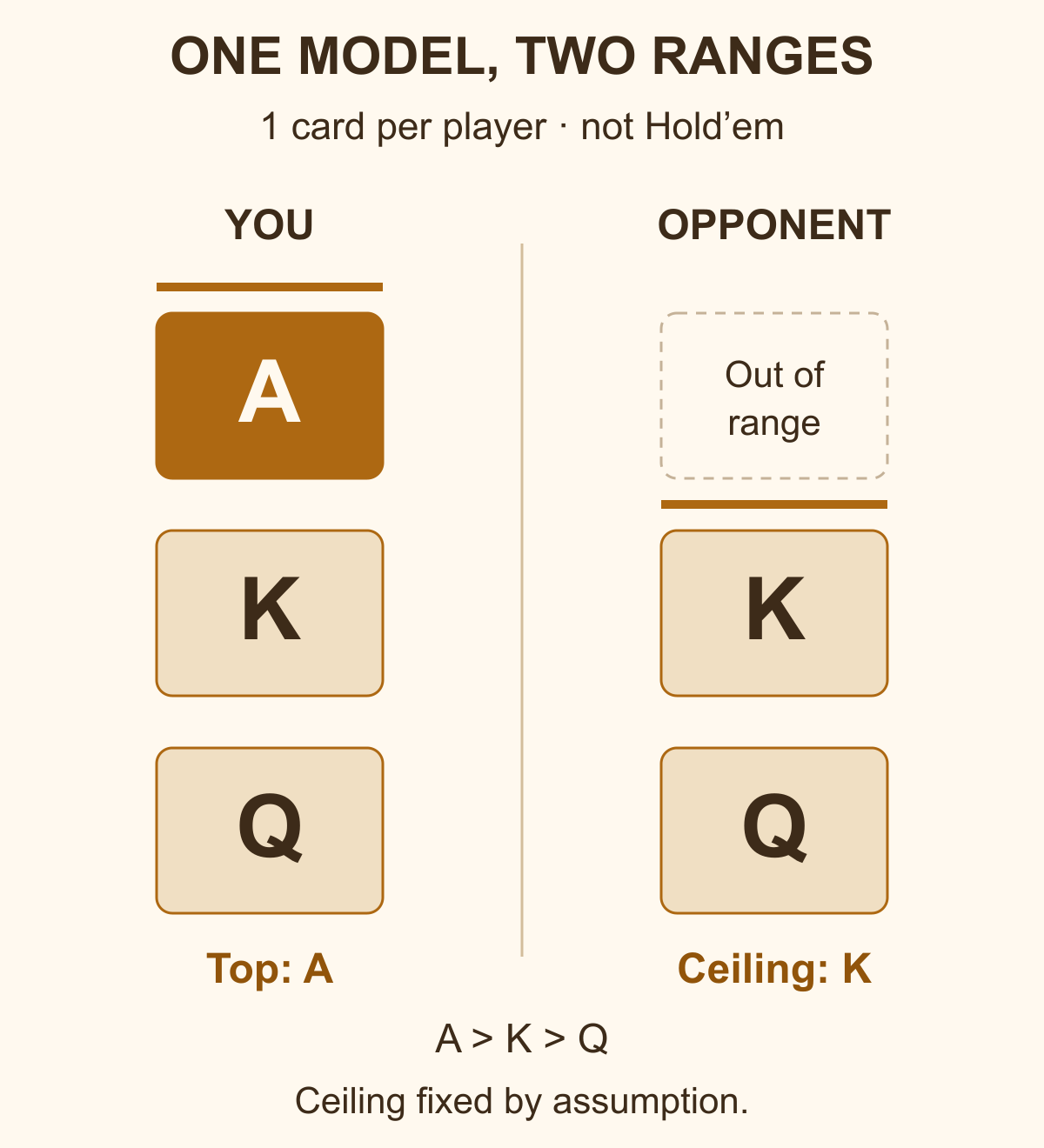
First reading: the ceiling is the king. The opponent cannot hold an ace, so your ace is always ahead in this model [2]. If they are willing to call with a king or queen, betting your ace gets value from those worse cards. Being ahead and getting called by worse are the two conditions to check.
Second reading: compare both ranges. The ace matters because it is available to you but absent from the opponent’s range [2]. In a real hand, examine the strongest hands each side retains before deciding how to act.
To apply this reasoning to a real hand, make four checks:
- Write down the premise. With a strong hand in this spot, what would this opponent do? If they would raise but only called, the line shows what the read is looking for: calls where raises were expected [1].
- Read the entire history. An isolated action, such as checking to the preflop aggressor, does not create a ceiling [3]. Passive actions on the flop and turn strengthen the read when a strong hand would have played aggressively [1].
- Classify the result. Does the action history support excluding strong hands, reducing their weight, or neither? Keep the conclusion at the level the evidence supports [1][3].
- Reassess unexpected aggression. If the opponent reraises, bets big, or changes their line, reassess whether their range still lacks strong hands [1].
How the Ceiling Forms: A Passive Line and a Premise
The ceiling usually arises from a passive action at a point where a strong hand would act aggressively: calling instead of raising, checking instead of betting [3]. Poker Skill’s preflop example is straightforward: a call in a spot where big hands usually raise often signals a lack of premium hands [1].
The reasoning has three stages: “with a strong hand they would have raised; they did not raise; therefore, strong hands are less likely.” The conclusion is only as sound as the first stage, the premise about how this player acts with strong hands in that spot. If they also call with strong hands there, the call says little about the ceiling.
Without the strongest hands, the opponent has more difficulty representing them on later streets [1]. Their best remaining hands may be only medium strength [2].
Assess the Actions and the Defense of the Remaining Hands
A range stays uncapped when the player has not yet passed up a natural opportunity for aggression after the flop. Checking to the preflop aggressor and calling a turn overbet are both compatible with holding the nuts [3].
The same actions may or may not support the hypothesis:
| Observed action | When the source treats it as a sign of a ceiling | When it is not enough |
|---|---|---|
| Preflop call | In a spot where big hands usually raise, it often indicates a lack of premium hands [1] | Some opponents occasionally call with big hands [1] |
| Check on the flop or turn | A flop check-back by the preflop aggressor, or a turn check-back by the flop bettor, appears among the likely signs for a competent opponent [3] | Checking to the preflop aggressor does not cap the range [3] |
| Calling a turn bet | Check-calling a turn bet out of position appears in the same list of likely signs [3] | Calling a turn overbet does not cap the range [3] |
These likely signs concern a competent opponent whose strong hands would normally take an aggressive line [3].
Having a capped range yourself is not a problem in itself: it is acceptable for strong hands to take a different line in many spots. When defending against aggression, examine which hands in the set you would continue with against that bet. If the defense ends up effectively folding the entire range, that complete surrender is an exploitable case of overfolding [3]. Being near the top alone does not establish that no other hand continues, nor does it oblige you to call. The comparison needs to consider the defense that actually remains, rather than deducing a mandatory response from the relative strength of a single hand.
Next Step: Turn the Ceiling into a Hypothesis You Can Revise
Before choosing a bluff, identify which better hands you expect to fold. When you hold one of the strongest remaining hands, identify which worse hands could call a value bet. If neither objective fits your medium-strength hand, compare the alternatives covered in pot control.
Recommended reading
- Poker Hand Ranges: Reading and Making Decisions in Context
- Nut Advantage in Poker: Strong Hands and the Difference from Range Advantage
- Pot Control in Poker: Concept, Choices, and Limits
 52 minutes ago