

What Nut Advantage Means and How It Differs from Range Advantage
Nut advantage is the advantage held by a range containing more combinations of the strongest possible hands on the current board. The nuts is the best possible hand on that street; a range is the collection of hands a player could hold given their actions [1].
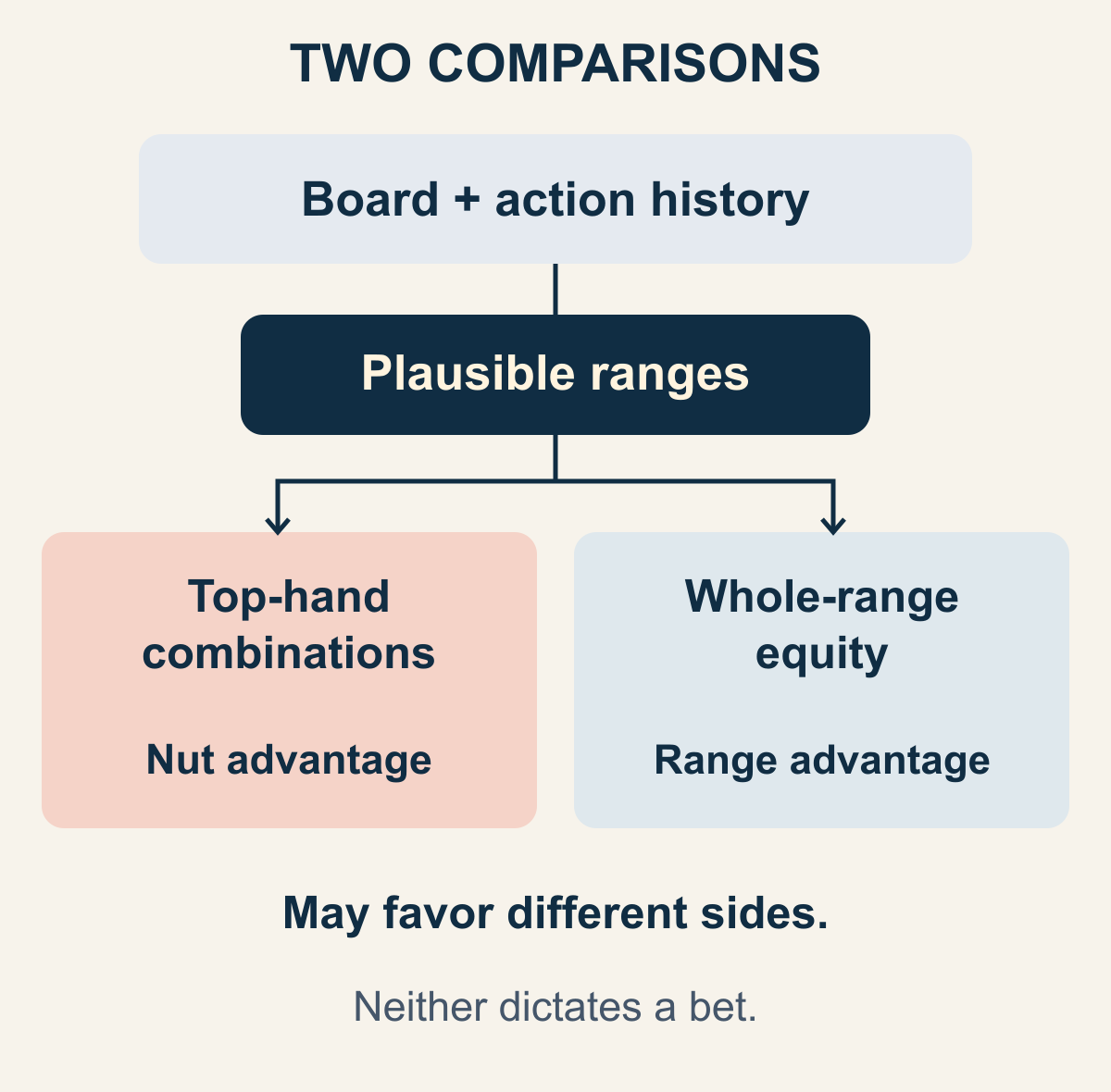
Range advantage compares the equity of the complete ranges. Nut advantage looks at the top of that distribution. A player can therefore have more very strong hands while the opponent still holds the equity advantage across the whole range [2][3].
Example: UTG Against the Big Blind on 8♠ 7♦ 6♣
Consider Jonathan Little’s example: an eight-handed MTT at 60bb depth, with UTG opening and the big blind calling [2]. UTG is the first position to act preflop; the big blind defends against that raise. On this flop, these hands make the comparison concrete:
| Hole cards | Hand made with 8♠ 7♦ 6♣ |
|---|---|
| T9 | Ten-high straight: T-9-8-7-6, the nuts on this flop |
| 95 | Nine-high straight: 9-8-7-6-5 |
| 54 | Eight-high straight: 8-7-6-5-4 |
| 87, 86, or 76 | Two pair |
| 88, 77, or 66 | A set, made with a pocket pair |
T means ten. The table identifies the hands made; it does not assume that all these holdings belong in both ranges.
The comparison asks how many of these combinations UTG opens and how many the big blind calls. The big blind may defend hands UTG does not open, including combinations that make straights and two pair. That difference between the preflop ranges can give the big blind nut advantage in this example [2]. If both ranges contain T9, for instance, check which suited and offsuit combinations each retains and how frequently each plays them.
It is not enough to say that the big blind has more sets: 88, 77, and 66 may also belong in UTG’s opening range. Without comparing those ranges, there is no basis for assigning more combinations of these hands to either player.
Position Gives Information; the Range Determines Possible Hands
Acting after an opponent lets you see their action before deciding. That is positional advantage. Acting last does not make a range stronger by itself. A player in the blinds who 3-bets — reraises preflop — can have range advantage even while acting first on the flop [3].
The three questions are different:
- Position: who decides after seeing the other player’s action?
- Range advantage: which complete range has more equity against the other?
- Nut advantage: which range contains more top-hand combinations on this board?
The answer depends on the hands that remain plausible after the actions and how they connect with the community cards. A low, connected flop may favor the top of the big blind’s range; another board may favor the preflop aggressor [2][3].
How to Compare the Ranges During Review
- **Reconstruct the hand ranges.** Consider positions, raises, calls, and later actions; do not give a player every hand that is possible in the deck.
- **Identify the top hands for the board texture.** On the example flop, start with straights, then look at the two pair and sets present in the ranges.
- Compare the combinations each range retains. Consider whether earlier actions made certain hands less likely. On the next street, update the comparison for the new card and action [2].
How to Use This Advantage When Betting
Nut advantage helps inform bet sizing, while the particular size still depends on the hand, stacks, and opponent. When your range has more top hands, it may be better suited to combining strong value hands with appropriate bluffs and using larger bets. The value portion seeks to win more chips; the bluffs put pressure on hands facing that same strong range [2][3].
On the other side, having few of those strong hands calls for care when building a pot with medium-strength holdings. On 8♠ 7♦ 6♣, for example, a high pocket pair should not be treated as if it removes the straights and two pair available to the preflop caller.
During review, connect the chosen size to the strong hands the range represents and the worse hands that could call. This turns the range comparison into an assessment of the decision, rather than merely naming an advantage.
Recommended reading
- Equity in Poker: Hands, Ranges, and Share of the Pot
- Poker Hand Ranges: Reading and Making Decisions in Context
- Poker Board Texture: Connectivity, Suits, and Board Changes
Sources
- [1] Nut Advantage in Poker: Definition, Examples & Strategy — Poker Skill
- [2] Dominating with Nut Advantage: A Key Edge in Poker Strategy — Poker Coaching, Jonathan Little, June 19, 2025
- [3] How to Use Positional, Range, and Nut Advantages to Maximize Profit — Upswing Poker, January 15, 2019

 3 hours ago