Bluffing in Poker: Meaning, Conditions, and Risks
By the Editorial Team
Bluffing in poker means betting or raising with a hand you believe is not the best, trying to make an opponent fold a better hand. The goal is to win the pot by inducing a fold, rather than relying on a comparison of the cards. This intention distinguishes a bluff from a value bet, which aims to get called by worse hands. [4][2]
The decision requires more than noticing that your cards are weak. Position, the number of players contesting the pot, your reads on opponents, your table image, and previous actions help you assess the context. A bluff may win a particular pot, but it offers no guarantee of consistent wins. [4]
The Meaning of Bluffing in Poker
A bluff attempts to influence an opponent’s assessment of your hand. By betting or making a raise, you try to represent enough strength to get them to fold a better hand. The mere presence of a bet does not reveal whether it was made for value or as a bluff. [4][2]
The comparison becomes especially clear on the river, the final betting round: with no more cards to come, there is no further possibility of improving the hand. At this point, the distinction presented by GTO Wizard is straightforward: value bets seek calls from worse hands; bluffs seek folds from better hands. [2] A semi-bluff, meanwhile, involves a worse hand or a drawing hand that can still improve on a later round. [3]
| Concept | Goal of the bet | Role of potential improvement |
|---|---|---|
| Value bet on the river | Get a call from a worse hand | There are no more cards to come. |
| Bluff on the river | Make a better hand fold | There are no more cards to come. |
| Semi-bluff | Win through opponents folding immediately or through later improvement | The hand can still improve on a subsequent round. |
Why Believing You Are Ahead Is Not Enough to Bet for Value
On the river, having a hand that is probably better before the bet does not settle the decision on its own. You also need to consider which hands will call. The analysis changes when you move from the range of hands an opponent might have to those with which they are willing to continue against the bet. [2]
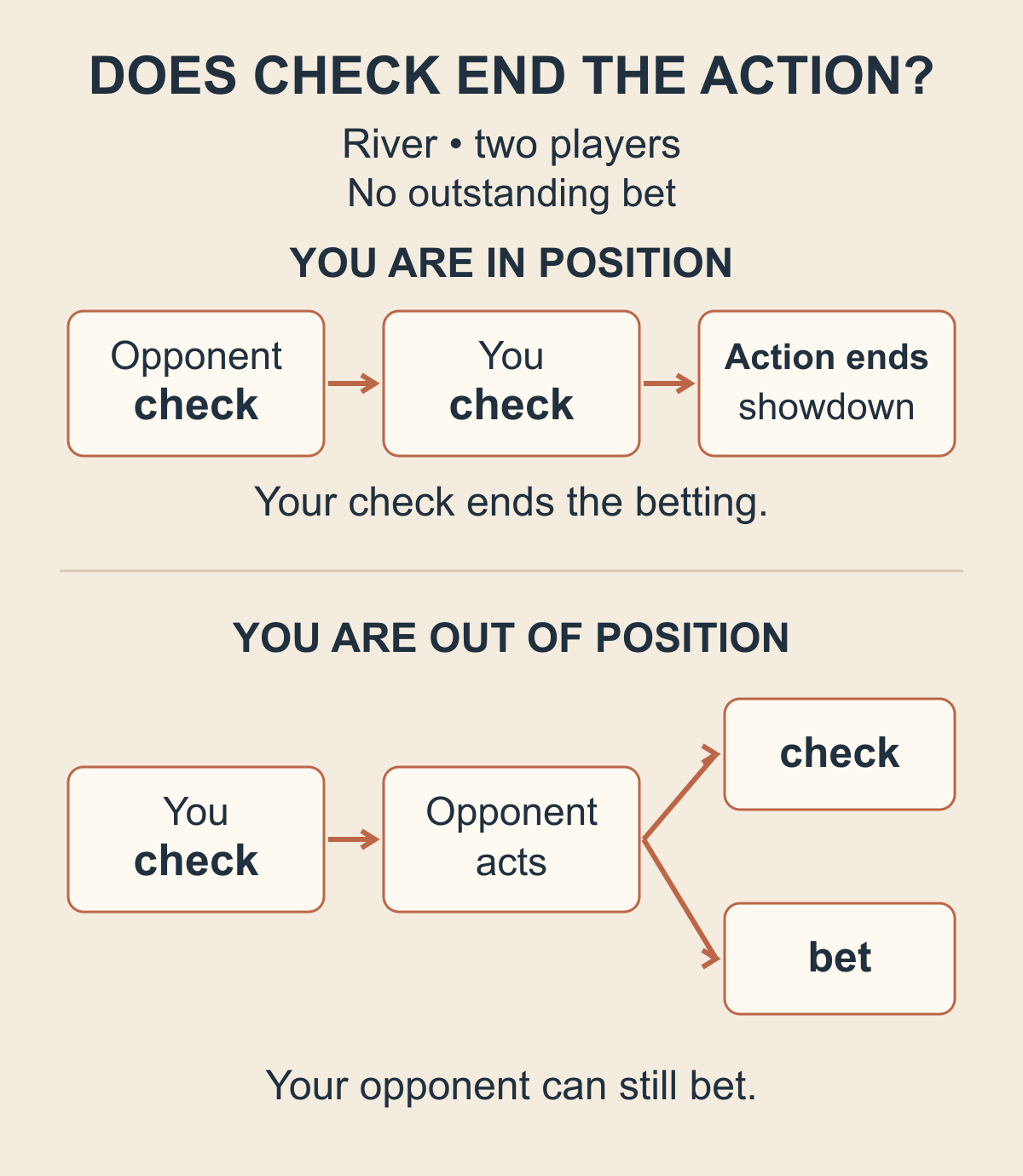
On the river, the player in position can choose to close the action by checking and reach showdown. Out of position, checking still allows the opponent to bet. [2]
What Makes a Bluff a Semi-Bluff
A semi-bluff tries to make the opponent fold now while retaining the chance to improve on later cards. Strong flush or straight draws can also be used as semi-bluffs. (PokerStars)
A Hypothetical Example: a Flush Draw on the Flop
In a No Limit Hold’em cash game, the cutoff raises before the flop and you call on the button with A♥5♥. The blinds fold. Only the two of you remain, and the flop is K♥8♣2♥. Your opponent checks, so you act in position.
You still have ace-high, but your cards and the board already contain four hearts. A semi-bluff would aim to make a currently better hand, such as 6♠6♦, fold. If called, a heart on the turn or river could complete your flush. The pair of sixes illustrates the target of the bet; it is not a claim about the opponent’s cards or a promise that they will fold. The example brings together the two possibilities: winning through a fold or continuing with a chance to improve. [1][3]
The check alone does not determine the bet: strong players can also check good hands. Your read on the opponent, bet size, and stacks still matter; the example explains the purpose of a semi-bluff without claiming that betting is the best decision. [1][4]
On the Hold’em river, there are no more cards to come. A semi-bluff relying on later improvement is therefore no longer possible. [2]
Which Conditions Need to Inform the Decision
The definition explains the goal of a bluff; the circumstances of the hand help you assess whether the attempt makes sense. Relevant factors include your position, the image other players have of you, your reads on opponents, and how many players remain in the pot. The appropriate frequency also depends on table dynamics and previous actions. [4]
These factors need to be considered together. Identifying just one favorable sign does not eliminate the others: your opponent may interpret your bet differently, have a hand they intend to continue with, or recognize patterns in your play.
Position and Previous Actions
On the river, strategy cannot be assessed separately from what happened on earlier rounds. The composition of ranges—the sets of hands considered in the analysis for each player—depends on that history. It influences who has the advantage, which hands they can bet for value, and how their bets should be interpreted. [2]
Looking only at the final card therefore leaves out an essential part of the decision. The final round needs to be understood in light of the bets and checks that came before it. A particular card appearing convenient for representing strength does not automatically justify a bluff.
Number of Players in the Pot
In its cash game guidance, Upswing Poker recommends greater selectivity when betting the flop in multiway pots. The reasoning is that the more players see the flop, the greater the chance that someone has hit two pair or better. The guidance includes checking hands stronger than those you would need to check when facing only one opponent. [1]
Having fewer opponents who need to fold is one condition that favors bluffing. When several players are still in the hand, the analysis also needs to consider the other participants, rather than just one player’s reaction. [3]
Reading Opponents and Table Image
Bluffing involves both your reads on others and the image they form of your play. PokerNews highlights both aspects and warns that experienced players may identify bluffing patterns, call the bets, and cause losses. [4]
Table image, therefore, is not a resource that works independently of the opponent. It is part of an interaction: you try to represent a hand while the other player interprets your actions. Repeating recognizable behavior may change how they respond.
This also explains why there is no universal frequency to apply at every table. The circumstances of the hand, the opponents, and the history of the action are all part of the decision. Turning bluffing into a periodic obligation ignores the very elements that help you assess it. [4]
The Risk of Interpreting Every Signal as Weakness
The risk also exists when interpreting a bet. On the river, recognizing that someone might be bluffing is not enough to justify a call. That player may also bet for value. Likewise, a card considered good for bluffing may also favor value bets. An action consistent with a bluff therefore does not prove that intention. [2]
How to Analyze the Intention Behind a Bet in Your Next Review
To review a decision, examine the goal of the bet and the conditions under which it was made:
- Identify the goal. Were you seeking a call from a worse hand or a fold from a better hand? This distinction separates value from bluffing on the river. [2]
- Check the possibility of improvement. If you were trying to induce a fold before the river, which future cards could still improve your hand? [3]
- Reconstruct the context. Consider position, the number of opponents, your read on the opponent, your table image, and previous actions. These factors give substance to the decision. [4][2]
- Check the interpretation you used. If the bet followed an opponent’s check, consider whether they were capable of checking a strong hand. That possibility may contradict the read of weakness. [1]
The review should account for the available alternatives. In the cash game guidance, for example, medium-strength hands are generally recommended for checking and keeping pots smaller, where they can serve as bluff-catchers. This does not require calling a later bet; it simply shows that building the pot is not the only way to play these hands. [1]
Sources
- [1] What is a Cash Game & 10 Tips for Playing Them — Upswing Poker — Dan B., published on August 25, 2021.
- [2] Principles of River Play — GTO Wizard — published on February 21, 2023.
- [3] Bluff (poker) — Wikipedia)
- [4] Bluff Definition | What is a Bluff in Poker? — PokerNews

 3 days ago