HORSE Poker: Five Variants and How the Rotation Works

By the Editorial Team
HORSE poker, also written H.O.R.S.E., is a set of five variants played in rotation at the same table. The order always follows the letters of the acronym: Texas Hold'em, Omaha Hi-Lo, Razz, Seven Card Stud, and Stud Eight-or-better, also called Stud Hi-Lo. In the conventional format, all are played with Limit betting. Once the Stud Hi-Lo stage ends, the cycle starts again with Hold'em. The format is one of the most popular mixed games, a name given to formats in which the variant changes regularly at the table [1][3].
Why this matters: at least one decisive element changes with each switch. It might be the number of cards dealt, the type of hand that wins, or how the first player to act is determined. In Razz, for example, the pot goes to the lowest hand. In Stud games, position no longer depends on the button and instead varies according to each player's face-up cards. Understanding the format is less about memorizing five rulebooks at once and more about classifying each stage with three questions. Does the game have a flop, or is it a Stud game? Does the pot reward the high hand, the low hand, or split between the two? And how is position determined?
The Five HORSE Poker Variants
The table summarizes the five stages in the order they appear in the cycle [1][2].
| Letter | Variant | Family | Cards | Who Wins the Pot |
|---|---|---|---|---|
| H | Texas Hold'em | Flop game | Two face-down cards per player; flop, turn, and river dealt face up on the table | The best high hand |
| O | Omaha Hi-Lo (Split-8 or Better) | Flop game | Four face-down cards per player; use exactly two with three community cards for each five-card hand | Split between the best high hand and the best qualifying low hand |
| R | Razz (Seven Card Stud Low) | Stud | Seven per player: three face down and four face up, with no community cards | The lowest hand |
| S | Seven Card Stud | Stud | Same deal as Razz | The best high hand |
| E | Stud Eight-or-better (Stud Hi-Lo) | Stud | Same deal as Razz | Split between the best high hand and the best qualifying low hand |
The five stages come from three core games: Texas Hold'em, Omaha, and Seven Card Stud. Razz and Stud Hi-Lo are variations of Stud. The format therefore requires skill in the three core games and knowledge of each one's particular features and strategies [2].
How the Rotation Works at the Table
The variants alternate in blocks of hands, following the letters of the acronym. The duration of each block depends on the table or tournament structure. Since the order does not change, remembering the word HORSE is enough to know which game comes next [1][2].
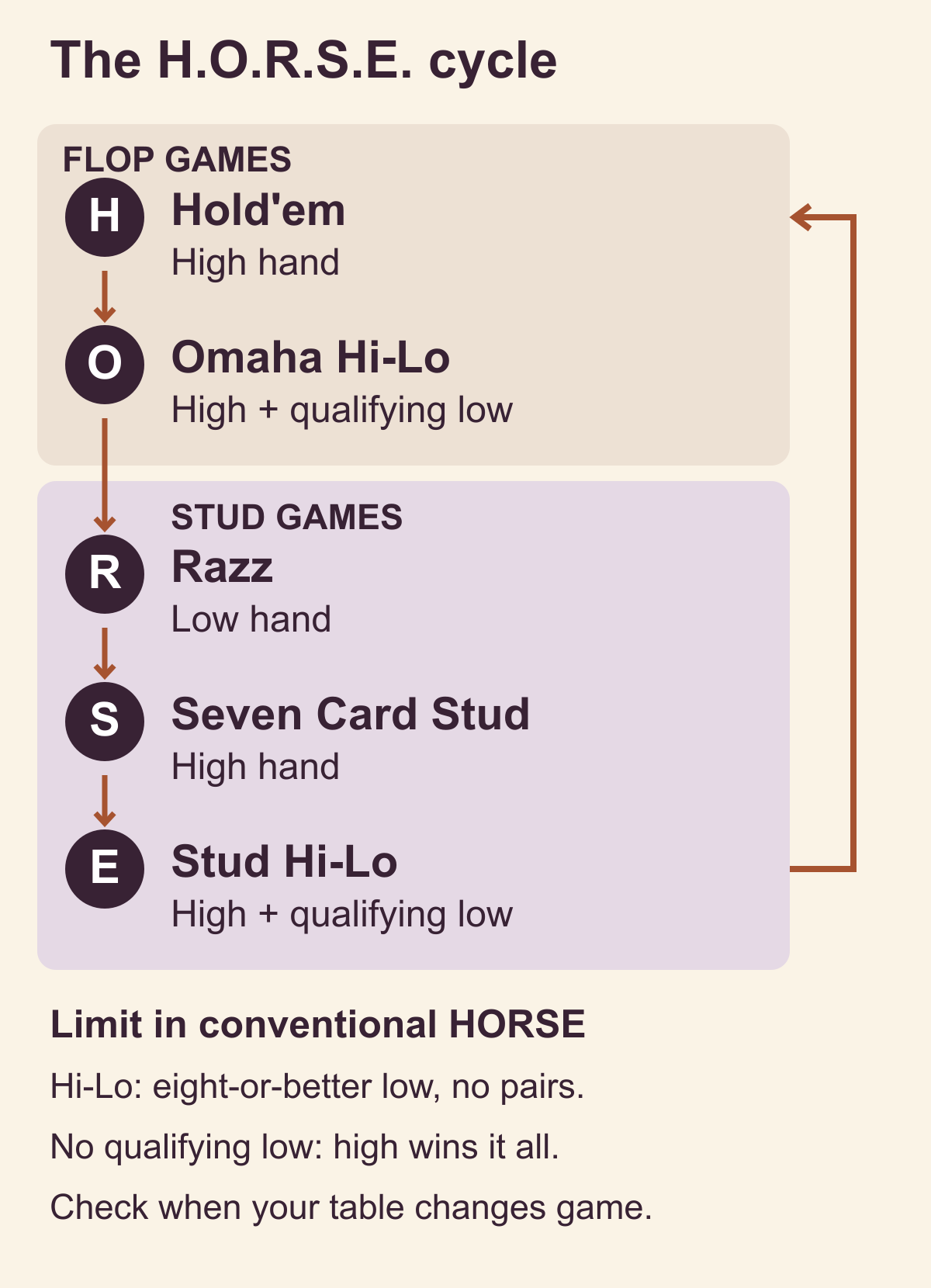
The betting structure, meanwhile, stays the same across all stages. In conventional H.O.R.S.E., all five games use Limit betting, with a set amount that can be bet. The cycle has no Pot Limit or No Limit stages [1][3]. Each switch changes the game, with its cards and criteria, but not the betting format. Standard HORSE tables, whether in cash games or tournaments, generally seat no more than eight players [3].
Noticing the switch is part of the game. In live play, the dealer announces it verbally and changes the sign displaying the variant's name, which is kept somewhere visible. Online, the current game appears at the top or center of the table. More care is needed toward the end of the cycle. Hold'em and Omaha Hi-Lo are easy to distinguish by the number of cards: two versus four. Razz, Stud, and Stud Hi-Lo, however, come in sequence and use the same deal, making it easier to miss the change [1][3].
Flop Games: Hold'em and Omaha Hi-Lo
In PokerNews's classification, the first two stages are “flop games.” Each player receives face-down cards, and the hand progresses through a flop, turn, and river dealt on the table. In these games, position follows the usual logic, and the button retains its full importance [1].
What separates the two games is the number of cards and how the pot is awarded. The Hold'em in the cycle is Limit Texas Hold'em, with two cards per player. In Omaha Hi-Lo, each player receives four cards and uses exactly two of them with three community cards for each five-card hand. The high and low hands are assessed separately and may use different combinations [2]. It is the first split-pot stage in the cycle, a rule explained below.
Stud Games: Face-Up Cards and Changing Position
Razz, Seven Card Stud, and Stud Hi-Lo form the group that the same classification calls “board games.” The name comes from the fact that some of each player's cards are visible to opponents. Their face-up cards therefore factor into your reading of the table just as much as your own [1]. Here, “board” does not refer to community cards, which do not exist in these games. Each player who stays in the hand until the end receives seven cards of their own, three face down and four face up, and the betting rounds are called streets [2].
Position also stops being fixed: in Stud games, it varies with each street because it depends on the cards each player shows. From the second betting round onward, the criterion reverses between games: in Razz, the player showing the lowest face-up cards acts first; in Stud and Stud Hi-Lo, the player showing the highest acts first. Action then proceeds clockwise [1]. For the first round, check the specific opening rules for each Stud variant.
High Hands, Low Hands, and Split Pots
In high-hand games, the strongest hand wins. The royal flush remains at the top of the rankings in Hold'em and Seven Card Stud. It is also the best hand for the high half of the pot in Omaha Hi-Lo and Stud Hi-Lo. Razz reverses the criterion: it is Seven Card Stud Low, in which the lowest hand wins the pot [1][2]. For a detailed look at how two low hands are compared, see the guide to Razz poker and low hands.
Omaha Hi-Lo and Stud Hi-Lo are the cycle's two split-pot games. When there is a qualifying low hand, half the pot goes to the best high hand and the other half to the best low hand. If the same player wins both halves, they take the entire pot: this is a scoop. To compete for the low half, a hand must meet the eight-or-better qualifier: it must contain five different ranks, with no card ranked higher than an 8 [2]. When no one makes a qualifying low hand, there is no split: the entire pot goes to the best high hand [4].
What Does Not Apply to Every H.O.R.S.E. Table
The core of the format is stable: five variants, always in the order of the acronym. Some details, however, should not be generalized.
How often the game changes depends on the structure. The length of a round and the timing of a switch can vary; in some formats, switches follow blind increases [2][3]. Before a tournament or a private game, check the announced structure instead of assuming the button physically makes a complete trip in every variant.
Limit is the convention for H.O.R.S.E., not for every mixed game. Similar acronyms refer to other combinations. H.O.S.E. leaves out Razz. The much less common T.H.O.R.S.E.H.A adds 2-7 Triple Draw, No Limit Texas Hold'em, and Pot Limit Omaha to the five H.O.R.S.E. variants [2]. If the table advertises a different acronym, the lineup changes. In T.H.O.R.S.E.H.A, not every stage uses Limit betting. To distinguish a variant's name from its betting structure, it is worth reviewing poker's basic concepts.
The “O” is Omaha Hi-Lo, not Omaha high. In H.O.R.S.E., the Omaha stage is the Hi-Lo Split-8 or Better version described above, with a split pot and a low-hand qualifier. Applying the logic of Omaha played only for the high hand would leave out half the contest.
The eight-or-better requirement belongs to the Hi-Lo games. The qualifier applies to the low half of Omaha Hi-Lo and Stud Hi-Lo. In Razz, the entire pot goes to the lowest hand, without an eight-or-better qualifier.
Examples: Identifying the Game and Reading the Pot
Hypothetical Example: Arriving Midway Through the Cycle
Imagine sitting down at a conventional H.O.R.S.E. table that plays each variant in a block of hands. During the deal, each player receives some cards face up. That is enough to rule out Hold'em and Omaha Hi-Lo: you are in one of the three Stud games. The deal does not tell you which one, however, because Razz, Stud, and Stud Hi-Lo deal the cards in the same way. The answer is on the table's sign or in the dealer's announcement [1][3].
Suppose the sign says Razz. The objective for this stage is the lowest hand. The next switches bring, in order, Seven Card Stud, Stud Hi-Lo, and Hold'em again, restarting the cycle. If, instead, you received four face-down cards and the hand continued with a flop, you would be playing Omaha Hi-Lo, and the next stage would be Razz. The practical lesson: toward the end of the cycle, the table's game indicator confirms the variant, rather than the cards.
The Same Combination, Different Objectives
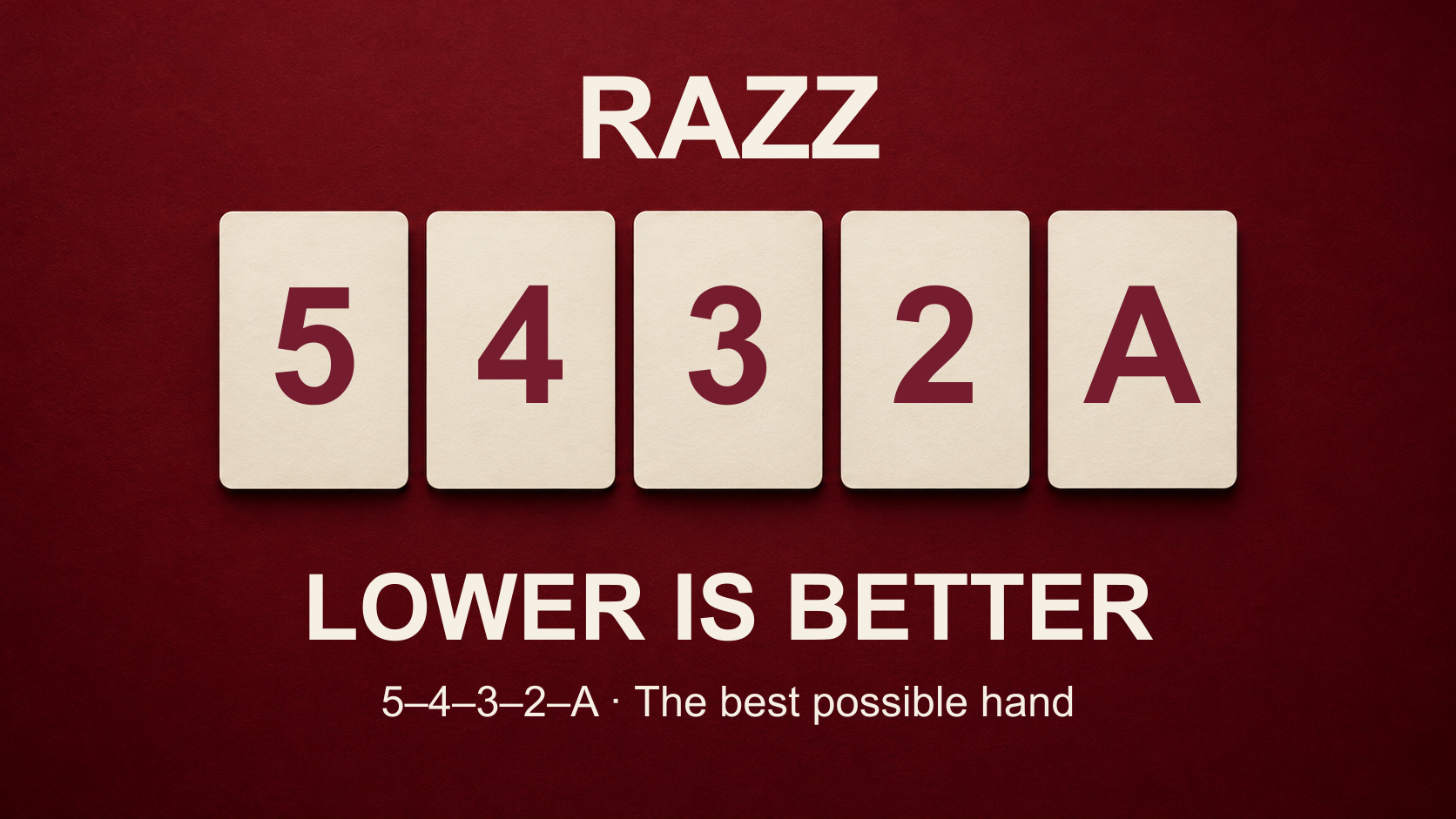
The ace-to-five combination shows how the objective changes within the cycle. In Razz, A-2-3-4-5 is the best possible hand, called a wheel. In Omaha Hi-Lo and Stud Hi-Lo, it is the best hand for the low half of the pot. It also qualifies, since its highest card is a 5 and it contains no pair [1][2]. In high-hand games and the high half of split-pot games, the same cards count as a straight and are evaluated using traditional hand rankings. If all five are of the same suit, they make an ace-to-five straight flush, the steel wheel [1]. Before evaluating any hand, therefore, confirm which letter of the acronym is in play.
Applying the Qualifier in Omaha Hi-Lo
For a low hand to be possible in Omaha Hi-Lo, the board must contain at least three cards of different ranks, all 8 or lower (the ace counts as low). The player must still use exactly two hole cards to complete five different ranks, all 8 or lower [2]. If no player makes a qualifying low hand, the best high hand wins the entire pot [4].
In Stud Hi-Lo, face-up cards help you track whether an opponent is pursuing a high hand or a low hand [1]. That read does not guarantee they have already completed a qualifying hand.
Next Step: Study Each Game, Then the Rotation
Knowing the rotation is the foundation, but each of the five variants calls for separate study of its rules and strategy [1]. A practical sequence:
- Learn the order and the families. The acronym gives you the sequence. The distinction between flop games and Stud games, combined with how the pot is awarded, shows what changes at each stage.
- Study each core game separately. If Hold'em is your starting point, see how Omaha and Texas Hold'em differ in hand construction. Then add the Hi-Lo split used in H.O.R.S.E. For the low side of the cycle, study Razz and the eight-or-better qualifier in split-pot games.
- Confirm the structure before sitting down. Check when the variant changes and how betting works at that table or in that tournament.
- Practice each game and the entire sequence. The recommendation identified as the most valuable for the format is to practice until you feel equally comfortable with each variant and with switching between them [1].
Recommended reading
- Razz Poker: Rules, Streets, and How to Compare Low Hands
- Omaha vs Texas Holdem: Rules and Differences for Evaluating Your Hand
- What Is Poker? Understand the Game and Its Basic Concepts
Sources
- [1] What is HORSE Poker? How to Play HORSE Poker — PokerNews
- [2] HORSE Poker: Learn How to Play H.O.R.S.E — partypoker, February 22, 2022
- [3] HORSE Poker: Understand This Set of Variants — GipsyTeam, November 15, 2022
- [4] Poker Glossary – G & H — GGPoker
 2 days ago