Razz Poker: Rules, Streets, and How to Compare Low Hands
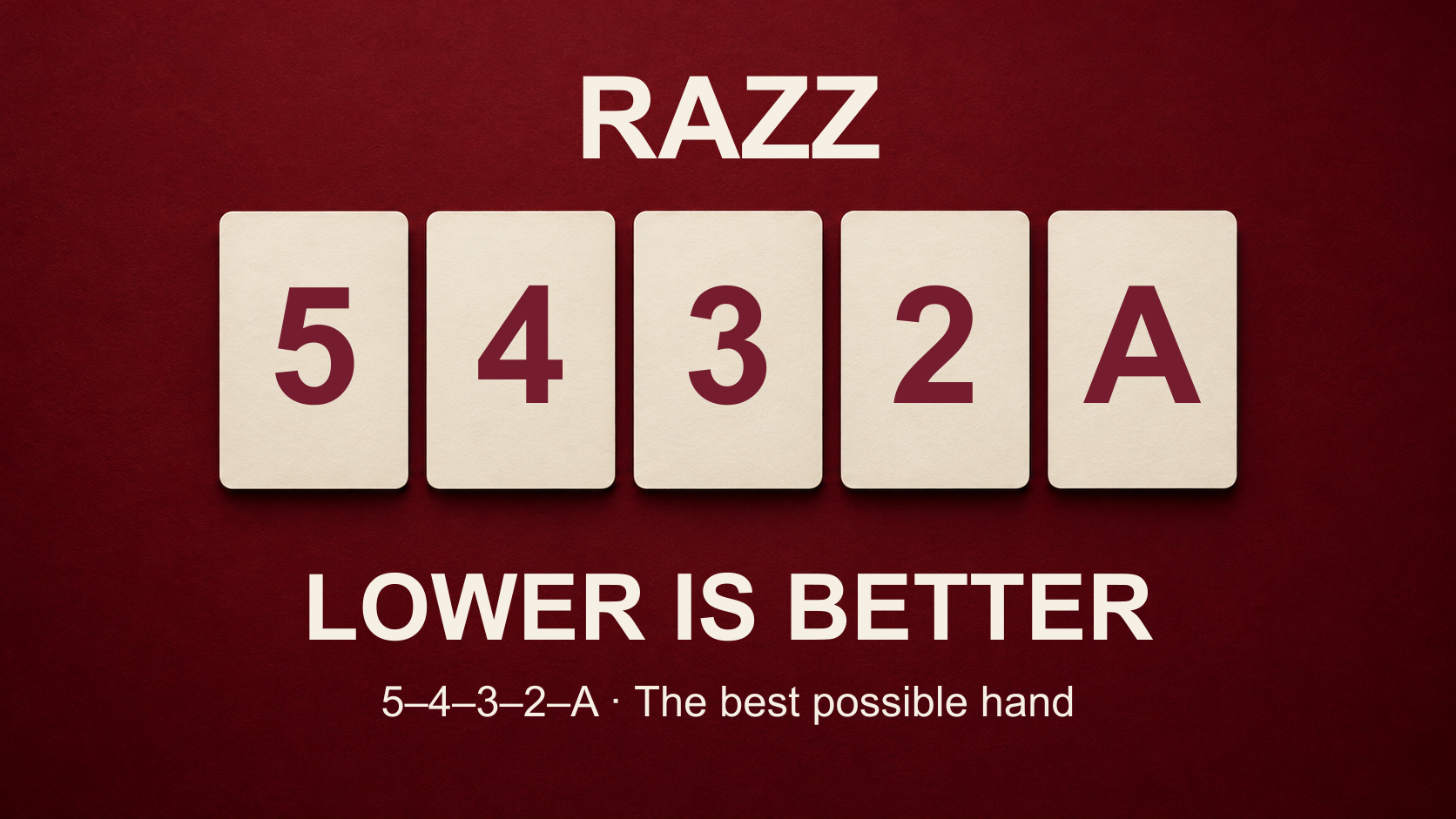
In Ace-to-Five Razz, the objective is to make the lowest five-card hand. Each player who remains through the final deal receives seven individual cards and selects their best five-card combination. The ace is the lowest card, and the game follows a structure similar to Seven Card Stud, with face-up and face-down cards. [1]
A straightforward example is A-2-3-4-5, the best possible hand, known as the wheel. It is also written as 5-4-3-2-A, from highest to lowest. Although it forms a straight, that does not hurt its ranking in Razz; flushes do not count against the low hand either. [2]
To follow the game, separate two questions: who must act first in this round and which hand wins at the final comparison. The first depends on the exposed cards and the stage of the hand. The second depends on each participant’s best five-card combination. An exposed card can determine who starts the betting without revealing who will finish with the best hand.
How Razz Poker Works, from the Ante to Seventh Street
The Ante and Bring-In Come at Different Times
Before the deal, all players who will participate post the ante, a mandatory contribution that starts building the pot. Its amount depends on the game structure. Understanding what an ante is in poker helps distinguish this payment from bets made after receiving cards: it is collected before any player knows their starting hand. [1]
Each participant then receives three cards: two face down, called hole cards, and one face up, the door card. The player with the highest door card must post the bring-in, the mandatory bet that starts the action in this round. The ante and bring-in therefore differ in who pays them and when: everyone pays the first before the cards are dealt; the second falls to the player identified by the exposed card.
The king, represented by K, is the highest card for this procedure. If more than one king is exposed, the tie to determine who pays the bring-in is broken by suit, in this order from highest to lowest: spades, hearts, diamonds, and clubs. Thus, among exposed kings, K♠ takes priority over K♥, followed by K♦ and K♣. This hierarchy applies to the opening procedure, not to comparing low hands.
In the fixed-limit betting format, the player responsible for the bring-in can also choose to complete the bet to the game’s smaller betting limit. Completing means bringing the opening bet up to the full amount used in that round, instead of posting only the bring-in. You need to know the announced structure to distinguish these amounts.
From this opening action, play proceeds clockwise. Facing the bet, players can call, raise, or fold when those actions are available. The door card determines the obligation to start the action; it does not automatically dictate the other decisions. [2]
Streets Organize the Deal and the Betting
A street is a stage of dealing accompanied by a betting round. The first is called third street because each player already has three cards. The sequence continues through seventh street, adding one card at each stage for participants who remain in the hand. [2]
| Stage | What Is Dealt at This Stage | Player’s Total Cards | Face Up | Face Down |
|---|---|---|---|---|
| Third street | Two face-down cards and one face-up card | 3 | 1 | 2 |
| Fourth street | One face-up card | 4 | 2 | 2 |
| Fifth street | One face-up card | 5 | 3 | 2 |
| Sixth street | One face-up card | 6 | 4 | 2 |
| Seventh street | One face-down card | 7 | 4 | 3 |
The standard deal therefore does not alternate between a face-up card and a face-down card each round. After the initial three cards, three consecutive face-up cards arrive; the final card is dealt face down. Players who fold before seventh street do not complete this seven-card progression.
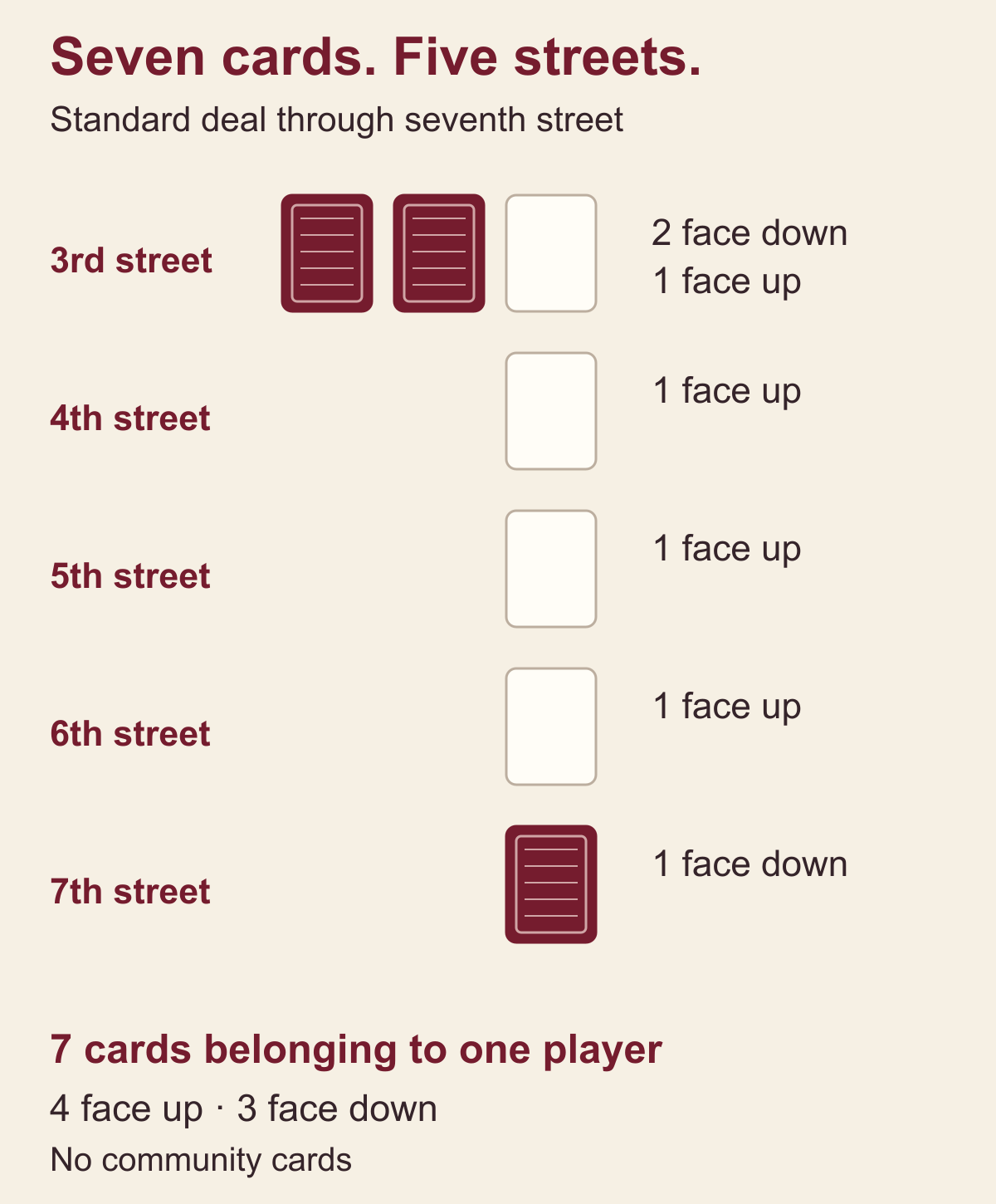
There is also no flop or community cards in this sequence. The face-up cards still belong to the player who received them: opponents can see them but cannot use them to form their own hands. This distinction between individual and community cards across poker variants helps avoid applying the logic of Texas Hold’em to the Razz deal. [2]
At the end, four of an opponent’s seven cards are visible. That information lets you follow part of the hand’s development but leaves three cards unknown. Seeing the exposed cards therefore does not mean knowing the complete combination that player may present. [3]
Who Acts First After the Opening Round
The third-street rule—the highest door card paying the bring-in—does not determine who will start every subsequent round. After that, the reference becomes the lowest exposed combination, among participants who are still in the hand and can act. As new face-up cards arrive, those combinations need to be checked again.
On seventh street, the final card is dealt face down. The order still uses the exposed cards, although the new card may change the player’s best five-card hand. This is where the distinction between action order and hand strength becomes especially clear: the information used to start the round does not include everything that will count in the final comparison. [1]
How Fixed-Limit Betting Works
Razz is usually played as fixed-limit, a format with set betting amounts. In this structure, third and fourth streets use the smaller betting limit; fifth, sixth, and seventh streets use the larger limit. The change therefore occurs on fifth street.
Antes, bring-ins, and fixed-limit bets serve different purposes; check the game structure for their respective amounts. [1][2]
After the seventh card is dealt, there is still a betting round. If two or more players remain at its conclusion, the showdown takes place: hands are compared to determine how the pot is awarded. Receiving the final card and finishing the betting are separate moments. [1]
The Boundaries of Ace-to-Five: Pairs, Suits, and Ties
The similarity to Seven Card Stud lies in the dealing structure, but the objective changes: in Razz, the aim is to make a low hand. There is also a difference in the opening action. In Stud high, the lowest door card determines the bring-in; in Razz, it is the highest. Recognizing the Stud dealing structure is not enough to apply the variant’s criteria correctly. [2]
Suits do not affect the strength of a low hand. The hierarchy used to break a bring-in tie determines who must make the mandatory opening bet, but it does not select a winner at showdown. After applying Ace-to-Five rankings to the best five cards, hands with the same ranks tie, and the pot is split equally among the tied players. [1]
Pairs hurt the ranking. The absence of a penalty for straights and flushes does not mean that every combination of low cards has the same value. Repeated ranks are unfavorable for a low hand. When evaluating the result, however, consider the final selection of five cards: those are the cards compared, rather than treating all seven cards received as an indivisible group. [3]
There is no “eight or better” requirement. The winning hand does not need to meet that threshold to qualify. Among the hands shown, the lowest according to Ace-to-Five wins, regardless of whether it meets a cutoff of that kind. Seeking the lowest possible combination is the objective; making a wheel is not a requirement for competing for the pot. [2]
Example: How to Compare Two Six-High Hands
Compare these two unpaired hands, both with a six as their highest card. In the PokerNews rankings, they are the second- and third-best hands, respectively. [2]
| Hand, from Highest to Lowest | Highest Card | Second-Highest Card | Ranking |
|---|---|---|---|
| 6-4-3-2-A | 6 | 4 | Second-best |
| 6-5-3-2-A | 6 | 5 | Third-best |
The comparison starts with the highest card in each hand. Since both have a six, that first point does not settle the contest. Move to the next card: one has a four, and the other has a five. 6-4-3-2-A is better because the four is lower than the five at the first point of difference.
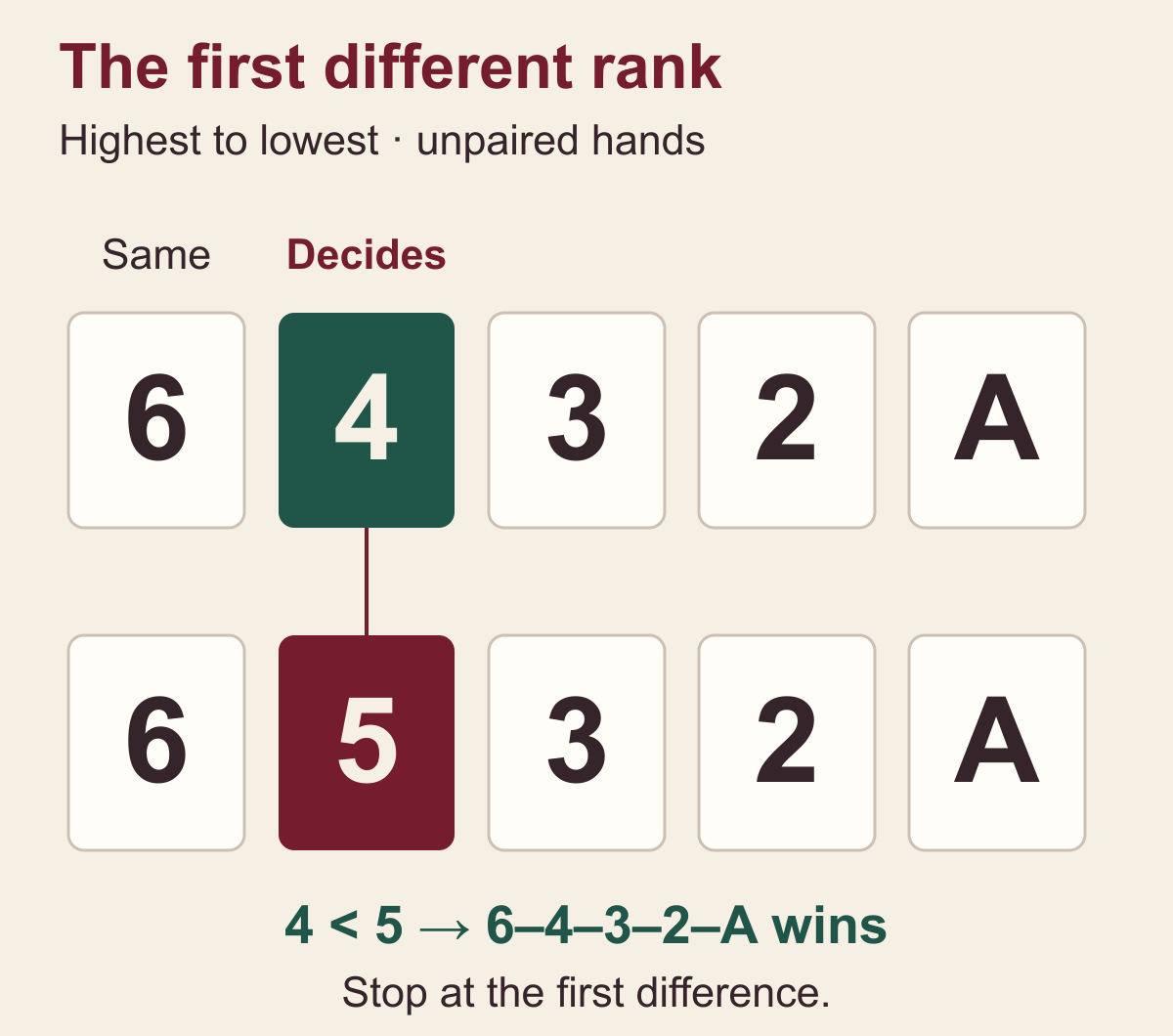
To apply the method to unpaired hands, arrange the five cards from highest to lowest and compare their ranks in that order. If the first position ties, move to the next; the lower card at the first point of difference identifies the better low hand. The World Poker Federation’s explanation also uses the second-highest card to resolve a comparison in which the highest cards match. [1]
The Next Step Is to Follow a Hand Street by Street
When following a Razz hand, keep a simple record: identify the street, note which cards are face up, and track who starts the action. If there is a showdown, record the five cards selected by each participant separately. First check for pairs, because they affect the ranking. Between unpaired hands, compare from highest to lowest.
Before starting, check the game’s ante, bring-in, and betting limits so you can recognize each payment.
Recommended reading
- What Is Poker? Understand the Game and Its Basic Concepts
- What Is an Ante in Poker: How It Is Paid and How It Differs from Blinds
- How Many Cards Are Used in Poker? Decks and Rules by Variant
Sources
- [1] How to Play Razz — World Poker Federation. Published on August 30, 2023.
- [2] What is Razz Poker, full guide to learn how to play razz — PokerNews.
- [3] Razz Poker: A Simple Guide — The Festival. Published on July 28, 2026.

 1 day ago