What Is Poker? Understand the Game and Its Basic Concepts

By the Editorial Team
What Is Poker, and What Is the Objective of the Game?
Poker is a card game in which two or more people compete for a pot made up of bets. Some cards are hidden from opponents, and the pot can be won in two ways: by showing the best combination among the participants still in the hand or by being the only player remaining after everyone else folds. [4]
Texas Hold’em is a poker variant, not a synonym for the entire game. There are also Omaha, Seven Card Stud, and Five Card Draw, among other variants. They share concepts, but the way cards are dealt, the information visible to players, and the rules for forming a combination can differ. [1][2]
A comparison helps distinguish poker from another card game: in poker played between players, participants compete against one another for the pot. In blackjack, each player faces the dealer and aims for a total close to 21 without exceeding it. It is therefore more than simply another name for the same contest: the opponent and the criteria for determining the outcome are different. [4][6]
How Cards, Bets, and Decisions Connect
The pot is the amount collected from participants’ bets. It is what they compete for: the cards help determine who can win it, while players’ actions determine who remains in contention. The chips used to represent bets can be symbolic or have real value. [2][4]
In table terminology, the word hand refers both to a player’s cards and to the contest currently underway. Thus, “staying in the hand” means remaining in that contest; “winning the hand” means winning that contest. Context distinguishes the set of cards from the sequence of actions among participants. [3][4]
The Two Ways to Win the Pot
When more than one participant remains for the comparison of cards, the outcome depends on the combinations and the variant’s rules. The general definition allows the pot to be awarded to one or more players; it is incorrect to assume that every hand must have a single winner. [4]
The other route is for opponents to fold. In that case, there is no need to demonstrate that the combination would beat the others: it is enough to be the only participant who has not folded. This possibility explains the role of bluffing, an attempt to represent strength to get opponents to fold. [1][4]
A bluff is an attempt, not a guarantee of success. The example discussed on Wikipedia illustrates precisely how an attempt to make others fold may fail. The concept helps explain why poker involves decisions about opponents’ behavior as well as evaluating one’s own cards. [1]
What the Actions at the Table Mean
English terms are common in Texas Hold’em. To follow a basic explanation, the essential thing is to recognize what each action does in the contest: [2][3]
| Term | Basic Meaning |
|---|---|
| Bet | Make the first bet of the round, when no one has bet yet in that round. [5] |
| Call | Match the bet required to stay in the hand. |
| Raise | Increase the previous bet. |
| Fold | Give up the hand. |
| Check | Pass the action without betting when there is no outstanding bet to call. [5] |
| All-in | Put all of one’s chips into play. |
Checking and folding are not equivalent. A player who checks remains in the hand; a player who folds leaves the contest. Preflop in Hold’em, the big blind can check if no one has raised. Calling and raising also serve different purposes: the former matches the required amount, while the latter increases the bet. The action’s name describes what the player does; it does not prove the strength of their cards. [2][3][5]
Going all-in, in turn, concerns the chips committed. In No Limit Hold’em, a player can bet all their chips when it is their turn to act. This does not mean they are allowed to act out of turn: the option is available as part of the participant’s action within the flow of the hand. [2]
An Overview of Texas Hold’em
In Texas Hold’em, each player receives two cards. The variant uses community cards, dealt face up in the center of the table and shared by participants. The dealer is the person who deals the cards. [2][3]
The community cards appear in this sequence:
- Flop: the first three cards dealt face up in the center of the table.
- Turn: the fourth community card.
- River: the fifth and final community card. [2][3]
These names also identify stages of the betting. Copag’s glossary identifies the flop as the second betting round and the turn as the third. Thus, hearing “on the flop” or “on the turn” tells you at what stage of the hand an action took place, as well as which community cards have already been revealed. [3]
Another concept in this context is the blinds, mandatory bets posted before the cards are dealt. The small blind and big blind start the pot before players make decisions based on the cards they receive. They are part of the structure described for Hold’em and should not be used to define all poker variants. [2][3]
This overview explains how the variant generally works. The flop, turn, and river sequence describes the revealing of community cards; it is not a mandatory sequence for every game called poker.
What Changes Between Poker Variants
Variants can be broadly grouped into draw poker, stud poker, and community card poker. Five Card Draw, Seven Card Stud, and Texas Hold’em are examples of these families, respectively. Omaha also belongs to the community card group. [1]
The comparison below shows why knowing one variant does not mean knowing them all:
| Variant | Key Feature | Distinction to Keep in Mind |
|---|---|---|
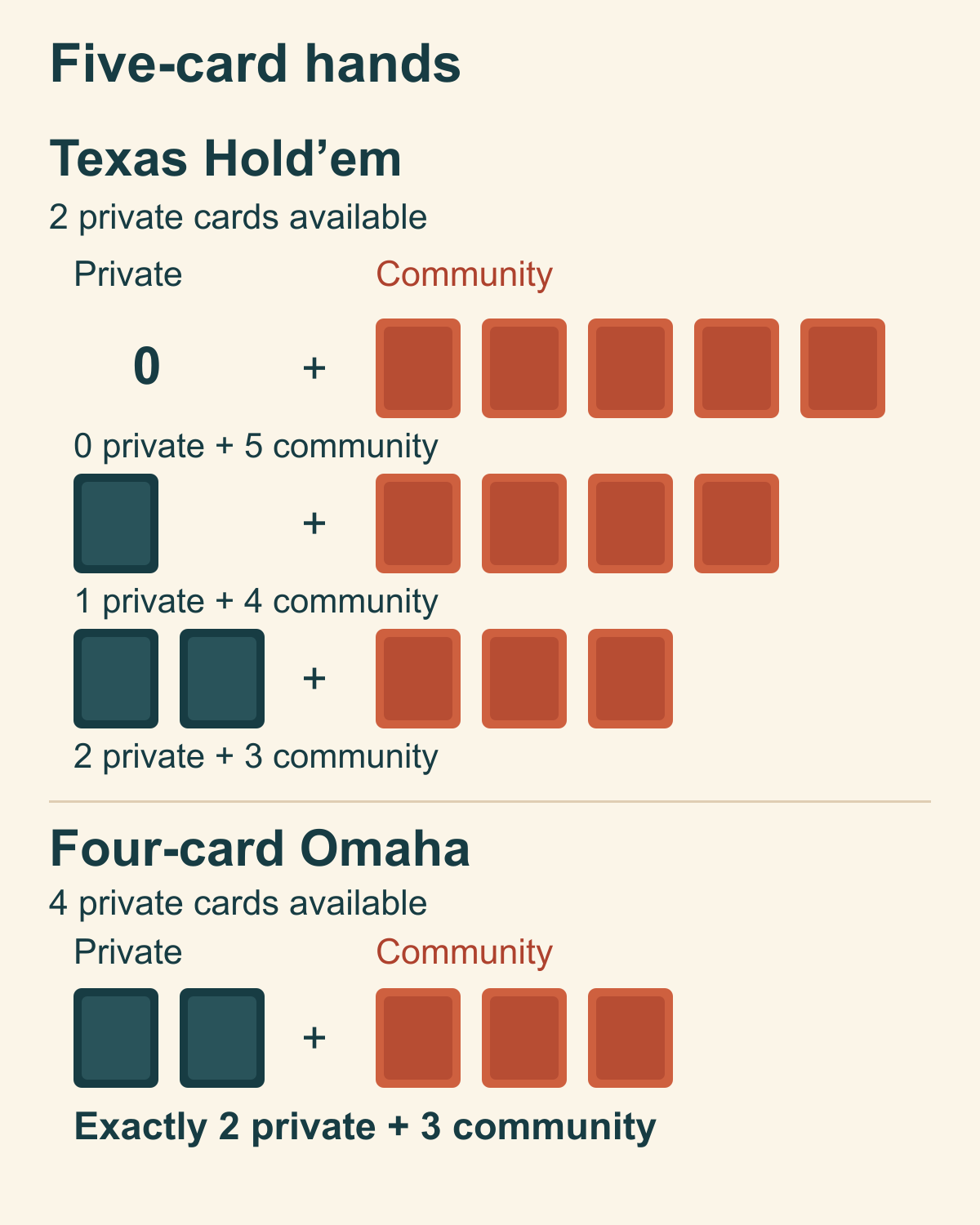
| Texas Hold’em | Two hole cards and five community cards once all cards have been dealt. | The best five-card hand can use two, one, or none of the hole cards. [5] |
| Four-card Omaha | Four cards dealt to each player, in addition to the community cards. | The combination must use two hole cards and three community cards. |
| Seven Card Stud | Individual face-up and face-down cards; there are no shared community cards in the center. | The player receives seven cards, and the outcome is determined by a five-card hand. |
| Five Card Draw | Each player receives five face-down cards. | Players may exchange cards according to the variant’s rules. (PokerStars) |
The classification of these families is described on Wikipedia; the characteristics of Hold’em, Omaha, and Seven Card Stud are detailed by Santa Mônica Clube de Campo. [1][2]
In Seven Card Stud, a face-up card still belongs to the player who received it: being visible does not make it a community card. [2]
Variant and Betting Limit Are Different Things
In addition to identifying the variant, it is necessary to know which betting structure is being used. Hold’em, for example, can be offered as Pot Limit or No Limit. In the source’s description, the former ties the betting limit to the pot; the latter allows players to commit all their chips when they act. [2]
These names concern betting. Names such as Hold’em, Omaha, and Stud identify variants with differences in how cards are dealt or used. Knowing only that a table offers “poker” leaves this information unspecified; knowing that it is Hold’em still does not, by itself, identify its betting limit.
Examples for Understanding Combinations and Information at the Table
Card combinations have specific names. Understanding what these names describe helps you follow a comparison, but two questions need to be separated: which combination was formed and which cards the variant allows players to use to form it. The first involves hand rankings; the second involves the game’s specific rules. [1][2]
Pairs, Three of a Kind, and Full Houses Describe Groups of Matching Ranks
In the rankings presented for high-hand variants, one pair consists of two cards of the same rank; two pair consists of two such groups; and three of a kind consists of three cards of the same rank. A full house combines three of a kind with a pair. [2]
These definitions show why recognizing only part of a hand is not enough. Identifying three of a kind, for example, does not complete the description if the combination also contains a pair: that set is called a full house. The name refers to the complete relevant combination, not just the first group noticed.
Flushes and Straights Depend on Different Features
A flush consists of five cards of the same suit that are not in sequence. A straight consists of five cards of consecutive ranks that are not all of the same suit. One combination depends on matching suits; the other depends on consecutive ranks. [2]
Suit and rank are therefore different pieces of information. Saying that cards share a suit does not, by itself, tell you whether their ranks are consecutive. Saying that the ranks form a sequence also does not, by itself, tell you whether they all belong to the same suit.
Hand rankings organize these differences, but the category name does not replace all the rules needed to determine an outcome. The general definition of poker provides for awarding the pot to the player or players with the best set of cards among those who remained in the hand. [4]
The Next Step Is to Learn the Rules of a Variant
After understanding the general concept, study can focus on one variant. The necessary foundation covers three topics: game procedures, the value of combinations, and betting rules, including their limits. This organization appears in general descriptions of poker and helps separate questions that seem similar but concern different parts of the game. [1][4]
A few questions can help guide that reading:
- Which cards does each participant receive, and which are visible?
- Are there community cards?
- Which cards can be used to form the combination?
- How do betting and its limits work?
- How does the variant determine the outcome among participants still in the hand?
Sources
- [1] Poker — Wikipedia, the Free Encyclopedia
- [2] How to Play Poker? — Santa Monica Clube de Campo
- [3] Poker Made Simple! Learn the Game’s Basic Terms — Copag
- [4] Poker — Ludopedia
- [5] Learn the Rules of Texas Hold’em — CBTH — published July 21, 2024.
- [6] The World of Cards: Exploring Blackjack vs. Poker — WinStar — published February 13, 2024.

 1 day ago