
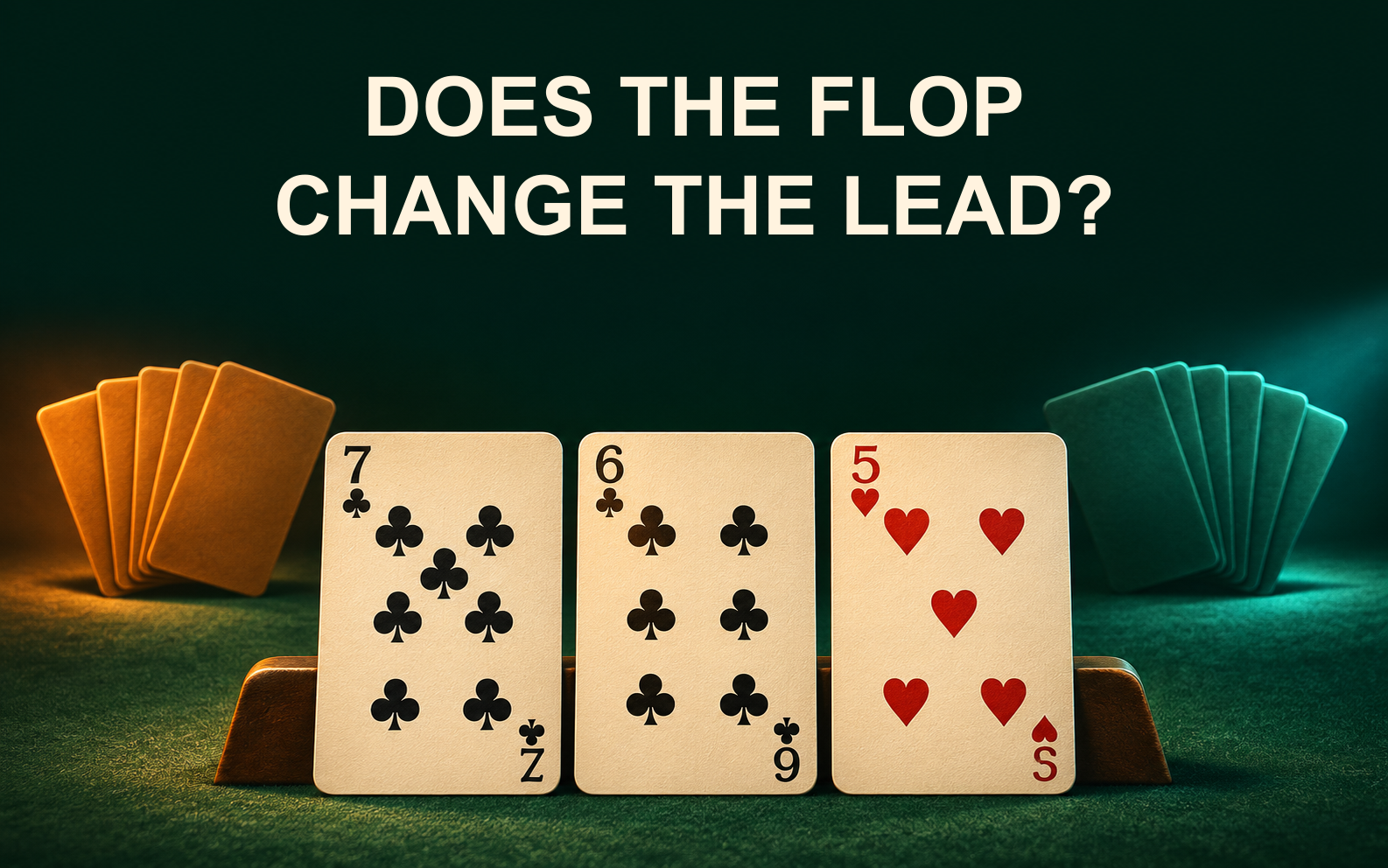
Range advantage is the advantage held by the player with the stronger of the two competing ranges on the current board. The board consists of the community cards face up on the table; a range is the set of hands a player could hold, given their actions and position. The comparison, therefore, does not pit your hand against your opponent’s. It places two distributions side by side and asks which contains the greater proportion of strong made hands (combinations already formed) and powerful draws (hands still waiting for a card) on those cards [1][2].
The assessment applies to a particular moment in the hand. It can change when a new card comes or when actions narrow the ranges, and it may apply to only part of the distribution [1][2]. Even when clear, it serves as information for your read, not an instruction to bet. In this article, the ranges are treated as already estimated: the focus is on comparing them and repeating that comparison with each new piece of information.
Range Advantage in Poker: How to Compare Two Distributions on the Same Board
The measure behind the comparison is equity. Imagine dealing the remaining cards many times. Count the whole pot for a win and the appropriate share for a split. The player whose range takes the larger share on average has range advantage on that board [1][3]. This answers a common question: if everyone plays the “correct” hands, how can one range be ahead? Because the set of hands held by the player who opened the pot differs from that of the caller, and each board interacts differently with each range [3].
There is also a matter of perspective. You see your two cards, but your opponent does not: to them, you are playing a range, and that range influences how you play the hand you actually hold [3]. Four steps organize the comparison.
- Start with two ranges you have already estimated. Preflop action and position provide the baseline: the raiser’s opening range against the defender’s calling range [1]. The fact that your opponent called, rather than choosing another action, is the first element of postflop hand reading [3].
- Read the board against each range. Ask which set finds more strong made hands and powerful draws. Connected, coordinated, or flush-friendly boards tend to favor ranges rich in suited connectors (consecutive cards of the same suit) and straight and flush combinations; dry boards tend to favor opening ranges containing many high cards [1]. Board texture helps classify what each flop does to each set.
- Look at the entire distribution and its top end. Range advantage compares the average equity of the two complete ranges. Nut advantage compares the proportion of the strongest hands at the top of each range [2]. Even if both players can hold the nuts, the best possible hand on that board, one can still have an advantage at the top.
- Record the assessment with its scope. Instead of “this player has the advantage,” write something like “range A has the advantage, concentrated at the top of the distribution,” specifying the board and street where the read applies. This is the record you will update on the next card.
How Actions and New Cards Change the Comparison
The advantage is not a fixed label: it is dynamic and can change on every street, meaning each new round of cards and betting (flop, turn, and river) [1]. Two things move it.
The new card. Different cards help different preflop ranges. If the board eliminates many of the preflop aggressor’s speculative hands, they may lose their initial advantage [1].
The action. Calls, raises, and checks are worth watching, but they only let you adjust the distribution when your opponent is more likely to choose that action with some hands than others. If they check every hand in this spot, the check excludes none of them. The overall advantage does not have to change sides. When an out-of-position caller checks and then continues calling on later streets, their range tends to concentrate on stronger made hands and draws, and the advantage may shift to them [1]. What changes is the distribution of plausible hands, not certainty about the opponent’s two cards.
That is why the question on each street is the same: with ranges estimated from the information available, who benefits from this card? Reassessing who benefits from the board and whether the betting justifies adjusting each range keeps the read up to date [1]. If the answer has changed, the read of the hand has changed too.
Why Range Advantage Does Not Decide the Bet on Its Own
Range advantage tells you who is stronger overall. To turn that comparison into a betting decision, check where the advantage lies and then consider your position and the hand you actually hold.
- Ranges are estimates. Hand reading is much broader than guessing an opponent’s exact hand [3]: an action may help adjust those possibilities without revealing the cards. If one of the ranges has been poorly estimated, the comparison becomes less reliable. Review which hands were included before using the result to decide.
- The advantage may be partial. It may apply to only part of the distribution [2], and looking only at the overall result hides where it lies. The top of the range requires its own interpretation, explored in the article on nut advantage.
- Position plays a role in the decision. Playing in position helps you take advantage of the edge [1]. If your opponent has the stronger range and you are out of position, examine that combination before interpreting your hand’s strength as the strength of your entire range [3].
- The player who opened the pot may no longer be ahead. Being the preflop aggressor identifies the starting point. The postflop read depends on how the community cards fit each set of hands [1][3].
- The specific hand still matters. Against someone who does not think in ranges, the specific hand tends to carry more weight. Even so, estimating that opponent’s range gives you an idea of how strong they are likely to be and helps you plan your postflop line [3].
Example: UTG Starts Ahead, but the Flop Favors the Big Blind
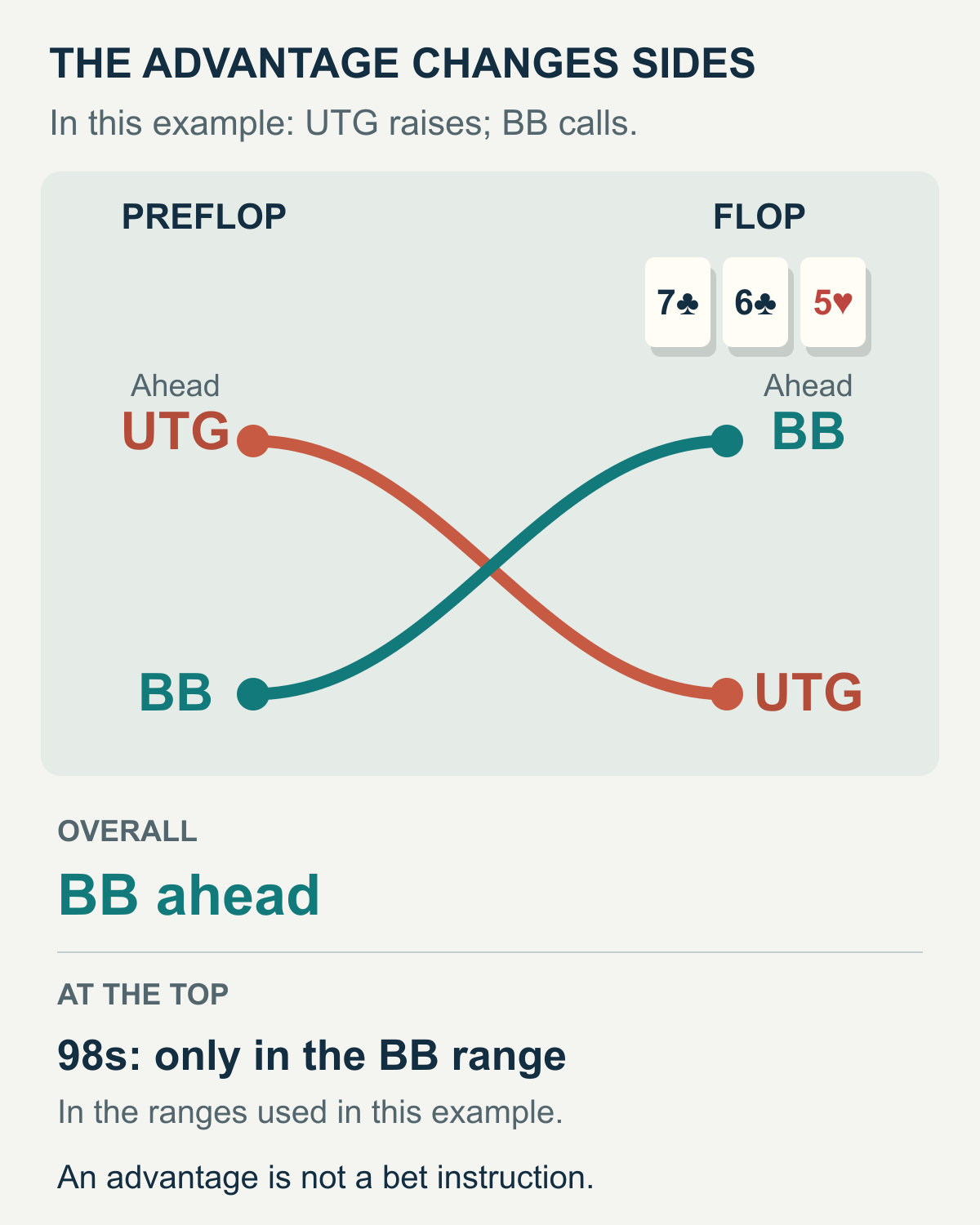
At a six-player table, UTG opens with a raise and the big blind (BB) just calls. In SplitSuit’s comparison, UTG’s opening range starts ahead of the BB’s calling range. On the 7♣ 6♣ 5♥ flop, the order reverses: the BB gains the overall advantage and, in the distributions used in the example, only the BB can hold 98s, the best straight on this board [3].
| Moment in the hand | How to compare the same ranges |
|---|---|
| After the preflop call | UTG has the stronger range overall. The BB’s call defines which defending distribution enters the comparison [3]. |
| On the 7♣ 6♣ 5♥ flop | The three consecutive cards favor straight combinations. In this case, the BB leads across the entire distribution and retains the strongest hand that either range can contain [1][3]. |
The comparison changes before any new action. What changed was the board: the range that started behind fits these cards better. To interpret your hand, first separate the example’s two conclusions: that the BB is ahead across the entire distribution, and that 98s appears at the top of only the BB’s range. Each answers a different question. Even for UTG, who started with the initiative, the starting point for assessing the flop is the new result, together with position and the hand actually dealt [3].
When the turn arrives, use the ranges estimated after the flop actions. A new card may change the comparison between them; an action may change the weight of plausible hands on each side. This lets you distinguish a change caused by the board from a change in the set of hands you are comparing [1].
Next Step: Repeat the Comparison in a Hand You Want to Review
Follow the same sequence in the hand you choose, without jumping straight to a conclusion about betting:
- Write down the two estimated ranges before looking at the board, using preflop action and position [1][3].
- On the flop, ask who has more strong made hands and powerful draws across the entire range, and who is ahead at the top [1][2].
- After each action and each new card, check whether there is reason to adjust the ranges and note whether the advantage has stayed with the same player or changed sides [1].
- Only then add what the comparison does not resolve: relative position, the specific hand you held, and the type of opponent [1][3].
The result is a map of when the advantage existed, where it lay, and when it changed, rather than a ready-made betting answer. To apply the same logic on the next round, it is worth looking at how to assess a second bet on the turn, where the card, ranges, and opponent all enter the decision.
Frequently Asked Questions
Does Range Advantage Mean My Hand Is the Best?
No. The comparison concerns sets of hands, not your specific hand [1]. Your range influences how you play the hand you hold, but it does not turn it into a strong hand [3].
Is Range Advantage the Same as Nut Advantage?
No. Range advantage compares the average equity of the complete ranges; nut advantage compares the proportion of the strongest hands at the top [2]. Both players can have the nuts and one can still have an advantage at the top.
Do I Need to Repeat the Comparison on Every Street?
Yes. A new card or an action may justify revisiting the comparison [1]. Adjust the range when the action favors some hands more than others; the advantage may stay with the same player.
Recommended reading
- Nut Advantage in Poker: Strong Hands and the Difference from Range Advantage
- Poker Board Texture: Connectivity, Suits, and Board Changes
- Double Barreling in Poker: How to Assess a Second Bet on the Turn

 3 hours ago