Poker Board Texture: Connectivity, Suits, and Board Changes
By the Editorial Team
Poker Board Texture: What to Look for in the Community Cards
Board texture is the structure of the community cards: how their ranks connect, how the suits are distributed, and whether any ranks repeat. In Texas Hold’em, reading this texture helps you recognize which types of combinations are possible and what a new card might change. [1]
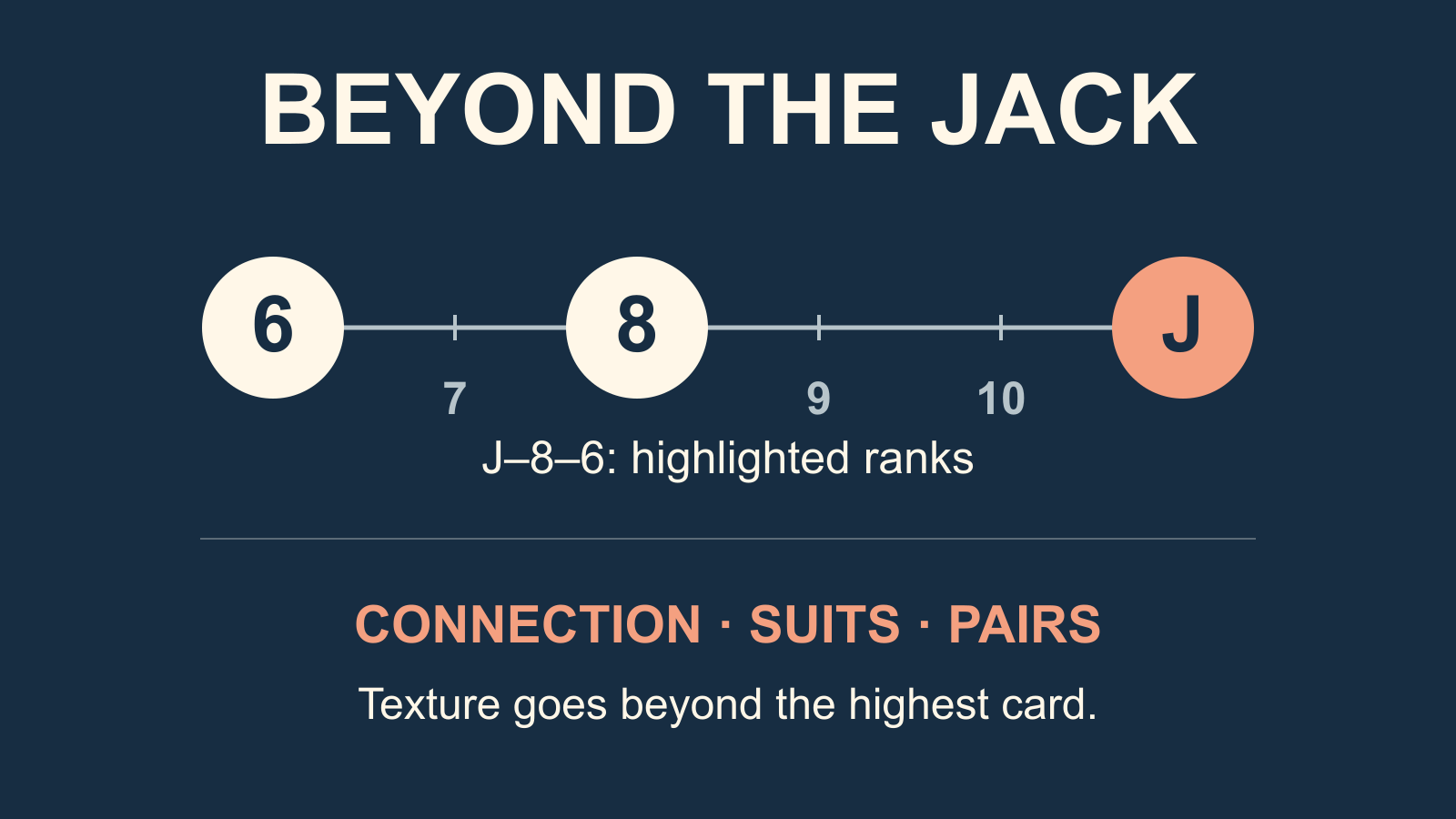
Poker Skill describes J–8–6 two-tone, meaning two suits, as a texture between dry and wet. There are three different ranks, with gaps between them, and two cards of one suit. [1]
How to Describe a Texture Without Relying on a Single Label
Observe connectivity, suits, and repeated ranks; then consider how the next cards might change hand strength. [2][3]
Connectivity: The Distance Between Ranks
Start with the card ranks. Nearby ranks can contribute to more straight combinations; ranks farther apart create a different structure. A flop with consecutive cards does not have the same connectivity as one with large gaps. There are also intermediate situations, with two nearby cards and one distant card, so there is no need to force every board into one of two extremes. [1][2]
Also consider how high the cards are: connections between high cards and those between middle cards may interact with different sets of starting hands. [3]
Suits: Rainbow, Two-Tone, and Monotone
On the flop, rainbow means three different suits; two-tone means two cards of one suit and one of another; monotone means three cards of the same suit. These descriptions concern suits, while connectivity concerns ranks. A flop can therefore be connected and rainbow at the same time, or disconnected and two-tone. [2][3]
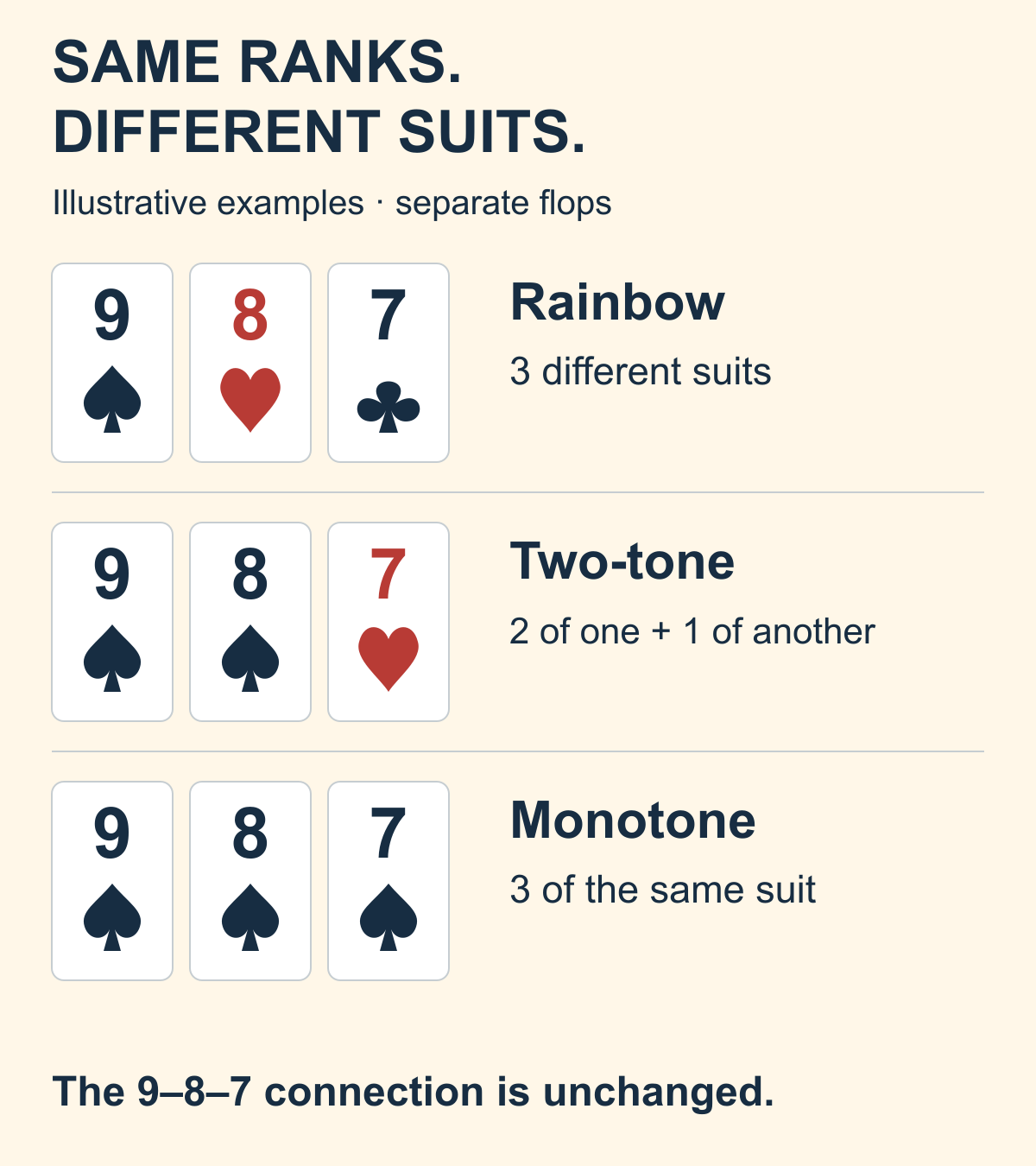
All three rows in the image have the same ranks, 9–8–7, and the same connectivity. What changes is the possibility of a flush:
- Rainbow: on the flop, five cards of the same suit are not yet possible, even using both hole cards.
- Two-tone: a player with two hole cards of the repeated suit has four cards of that suit and a flush draw.
- Monotone: a player with two hole cards matching the flop’s suit already has a flush.
The board shows which combinations are possible, not which ones an opponent necessarily holds. A draw still needs later cards to complete it; the guide to outs in poker explains how to count those cards.
Pairs: Repeated Ranks
A paired board contains a repeated rank. Classifications distinguish unpaired boards, paired boards, and boards with three cards of the same rank; suit distribution is observed separately. [2][3]
When moving from the flop to the turn, check whether the new card repeats a rank already exposed. If it does, the texture now includes that feature.
Potential for Change: What the Next Cards May Alter
On a relatively static texture, the best hand on the flop tends to change less before the river; on a dynamic texture, more subsequent cards may alter relative hand strength. [3]
Hypothetical example: on the image’s 9♠–8♠–7♥ flop, A♠K♠ has a flush draw, with four spades. If the turn is 2♠, that hand has five spades and completes a flush. The third spade on the board makes a combination possible that was not available on the flop: a concrete change in hand strength.
Dry or Wet Is Not the Same as Static or Dynamic
The terms dry and wet mainly describe connectivity and draw possibilities on the current board: a drier board offers fewer such paths, while a wetter one offers more. Static and dynamic instead concern how much future cards may change relative hand strength. [1][3]
Example: Connectivity, Suits, and Pairs on J–8–6
Return to J–8–6 two-tone, the example introduced earlier, and separate its features:
| Dimension | What Is Exposed | How to Describe It |
|---|---|---|
| Ranks | Jack, eight, and six. | There are gaps between the ranks; the three cards are not consecutive. |
| Suits | Two cards of one suit and one of another. | The flop is two-tone; the notation does not identify the specific suits. |
| Repetition | Each rank appears once. | There is no pair on the board. |
How Texture Fits into Range Analysis
A range is the set of hands considered possible for a player. To analyze texture, start with the ranges suggested by position and previous actions, then compare which hands in each set make pairs, draws, or stronger combinations on the board. [3]
To study the characteristics of starting hands, see the best pre-flop poker hands. When assessing a second bet on the turn, consider the new card alongside the ranges and the opponent, the subject of double barreling in poker.
Recommended reading
- What Are Outs in Poker: Counting Cards Without Double Counting or Ignoring Dirty Outs
- Best pre-flop poker hands: strengths and factors that change their value
- Double Barreling in Poker: How to Assess a Second Bet on the Turn
Sources
- [1] Board texture — Poker Skill
- [2] 10 Fundamental Tips for The Most Common Types of Flops — Dan B., Upswing Poker (published March 17, 2020)
- [3] Using Board Texture to Guide Your Way — Chris Jones, RecPoker (published February 2, 2021)

 1 day ago