Double Barreling in Poker: How to Assess a Second Bet on the Turn
Your flop c-bet was called, and the turn has arrived: bet again or check? Betting again makes sense when three factors support a clear purpose: the card that came, its effect on your range and your opponent’s range, and the tendencies of the player you are facing. That purpose may be to get called by worse hands or make your opponent fold. When these factors do not help, checking is the natural alternative, including with some value hands. There is no fixed rule: the guidance is to adjust the frequency and size of your second barrel to the board texture and your opponent’s responses [1].
This second bet has a name: a double barrel, or second barrel. It is a turn bet made by the same player who bet the flop and was called. Usually, this is the preflop aggressor. That player had already made a continuation bet, or c-bet: a bet by the player who took the initiative before the flop to continue representing strength [1]. Range means the set of hands each player could have, considering the action up to that point.
The bet can have two purposes. For value, you want worse hands to call and to build the pot. As a bluff or semi-bluff, you want your opponent to fold and settle the pot right there [1][2]. The action is the same, but each purpose depends on different conditions. That is why the turn calls for a fresh assessment instead of automatically repeating what you did on the flop.
The cost of getting it wrong also rises. After a c-bet is called, the pot has usually already grown, which gives each decision more weight and makes mistakes more expensive [3].
Example: A Turn with Too Many Draws for a Second Barrel
An example from Upswing Poker shows how the turn board affects bluff selection [3]. You raised preflop on the button, and the big blind called. On the K♠ T♠ 8♣ flop (T stands for ten), they checked and called your c-bet. The turn is the 7♣, and you are considering a second barrel.
The starting rule. Suppose your rule for bluffing the turn is to bet with straight draws (open-enders and gutshots) and flush draws. On this board, there are so many draws that, if you bet all of them, they would far outnumber your value hands. Following the original rule of betting every draw would be a big mistake: you need to filter some of them out.
The filter. A new version of the rule could be: if there are too many draws and a straight is possible, choose turn bluffs only from combo draws, such as Q♠ J♠, and draws that block the straight the turn made possible, such as Q♣ 9♦. A combo draw combines more than one draw: Q♠ J♠ has both a spade flush draw and a straight draw. Blocking, here, means holding a card your opponent would need to make that straight: every possible straight on this board requires a 9, and Q♣ 9♦ contains one.
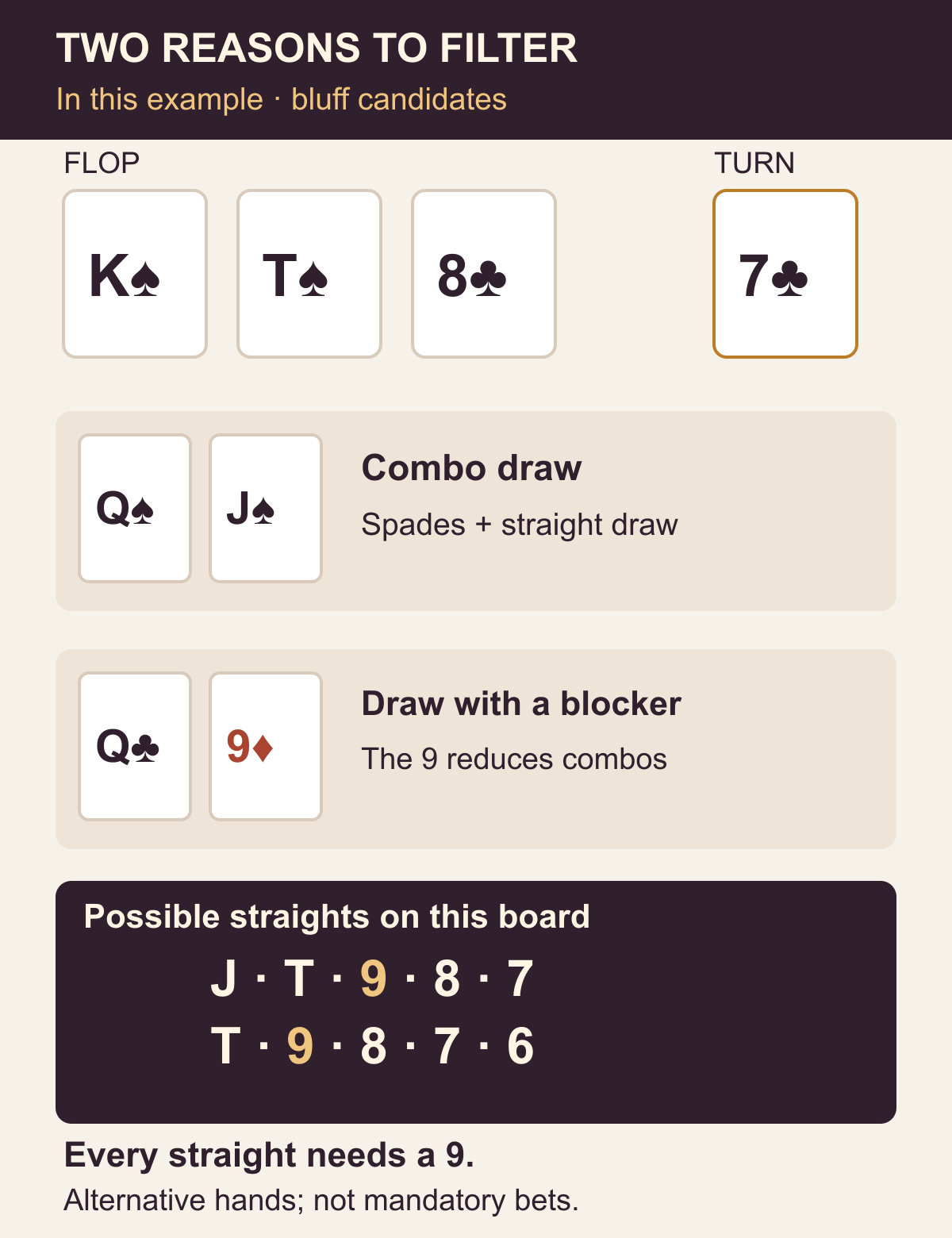
What the example teaches. On this board, the number of draws upset the balance with value hands, and the rule needed a filter. For the bluffing part of this example, the filter keeps combo draws and draws that block the straight; the other draws are checked. Notice, too, where these hands get their equity: from draws, rather than an overcard to the highest card on the board, the K. The example does not reveal the big blind’s hand; it shows how the rule adapts to the board.
How Double Barreling Works: The Card, the Ranges, and the Opponent
You may reach the turn with a strong hand, a medium-strength hand, or a draw. Before continuing, identify which worse hands could call your value bet or which better hands could fold to a bluff [1][3].
Value and Bluffs Call for Different Conditions
Value betting. This includes made hands that still beat the hands your opponent would call with, such as top pair with a good kicker or better. They are bet to build the pot and for protection [1]. A turn card that improves your hand is also an occasion to consider betting: if you only fire a second barrel when you miss, your strategy becomes exploitable [2]. This does not make every strong hand a mandatory bet, as the limitations discussed later show.
Bluffs and semi-bluffs. The candidates are hands with little showdown value, meaning little chance of winning when the cards are compared at the end. Even so, they need some equity against part of the opponent’s range. And they are only justified when there is enough fold equity, meaning a real chance that the opponent will fold [1]. The goal is to win the pot right there.
Equity is a hand’s expected share of the pot at showdown, including wins and ties; improving on the river is one way to realize that share if the bet gets called. The more equity, the better, as with most bluffs in poker. In general, many flop c-bets are made with two overcards (cards higher than those on the board), such as A-K, which is where the heuristic of having at least one overcard when firing a second barrel as a bluff comes from [2]. It starts from that type of c-bet and is not a universal requirement: draws also provide equity, and the hands selected in the example above are draws with no overcard to the highest card on the board [3].
What the Turn Card Changes
Board texture helps you decide whether to continue and how to do so. It indicates how connected, coordinated, or draw-heavy the board is. On static boards, most turn cards do not change the relative strength of hands, and many of the hands that called the flop remain weak and liable to fold. On dynamic boards, many cards complete draws or bring overcards, and the opponent’s range is more likely to improve [1].
Compare how the turn card affects your range and the range that called the c-bet. The table helps you assess that change before choosing a value bet or a bluff [1][3].
| Turn card | What to look for |
|---|---|
| Overcard to the flop (higher than every card on the flop) | Does it favor your range or your opponent’s range more? Which pairs could still call, and which hands better than yours could fold? |
| High card slightly below the highest flop card | What happens to top pair and the smaller pairs that called the flop? Which of them continue against another bet? |
| Low card or a card below the flop cards | Does it complete a draw or improve your opponent’s pairs? If little changes, which hands from the flop calling range remain weak? |
| Card that pairs the board | Which range contains more hands with the rank that paired? How does that change the strength of hands that would continue against a bet? |
A turn that changes little does not require you to stop. If the flop calling range still contains many weak hands that could fold, consider continuing; if the card clearly improves that range, reduce your bluffs [1][3].
The Opponent’s Tendencies and Position
The third filter is the player you are facing, and reads on the opponent matter, as always. Against a calling station, a player who rarely folds, the warning applies to bluffing: trying to bluff someone who almost never folds ends up shrinking your bankroll [2]. With value, the logic changes: against someone who keeps calling, the guidance is to favor value-heavy lines. Against someone who folds frequently, for example by giving up missed draws or weak pairs, there is room for more bluffs; against someone who check-raises aggressively, meaning they check and then raise the bet, there is less room for bluffing [1].
Position matters too. Being in position means acting after that opponent in the betting round, the same meaning as playing in position, and this makes double barreling easier. A player who called the c-bet out of position often reaches the turn with a weaker range, vulnerable to continued pressure. On dynamic boards, however, expect more check-raises or improved hands from that player, and reduce your bluffs [1].
The Limits of a Second Bet: When Checking Gains Weight
A c-bet does not oblige you to continue. When the card is very good for your opponent’s range, the guidance is to be more selective: take a more defensive approach and check frequently. You can still bet some hands, such as your best value hands and a few bluffs to maintain balance, but with much less aggression than would be appropriate on a more harmless turn [3]. In this case, checking does not indicate that your hand is bad: it responds to a turn that changed the balance between the ranges.
No filter reveals the opponent’s exact hand. The card classification starts from the hands they probably called with, and the texture-based assessment deals with ranges that are more or less likely to improve. These are assessments of sets of hands, not conclusions about the opponent’s two cards. That is why a bluff can still get called, and a bet can face a check-raise.
Ready-made rules need adjustment. A bluffing rule based on draws does not cover boards where those draws are not possible; in those cases, it needs to include other hands with relatively good equity [3]. The earlier example shows the opposite problem. There are so many variables and reads involved in a second barrel that no guide can cover them all [2].
Next Step: Review the Turn Before Betting Again
If the turn often leaves you without a plan, review the preceding c-bet. Before betting the flop, consider which turns allow you to continue and which ones you would prefer to check [2].
When a board does not fit your rule, see it as an opportunity to expand that rule with new additions, as in the example above [3]. Before each second barrel, and when reviewing the hand afterward, check how the turn card interacts with both ranges and define whether the bet seeks value or a fold. The next question, how much to bet, also depends on the board and the opponent, rather than a standard size [1].
Recommended reading
- Continuation Bet: When to Bet or Check
- Poker Bet Sizing: Amount, Purpose, and Context
- Showdown Value in Poker: Hand Strength and Decisions in Context
Sources
- [1] Double Barrel in Poker: When to Fire the Turn — Poker Skill
- [2] Double Barrelling: Firing The Second Barrel In Poker — The Poker Bank, by Greg Walker
- [3] What is Double Barreling in Poker & When Should You Do it? — Upswing Poker, published on September 9, 2022
 2 days ago