Polarized Ranges in Poker: What Goes In and What Stays Out
A polarized range is a set of hands made up of two extremes: very strong hands and bluffs, with no medium-strength hands between them [1][2][3]. A linear range has no such gap in the middle: it starts with the strongest hands and works down in order, without skipping bands, to a cutoff point [2]. The difference lies in the shape of the set, not in the bet size or the action taken with a single hand.
A range describes the hands a player could hold in a situation [1]. In a polarized bet, the strong hands seek calls from worse, while the bluffs seek folds from better hands [1][2].
Teaching Example: Value, Bluffs, and Checking on the River
Suppose you reach the river heads-up on K♣ 8♦ 4♠ 2♥ 2♣, and the opponent checks. Compare three possible hands you could hold. These are teaching assumptions about the opponent’s responses, not an observed hand or a prescribed range.
- 8♣ 8♠: value. You have a full house, eights full of deuces. If the opponent calls with a worse hand such as K♦ Q♣, betting wins more from that hand.
- Q♥ J♦: bluff candidate. You lose to a hand such as 8♥ 7♣ at showdown. A bluff seeks to make that better hand fold; it is a candidate only if you expect such folds.
- 9♣ 9♦: check back. You beat 8♥ 7♣ but lose to K♦ Q♣. If a bet makes the worse hand fold while the better hand calls, checking back keeps the showdown value of your nines.
Betting strong value hands and selected weak bluffs while checking the middle group creates the gap that defines a polarized betting range [1][2].
Reading the Gap in a Range
The contrast with a linear range. Imagine the hands ordered by strength in this situation. A linear set starts at the top and retains the following bands down to a cutoff point. A polarized set, meanwhile, leaves a gap between its value hands and its bluffs. The useful approach is to compare continuity between the bands, rather than trying to identify an exact card in the opponent’s hand from the name given to the strategy [2].
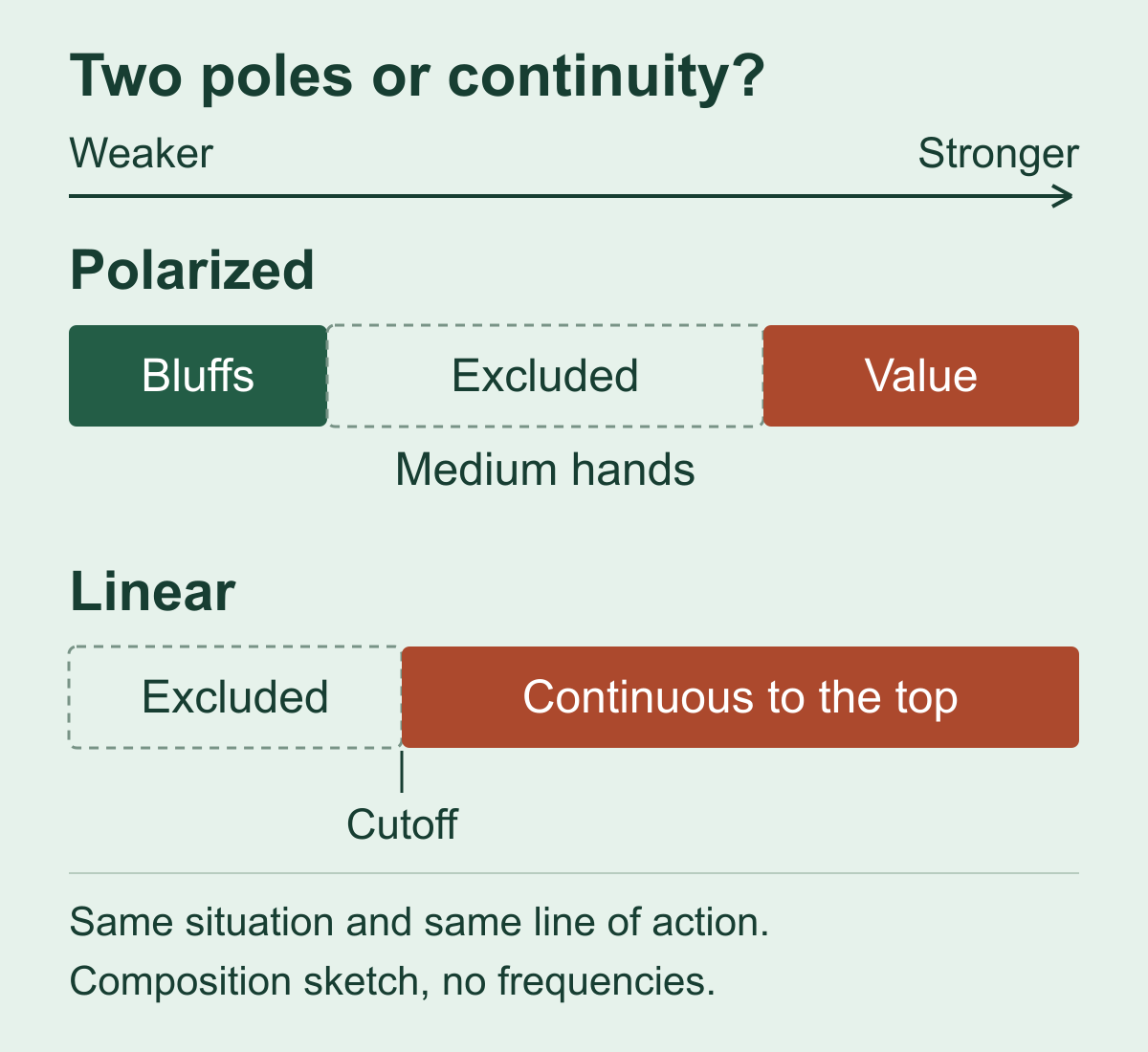
A merged range can include medium-strength hands that get called by worse. In the table below, linear describes a continuous range from the strongest hands down to a cutoff [2].
| Question to identify the shape | Polarized | Linear | Merged |
|---|---|---|---|
| Is there a gap between value and bluffs? | Yes, the middle region is excluded | The set is continuous down to the cutoff | It may select intermediate bands |
| Where do medium-strength hands belong? | Outside this polarized line | They are included if they are above the cutoff | They may be included to seek thinner value |
| What distinguishes the set? | Two ends with different functions | Continuity from the top | Inclusion of intermediate value |
Compare the hands taking the same action in the same situation: a flop betting range is only part of the range that reached the flop [1][2].
Adjusting Against an Opponent Who Calls Too Much
In Poker Skill’s cash-game example [2], the cutoff opens KQs (king-queen suited) and the big blind defends; the flop is K♠ 9♥ 4♦. This opponent has been observed calling two streets even with second pair. Against that tendency, reduce bluffs and consider more value hands that can be called by worse, including hands seeking thin value. KQs has top pair with a queen kicker here; the opponent’s willingness to pay is why the adjustment favors value.
How to Read Size, Street, and Responses
Size as a clue. The relationship between large bets and polarization has exceptions: a small bet can have a polarized structure, and a large bet can have a linear structure [1]. So, when facing a bet, consider its size together with the line and the hands that could take it. Size alone does not identify the hidden cards.
Future cards change the function of hands. Before the river, a hand used as a bluff can still improve; a semi-bluff combines pressure to fold with the possibility of making a stronger hand. On the river, no future cards remain to provide that improvement. This difference helps explain why a hand’s classification depends on the street [1]. Decisions such as a second bet on the turn need to account for this change.
Next Step: Review the Hand Through the Role of Each Hand in the Range
In your next review, instead of asking “was that polarized?”, work through these questions:
- Which hands would make this same bet here, and what does each one want? In a polarized line, strong hands want to be called by worse hands, and bluffs want to make better hands fold; medium-strength hands, with neither objective, are not included in this bet [2].
- Are there still cards to come? On the river, there are none: the bet is for value or as a bluff. Before it, a weak hand can still improve, and the boundary between value and bluff depends on future cards [1].
- Does this opponent fold enough for bluffs to have value? If not, bluffs lose their function, and the betting range tends to be value-only [2].
- Is the size they chose a clue to test against the rest of the line? It does not prove that the opponent has a monster or a bluff [1][3].
Recommended reading
- Bluffing in Poker: Meaning, Conditions, and Risks
- Thin Value in Poker: A Marginal Bet Depends on Who Calls
- Double Barreling in Poker: How to Assess a Second Bet on the Turn
 1 hour ago