
Thin value means value betting a marginal hand when you expect a small edge against the calling range—the set of hands your opponent would call with [1][2]. On the river, start with this question: which worse hands would your opponent call with against this bet size?
Example: Top Pair with a Jack Kicker on the River
Teaching hypothetical. You are on the button with Q♠ J♦, raise preflop, and get called by the big blind. On the Q♥ 9♣ 6♦ flop, they check, you bet, and they call. The turn is 2♠, and both players check. On the 3♥ river, they check again. You have a pair of queens with a jack kicker and are considering betting 30 chips into a pot of 100.
- Worse hands that might call: QT and Q8 have the same pair of queens with a lower kicker; A9 has only a pair of nines. Include these hands in the calling range only if the opponent's line and behavior support that read against the bet of 30.
- Better hands that beat you: AQ and KQ have higher kickers; Q9 has two pair; 99 and 66 have sets. These also belong in your assessment of the range that reaches the river and calls.
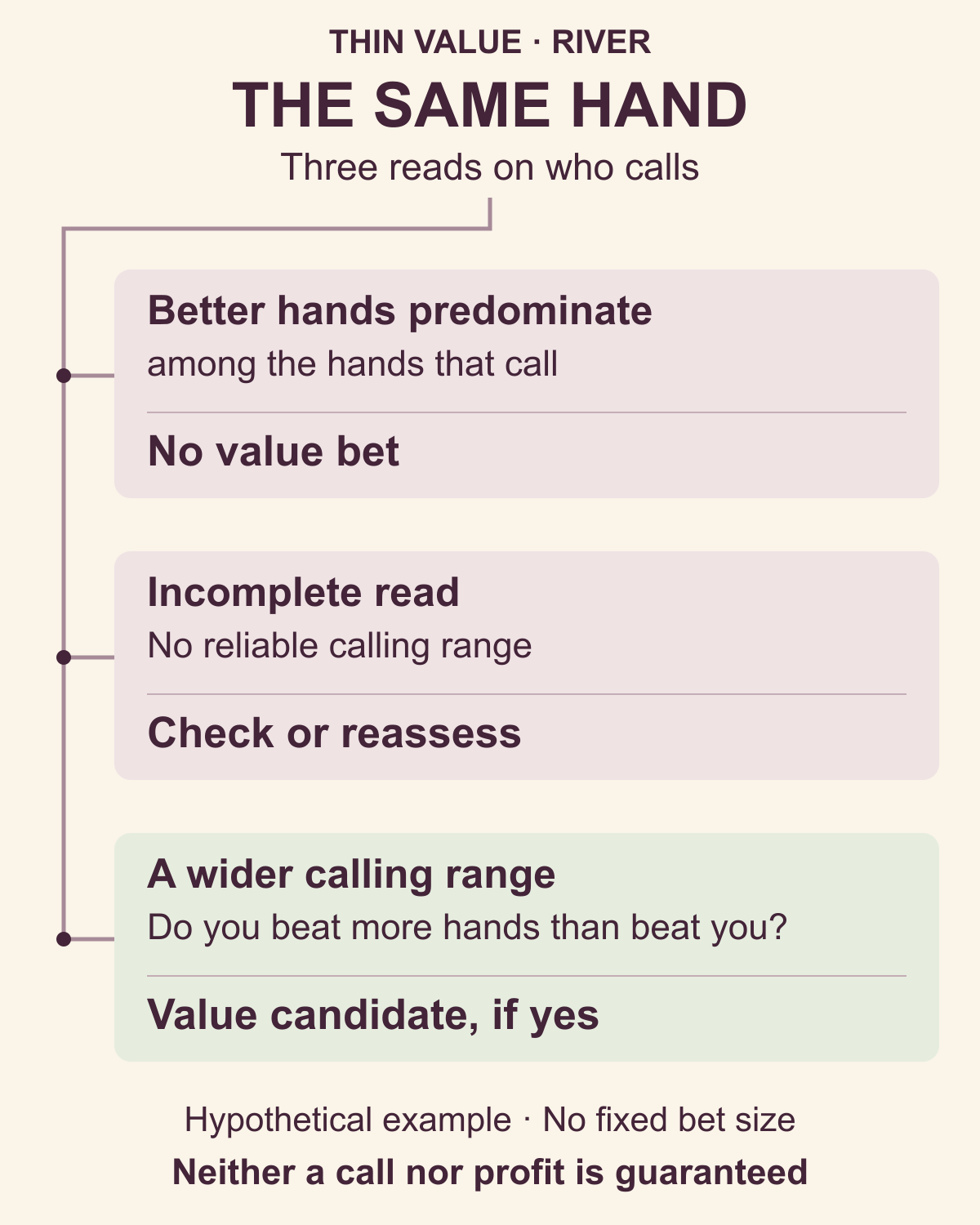
Against someone who tends to call with worse queens and some nines along this line, QJ can be a candidate for a value bet. If they fold those hands and call mainly with AQ, KQ, or better, prefer checking. If you cannot yet estimate what would call, you also lack a basis for choosing the bet. The edge over the worse and better hands that call determines whether the value is thin.
Thin Value, Small Bets, and Showdown Value
| Idea | Question it answers | What it does not tell you |
|---|---|---|
| Small edge (thin value) | Among the hands that would call, how many do you beat, and how many beat you? | It does not mean the bet is small. |
| Small sizing | How much should you put into the pot? | Nothing about your edge over the hands that call. |
| Showdown value | Can the hand win at the final comparison if there is no further betting? [4] | That ability does not confirm that worse hands would call a bet. |
Bet size changes which hands you aim to reach, but does not by itself define your edge: see poker bet sizing. A hand with showdown value, meanwhile, can win if you check without necessarily getting calls from worse hands [4].
Assess the Calling Range for the Chosen Size
- Estimate which hands reach this point, using your opponent's earlier actions.
- Within that range, separate the hands that would call this amount: which do you beat, and which beat you? If the calling range consists mainly of better hands, there is no good value bet [1].
The calling range does not have to change much when bet size changes. An opponent who calls too widely can already give you room to widen your value-betting range; what matters is getting enough calls from worse hands at the chosen size [3].
To estimate that range, observe the worst hands they call with at showdown and how many streets they keep calling. Compare similar situations: a player may call differently depending on the board and the line [3].
Also consider how they view your bets. If they believe your line contains many bluffs, they may call with more hands; if they expect almost exclusively value, they may call less. Against a wider calling range, the first additional value-bet candidates are the best hands you would normally check [3].
What to Record When Reviewing the Hand
Record the bet size, earlier actions, and the worst hand you saw call at showdown. In the next similar situation, use that record to revise your estimate of what calls, instead of assuming a marginal hand always deserves a bet [1][3].
Recommended reading
- Showdown Value in Poker: Hand Strength and Decisions in Context
- Poker Bet Sizing: Amount, Purpose, and Context
- Blocking Bets in Poker: Position, Purpose, and the Risk of a Raise
Sources
- [1] Thin Value In Poker | Thin Value Betting — ThePokerBank, by Greg Walker
- [2] Thin Value | PokerLAB - Online Poker Academy — PokerLAB, published on November 27, 2017
- [3] Exploits (2): Thin Value Betting — PokerStrategy.com, published on August 3, 2026
- [4] Showdown Value — PokerStrategy
 1 hour ago