Calling Stations in Poker: The Short Answer
A calling station is a player who, hand after hand, responds to bets mainly by calling, including with weak or marginal hands, and rarely raises [1][2][3]. Frequency is what supports the label: the same player repeating this behavior over several hands of Texas Hold'em, rather than making one isolated call.
Why this matters: the pattern changes the choice between bluffing and betting for value. A bluff needs a better hand to fold; a value bet needs a worse hand to call. Against someone who rarely folds, bluffing becomes less appealing and value betting becomes more appealing [1][3], provided your hand, the board (the community cards already dealt face up [4]), and the persistence of the pattern support that choice.
Example: Betting for Value Against an Identified Calling Station
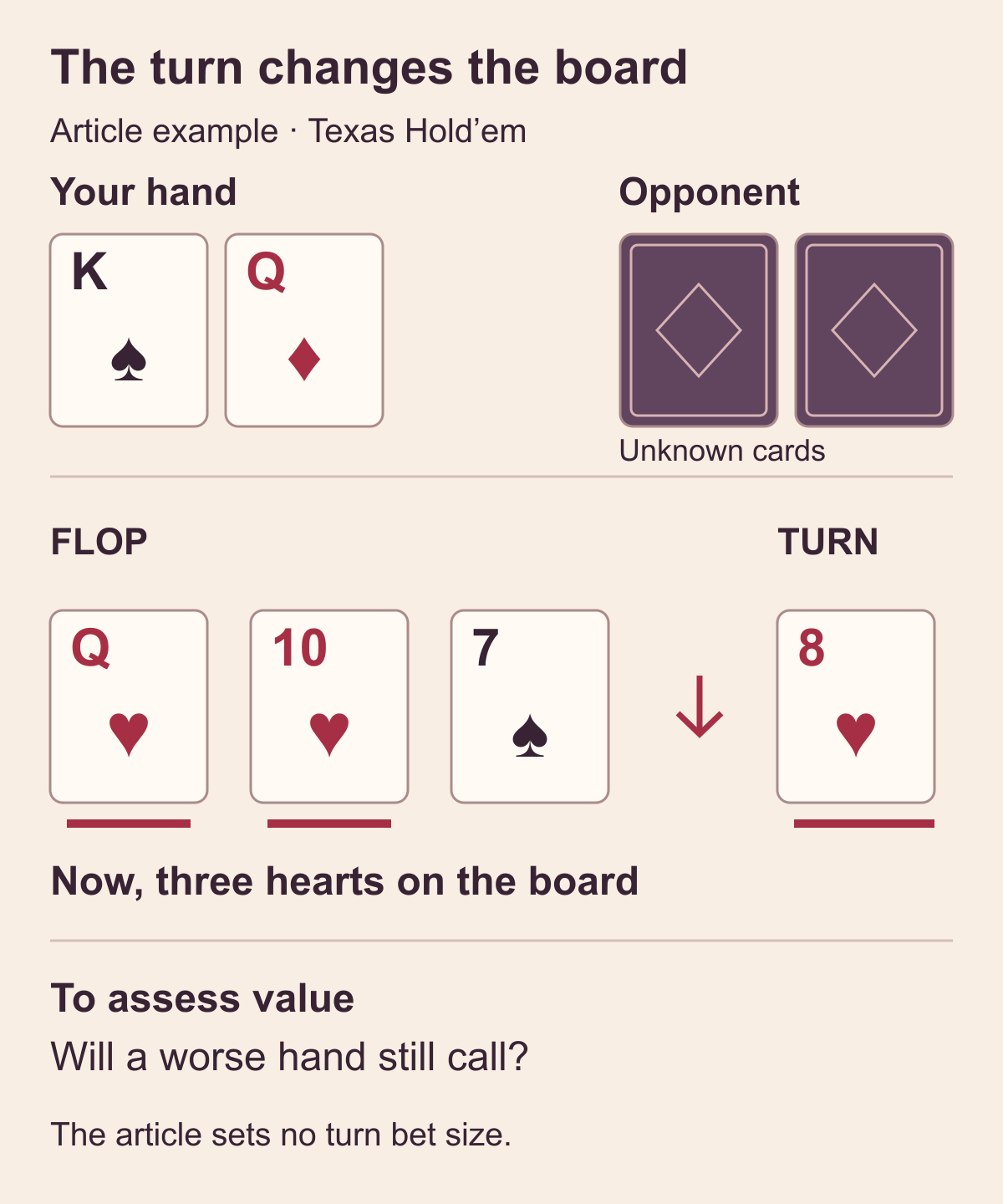
In the example published by PokerCoaching [3], you face an opponent already identified as a calling station in Texas Hold'em. The aim is to assess a value bet when the board changes. The sequence is as follows:
- Preflop: with K♠ Q♦, you raise to four times the big blind (4x), the bet used as the unit of measurement, and end up playing only against the calling station—heads-up [3][4].
- Flop (Q♥ 10♥ 7♠): you make the first bet of the round, betting 8 big blinds (8bb) into a 9.5bb pot. Your action is a bet, not a raise of a previous bet; your opponent faces the 8bb and calls without raising [3][4].
- Turn (8♥): a potentially scary card arrives: there are now three hearts among the community cards [3].
The contrast in this example lies in the response to the turn card. Other opponents might use this change to bluff on the turn or river. The player type described, however, usually wants to reach showdown with a weak hand, such as Q5s (queen-five suited) or K10 (king-ten) [3].
What the example helps you decide. The 8♥ brings the third heart. With K♠ Q♦, you are still ahead on this turn of hands such as Q♣ 5♣ and K♦ 10♣. If this opponent regularly calls with those pairs, there is still room to bet for value. But two hearts in their hand already make at least a flush [3][4]. The suits assigned here to Q♣ 5♣ and K♦ 10♣ are teaching hypotheses that make the comparison concrete; they are not cards the opponent revealed in the published example. These combinations do not represent every hand they might call with: passive play can also include strong hands [2]. The 8bb flop bet belongs to the published case, and no turn bet size is specified.
You can check the difference using the best five cards available on this turn. You use Q♥ Q♦ K♠ 10♥ 8♥: a pair of queens with a king as the highest kicker. For the hypothetical Q♣ 5♣ holding, the best five are Q♥ Q♣ 10♥ 8♥ 7♠. That is also a pair of queens, but the highest card outside the pair is a ten, below your king. This is why you are ahead of that combination even though the river is not yet known.
For the hypothetical K♦ 10♣ holding, the best five are 10♣ 10♥ K♦ Q♥ 8♥. That opponent has a pair of tens; your pair of queens is already higher, before comparing any kickers. Neither of these two combinations contains two hearts in the hand. These are comparisons of the cards as they stand now, not predictions of who will win the pot when the hand ends [4].
Bluffing and Value Betting: What Changes When the Pattern Is Present
| Point of comparison | Value bet | Bluff |
|---|---|---|
| Question the bet answers | Will a hand worse than mine call? | Will a hand better than mine fold? |
| Condition to assess | There are worse hands that keep calling on that board [1][3] | You need to get folds; the observed calling frequency makes this goal less favorable [1][3] |
Read the calls you observe together with the size and betting round of the bets they faced. Some players of this type call small early bets with many hands, while others eventually fold bad hands [3]. Calling an amount on the flop does not, by itself, show that the same opponent will call a larger amount later. What matters for value is not just the overall calling frequency: there must be worse hands willing to call the bet you are considering.
Bet size is a separate decision. The twice-pot recommendation is an adjustment example from PokerBrasil [1], separate from the PokerCoaching hand. It assumes a strong hand and a read that the opponent has a slightly weaker but still strong hand; it also requires a structure that permits that amount, such as No-Limit, and enough chips [4]. It is not a prescribed bet for K♠ Q♦ on the turn above. A tendency to call favors adjusting for value [3], but does not determine the size on its own. Before increasing the bet size, ask which worse hands would still call that amount.
How to Recognize the Pattern Across Several Hands
Recognition starts with responses to bets: how often the same player called, folded, or raised. A preference for calling and little initiative to bet or raise are the central signs of this player type; the label describes actions, not personality [2][3].
With no outstanding amount to match, checking keeps a player in the hand without making a bet. A bet opens the betting for the round; a call matches the amount in play, and a raise increases it. Whether a player can raise depends on whether the action is open to them and on the applicable rules [4]. Checking and then calling a postflop bet is therefore a sequence consistent with this player type [3], but it is the response to the bet, rather than the earlier check, that counts as a call.
The pattern appears as a set of actions repeated throughout the hand:
| Stage | What you observe | What it supports |
|---|---|---|
| Preflop | Usually enters the pot by calling rather than raising, or calls another player's raise [3] | Frequent participation with little initiative |
| Flop, when facing bets and raises | Calls with a wide variety of hands, including weak pairs [3] | Frequent calls, including with marginal hands [2] |
| Turn, after calling the flop | Generally calls again after having called the flop bet [3] | Calling repeats across betting rounds |
| As the hand progresses | Goes deep into hands with marginal holdings [2] and calls all the way down with weak hands [1] | Continued calling, checked against the actions and any cards shown |
| When they take the initiative | Rarely bets or raises [3] | Few raises [1][3] |
Read the sequence both within a hand and across hands. Within a hand, calling the flop, turn, and river bets and reaching showdown with a weak hand is the behavior of calling down with weak hands associated with this player type [1]. Calling the flop and folding to the next bet is simply a call followed by a fold. Across hands, repetition is what matters: if they usually call and almost never raise when facing bets, the pattern takes shape. If they alternate between calling, folding, and raising without a clear tendency, there is no pattern yet.
A raise does not reveal the hand. Since this player type rarely raises, a raise that breaks the pattern deserves attention [1][3]. But it does not identify the opponent's exact hand: it is a reason to reassess the hand and watch what follows, not to conclude what they hold. Nor does it single-handedly erase a pattern observed over several hands.
Next Step: Establish the Pattern Before Adjusting
In your next session, or when reviewing a hand, follow this order:
- Choose a player and separate their actions. For each bet they faced, record whether they called, folded, or raised. A check does not count as a call: only responses to bets enter the count.
- Note what they take to showdown. Check whether the hands they called with were weak or marginal, such as a low pair.
- Only then ask, before each bet you make: will a worse hand call, or will a better hand fold? If the calling pattern repeats and your hand is ahead of what they call with, the question points toward value. If the bet depends on a fold, remember that the observed pattern is one of rarely folding.
- Treat a raise as new information. Reassess the hand and follow the next hands without reaching a firm conclusion about their cards.
To see how this type of adjustment to an observed tendency works against other player types, and the risks it brings when the read is wrong, it is worth learning about exploitative poker.
Recommended reading
- Bluffing in Poker: Meaning, Conditions, and Risks
- Exploitative Poker: Reads, Adjustments, and Risks
- Double Barreling in Poker: How to Assess a Second Bet on the Turn
Sources
- [1] Calling Station - How to Play Against One - And How to Identify One Quickly — PokerBrasil — Felipe Carmanhani, January 11, 2021.
- [2] Calling Station - Glossary of Poker Terms — PokerStrategy.com — July 15, 2026.
- [3] How to Beat Calling Stations: 5 Expert Adjustments — Poker Coaching — January 26, 2024.
- [4] Learn the Rules of Texas Hold'em — CBTH — July 21, 2024.
 1 hour ago