Exploitative Poker: Adjusting to an Observed Tendency
Exploitative poker means deliberately changing your baseline strategy to take advantage of a recurring mistake by an opponent. Instead of using the same plan against everyone, you adjust actions such as bluffing, value betting, or raising to the behavior you observe [1].
| Observed tendency | Adjustment to consider |
|---|---|
| Folds too often to continuation bets | Add suitable bluffs in similar situations |
| Frequently calls with weak hands | Bluff less and value bet more with hands that can receive calls from worse hands |
| Enters many pots preflop and is reluctant to fold to raises | Make raises more value-focused and reduce attempts that rely on making this player fold |
These directions connect the mistake to the response: bluffs gain room against someone who folds too much, while value bets become more important against someone who calls too much. They are adjustments to assess in the hand’s situation, not fixed frequencies [2][3].
How to Recognize the Tendency and Choose an Adjustment
Compare Actions in Similar Situations
“They seem weak” does not identify a mistake. “They have been folding to flop c-bets” describes an action you can observe. A c-bet is a continuation bet made by the previous betting round’s aggressor. Note the position at the table, stack depth, and bet size involved; these factors help distinguish comparable situations [2].
For example, the first row of the table does not mean increasing all aggression against that player. The adjustment focuses on continuation-bet bluffs in situations similar to those in which they have been folding too much. If they often call with weak hands in a different situation, the response may be the opposite: reduce bluffs and seek calls from worse hands through value bets [2].
Use a Reference Point to Identify the Mistake
A balanced strategy, or GTO (game theory optimal), provides a reference for assessing whether someone calls, folds, or raises more than expected. Uri Peleg organizes the process around recognizing the type of mistake, identifying it in the opponent, and choosing a response that takes advantage of it [3]. Your baseline remains the starting point when there is not enough information for a specific adjustment.
Combine Information About the Player and the Pool
Consider both individual behavior and player-pool tendencies, along with the amount and relevance of the information. A few hands against one person are not automatically more reliable than extensive data from comparable situations. A pool tendency helps form an expectation; further observations of that opponent let you refine it. In live play, use observation and memory; online, hand histories and statistics, when available, help you track patterns [1][2].
Two Risks: A Wrong Read and an Opponent’s Response
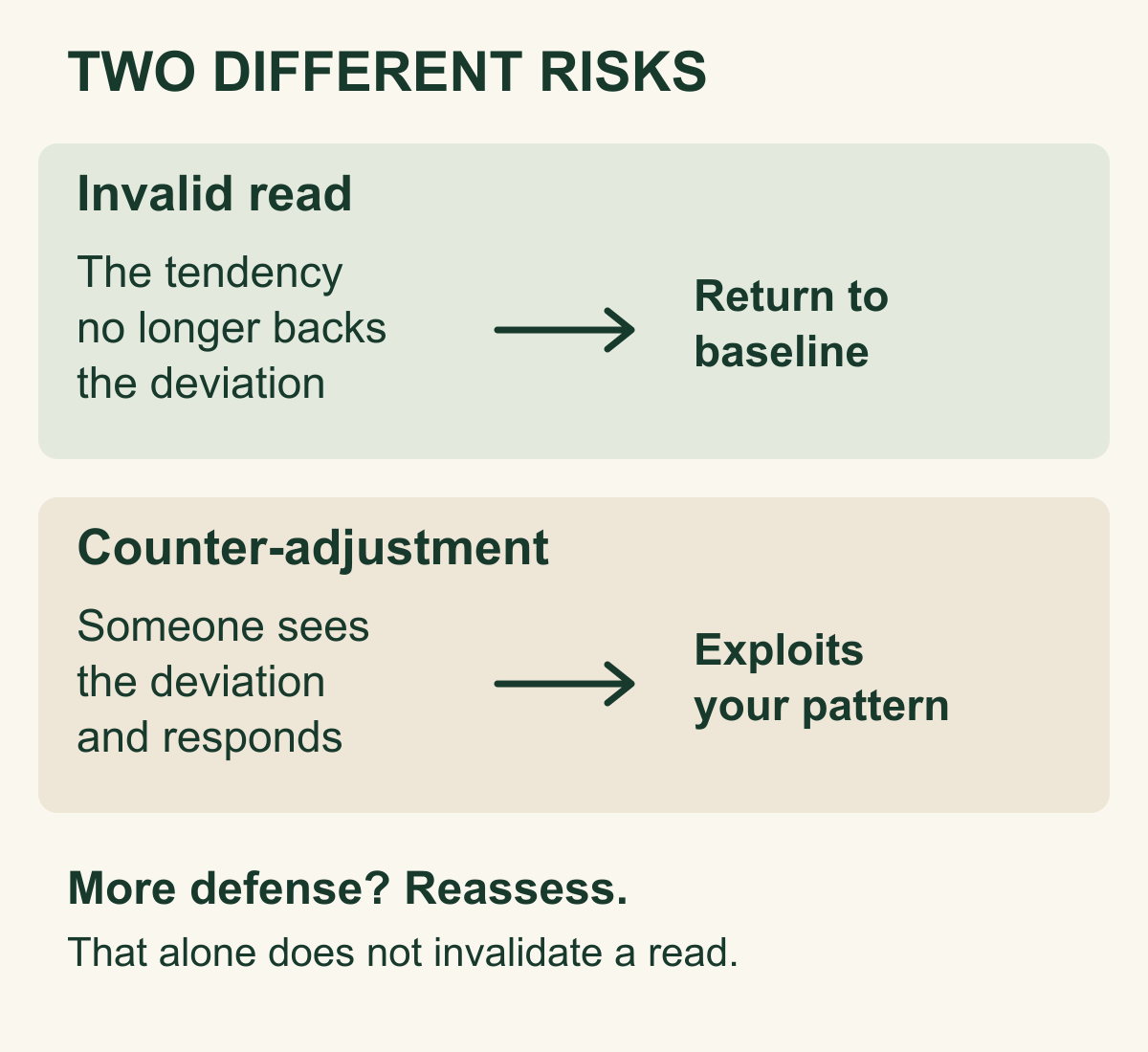
A read may be wrong or no longer apply; in that case, reduce or abandon the adjustment that depended on it. Alternatively, an opponent may notice your change and respond to exploit it: that is a counter-adjustment. More defense alone calls for reassessment, but does not prove that the read has stopped holding or that someone is counter-adjusting [1][2].
When Reviewing the Session
During review, note the opponent’s repeated behavior, the adjustment you made, and whether it remained appropriate on later occasions.
To go further, connect these actions to the hands the opponent could hold. The article on poker hand ranges explains how to organize that read using position and previous actions.
Recommended reading
- Poker Hand Ranges: Reading and Making Decisions in Context
- Playing in Position in Poker: Information and Post-Flop Decisions
- Heads-Up Poker Strategy: Decisions by Position, Stack, and Opponent
Sources
- [1] Exploitative Play in Poker: When Deviating From GTO Is the Right Call — PokerSkill
- [2] Exploitative Texas Hold'em Poker Strategy Explained — Bodog, published July 7, 2026
- [3] How to Exploit Loose Poker Players Preflop — Upswing Poker, published April 1, 2022
 1 hour ago