

A tell is a behavioral clue that may suggest whether someone’s hand is strong or weak [1]. It only helps when you treat it as a hypothesis. Separate what you saw from what you concluded, compare the signal with that player’s usual behavior, and look for alternative explanations. Only then use the signal to supplement your read of the game, alongside the action and the range. An isolated gesture or response time does not support a decision [1][3].
The channel changes, but the logic behind the read remains the same. Live, signals tend to be physical or verbal, such as facial expressions, gestures, and behavioral patterns. Online, without physical contact, they appear mainly in action timing, betting patterns, and other behavioral details [1]. In both settings, the useful question is not “What does this gesture mean?” It is “What changed compared with what this player usually does, and what other explanations fit what I saw?”
Online, behavioral information may serve as a tiebreaker when you are unsure about a hand [2]. To use it, start with the action and the range: technical and strategic skill remains the basis of decisions, and observing tells adds information to that read [3].
How Poker Tells Work: From Observation to a Read
The first layer is observation: what anyone at the table could confirm, such as “called instantly,” “took longer than usual before acting,” or “changed the bet size.” The second is interpretation: “doesn’t want to call,” “has a strong hand,” “wants me to call.” The observation is evidence. The interpretation is a hypothesis that still needs more evidence. Keeping the two separate prevents an impression from becoming a certainty too soon; the article on separating what you observe from what you assume explores this habit in more depth.
The table shows what each channel tends to offer and why observation alone still does not establish a read.
| Channel | What tends to appear | Alternative to consider |
|---|---|---|
| Live | Facial expressions, gestures, behavior, and speech [1][3] | Acting: deliberately showing nervousness [1] or feigning hesitation to appear weak [3] |
| Online | Action timing and betting patterns, including changes in sizing [1] | An easy decision behind an instant response; deliberately varying action timing; disconnection used as a tactic [1] |
In each setting, use the last column to test your initial read. If the same behavior allows another explanation, keep both hypotheses and look for an observation that helps distinguish them.
Usual Behavior, Changes, and Alternatives
Usual behavior. An isolated tell does not mean much, but repeated behavior may indicate a tendency [1]. That is why the comparison begins with what this player usually does in similar situations: pace of action, bet sizes, and behavior in previous hands. For a signal to inform a decision, it is essential to know your opponent and follow every play, rather than relying on the outcome of a single hand [3]. The reference point comes from actions you have already seen, not impressions of who the person is.
Change. Once you have a baseline, you can see what departs from it. A player who usually thinks for a long time and suddenly bets quickly may be acting without really considering the play, suggesting a weak hand or bluff to investigate. Abrupt sizing changes are also clues to investigate [1]. Compare the usual choice with that specific action; recognizing a change requires knowing the opponent’s prior pattern [3].
Alternative explanations. Before interpreting, ask what else could explain what you saw. Online, an instant response may simply indicate an easy decision [1]. The card that just appeared and the type of action also affect the read. Betting, raising, and merely calling are different decisions; record which occurred instead of grouping them all as “acted quickly.” Timing can also be varied deliberately [1][2]. Use these alternatives to test your initial guess.
Action and range. Finally, the signal supplements your read of the game rather than serving as its sole basis [1]. Before weighing the gesture or timing, ask what the action itself already shows and which hands, strong or bluffs, fit it. A check-raise, for example, may indicate strength, but some players use it to bluff; and someone who bets or raises all the time may be applying pressure with bluffs [1]. Betting behavior is only one part of the information [2]. To see how checks and calls contribute to hand reading, the article on capped ranges goes deeper.
Distinguishing Speed, Action, and Acting
Speed admits different readings depending on the action and setting. Online, an instant response may reflect an easy decision or a very strong hand; a sudden bet from someone who usually thinks for a long time may suggest weakness or a bluff [1]. In the live quick-call example, the hypothesis is insufficient strength to take the initiative [3]. These observations concern different situations: record the setting, action, and usual pattern before assigning hand strength.
Speed does not provide a measured probability. A quick bet and a quick call do not necessarily convey the same information. Hilger associates quick bets and raises on the turn and river with strength, but the author citing him questions that reading [2]. This disagreement affects how to use the signal: the association should not be treated as a decision rule. Progress comes from testing the hypothesis against observed actions and alternative explanations.
Deliberate signals. Nervousness displayed live and varied action timing online can be performed deliberately [1]. An unusual delay, even on a simple play, may reflect an inexperienced player’s actual difficulty or someone with a strong hand trying to appear weak [3]. Players may also fake disconnections to induce smaller bets [1]. Before giving the impression weight, compare it with the established pattern and see whether it repeats consistently [1].
The same caution applies to emotional labels. Nervousness, for example, can also be displayed deliberately [1], so an isolated behavior is not enough to label another player’s state. Your own emotional state, meanwhile, is the subject of the article on tilt in poker.
Example: Two Quick Calls After a Continuation Bet
Start with what you would record in a review: the same opponent called quickly on two consecutive streets. In GipsyTeam’s live example, the first call was against the aggressor’s continuation bet on a flop that allowed straight draws. The second was on the turn. The author reads the pace as consistent with someone who wants to stay in the hand without having the strength to take the initiative [3]. To use this situation, separate that guess from what the action confirms: there were two calls. What remains unknown is whether this opponent usually acts the same way in similar situations.
Apply the method to the situation, starting with the two recorded actions. Then consider what information would change your read.
| Step | Question | In this case |
|---|---|---|
| 1. Observation | What can be confirmed? | Two consecutive quick calls, on the flop and turn, after your c-bet. |
| 2. Interpretation | What read does the example suggest? | The player may want to continue with a hand they consider weak. Keep this as a hypothesis [3]. |
| 3. Usual behavior | Do they call this way in similar situations? | This is the information the situation alone does not provide. Without it, the read remains a hypothesis [3]; with it, you can see whether there was a change, as with a player who usually thinks for a long time and starts acting quickly [1]. |
| 4. Alternatives | What else explains it? | A strong hand presented as weak to avoid driving opponents out of the pot [3]. |
| 5. Action and range | What does the line played tell you? | The two consecutive calls are the action in the hand; speed supplements your read of the game rather than serving as its sole basis [1]. The same call can come from a weak hand or a disguised strong hand (step 4), and only what you know about the opponent helps you weigh the two hypotheses [3]. |
| 6. Use | What should you do with the read? | Keep it as a hypothesis and test it in subsequent hands, without deciding solely on that basis. |
The direction of the read depends on step 3. If this opponent usually calls quickly in similar spots, the speed does not depart from their usual behavior, and there is no change to interpret. If they usually think for a long time before calling, the haste is a change and deserves attention, but speed receives opposing interpretations depending on the channel and the situation, as the previous section showed. That is why the hypothesis “they don’t have a strong hand” only gains weight if the behavior repeats in other hands [1] and the alternatives in step 4 do not hold up.
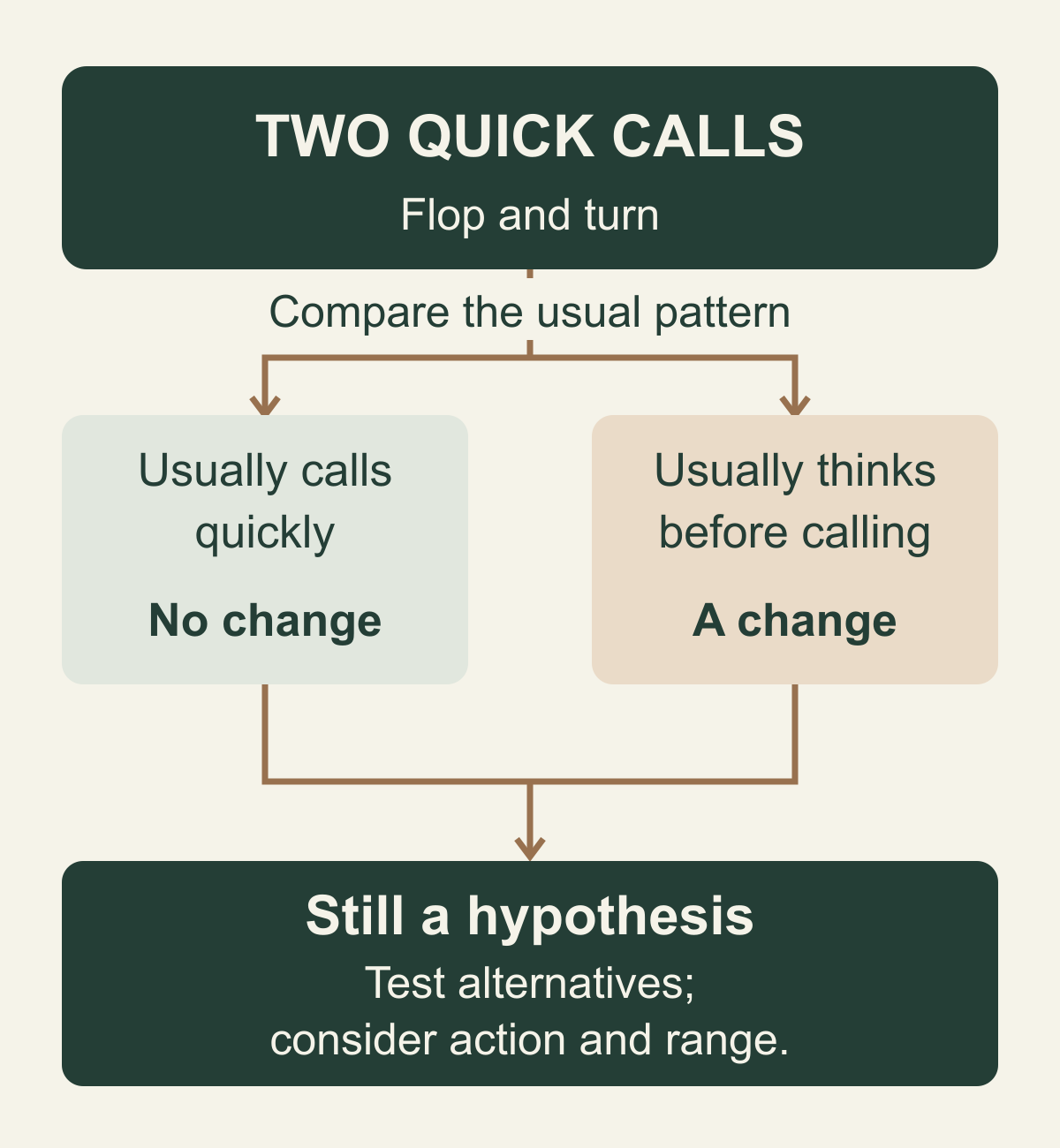
The example teaches a sequence of questions, not a verdict: the signal loses weight whenever a plausible alternative remains.
Next Step: Turn the Signal into a Hypothesis You Can Revise
In your next session, choose an opponent and start with their usual behavior. Record each observation in neutral terms (“called instantly,” “started varying the sizing”), keep the interpretation separate, and revisit it in subsequent hands. Follow every play and analyze each hand before becoming convinced: repetition may reveal a tendency [1][3]. Live, the time you spend waiting for your turn also lets you observe how each player reacts [3].
Reading works both ways: others also observe you. Adopting a consistent routine for looking at your cards helps reduce the chance of giving away tells [3].
Recommended reading
- Tips for Playing Poker: Basic Decisions and Common Mistakes for Beginners
- Capped Ranges in Poker: Limits and Uncertainty in Hand Reading
- Tilt in Poker: How to Recognize the Signs and Take a Break
Sources
- [1] Online and Live Poker Tells: Signals That Can Give Your Opponents Away — GGPoker, published March 31, 2025
- [2] Tells (Clues) in Online Poker — PokerStrategy, published July 7, 2026
- [3] Poker Tells Made Practical and Simple — GipsyTeam, published January 10, 2023
 3 hours ago