Tilt in Poker: When Emotion Steers Decisions Away from the Plan
Tilt is what happens when emotions start to harm your decisions. Most of the time, the emotion is anger, but the definition also includes euphoria and boredom, which likewise lead to mistakes and poor plays [1]. What reveals tilt is not your session balance, but a change in how you make decisions. Are you calling, betting, or staying at the table in a way you would not choose with a clear head, straying from the plan you had when you started?
If the answer is yes and you notice anger, euphoria, or boredom behind the choice, take a break or end the session and leave the analysis for later, away from the table [1]. Distinguish a bad outcome from a technical mistake and an emotion-driven decision before choosing how to respond.
How Tilt in Poker Steers Decisions Off Course: Signs and Triggers
Frustration or confusion can pull you toward a worse strategy. One way this can show up is playing more aggressively than you would with a clear head [3].
In practice, this departure shows up in decisions you would not make with a clear head. When you tilt, you may overestimate your hands, ignore signs of strength from an opponent, force marginal situations, call bets they would normally fold to, and bluff without a real chance of getting the opponent to fold [2]. Each individual decision may seem small; the damage comes from their combined effect. Online poker lacks external restraints: you play alone, away from other players’ eyes, and playing several tables at once magnifies the impact of each mistake. That is why tilt tends to be less noticeable and grow more quickly. It is also possible to play dozens of hands on tilt before recognizing the pattern [2].
Signs to Watch for in Yourself
Because emotion can go unnoticed, it helps to monitor your behavior. These are signs described in guides on the subject:
- wanting to move up in stakes “to recover quickly,” impulsively opening extra tables, thinking “just one more table” or “just until I win it back,” and continuing to play well past your planned stopping time [2];
- forcing the action, taking big risks, going all-in with a weak hand, or insisting on playing when you know you should stop [1];
- faster breathing, a physical sign that may accompany the state [2].
All of these are warning signs, not plans to follow. The list is there to help you observe your own play: a single sign does not prove tilt, and none of them lets you determine another person’s emotional state at the table or serves as a diagnosis.
Common Triggers
A trigger is the situation that sets off the emotion. Some arise within the game: losing many games in a row, bubbling a tournament (finishing one place short of the money), playing a game that is very important to you, or being on your way to an incredible win [1]. Others include a series of bad beats (losses with hands that were well ahead), excessive multi-tabling, an unstable connection with delays, and comparing yourself with other players’ results [2]. Still others come from outside the game or from the pace of the session: playing for hours without a break and bringing losses, fatigue, or everyday stress to the table [2]. The list is a starting point. The goal is to discover which of these triggers affect you [1].
Tilt, a Bad Outcome, and a Technical Knowledge Gap: How to Tell Them Apart
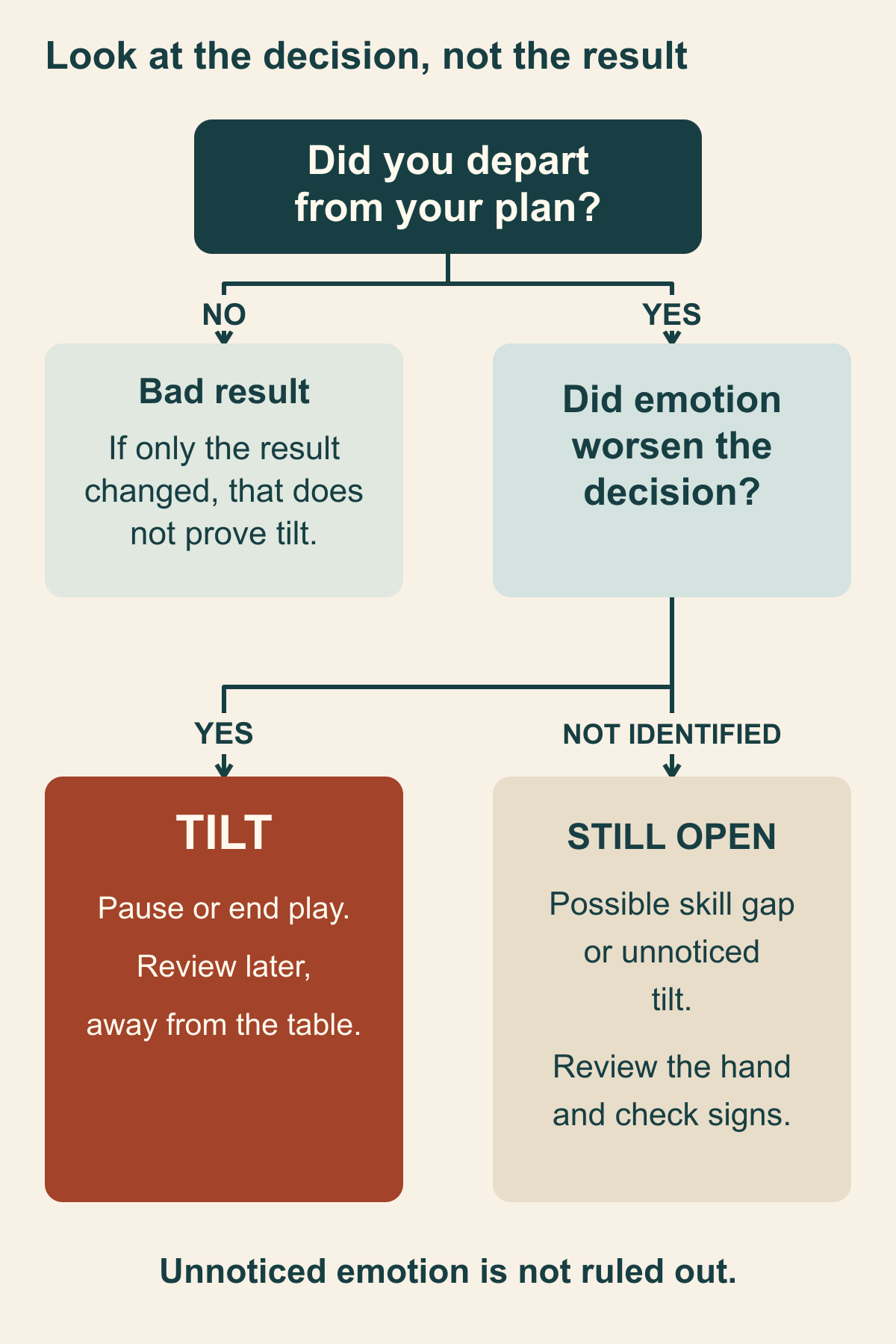
Before calling a bad session tilt, ask two questions about the decision, not the balance. Did the choice depart from the plan you would have followed with a clear head? And was anger, euphoria, or boredom influencing it? Tilt requires both: the decision changed, and emotion made it worse [1]. In the moment, however, emotion can go unnoticed [2], so “I didn’t notice it” is not the same as “it wasn’t there.” The other combinations have different names.
Bad outcome. The decision followed the plan, and only the outcome was bad. Losing an all-in when you were the favorite can trigger anger [1], but the trigger is not the departure from your plan: that departure only begins when emotion changes how you make decisions afterward. Assessing your play by the quality of your decisions, rather than just your session balance, is the criterion GipsyTeam recommends for maintaining discipline even during a losing streak [2].
Technical knowledge gap. Playing poorly does not prove tilt. A poorly played hand, or an unusual choice made on instinct, may stem from a knowledge gap [1]. If the decision departed from the plan and you cannot identify anger, euphoria, or boredom behind it, a technical knowledge gap is a possibility to investigate by reviewing the hand after the session, not a conclusion. Because tilt can go unnoticed [2], also check the behavioral signs listed above before ruling it out. If your uncertainty is, for example, about when to bet or check on the flop, the article on continuation bets: when to bet or check addresses that very decision.
Tilt. The decision departed from the plan, and emotion influenced it: this is what the definition describes—emotion negatively affecting the decision [1].
The categories can lead into one another. A lapse in focus causes a mistake; if it provokes an angry response, tilt follows, and further mistakes feed the cycle. PokerStars calls this mistake tilt and suggests developing a routine for analyzing decisions away from the tables [1]. The same guide organizes tilt into several types, such as mistake tilt, hate-losing tilt, and desperation tilt. These are editorial labels for thinking about causes, not a clinical classification or a diagnosis, and the two-question test works without them.
Three Situations in Practice: Interpretation and Response
The three situations below are illustrative. The starting point in rows 1 and 3, losing an all-in as the favorite, is the scenario cited in [1]. The interpretation of each row depends on what changed in the decision and what influenced it, not on what happened in the hand.
| Situation | Did the decision depart from the plan? | Did emotion influence the choice? | Interpretation | Response |
|---|---|---|---|---|
| You lost an all-in in which you were the favorite, and your subsequent decisions remain the ones you would make with a clear head | No | No (irritation, if present, did not change the choice) | Bad outcome | There is no departure from the plan to correct; the balance alone is not tilt [1][2] |
| You made an unusual choice and cannot identify anger, euphoria, or boredom behind it | Yes | Not identified | Unresolved: a possible technical knowledge gap or unnoticed tilt | Record the hand, review it away from the table, and check the behavioral signs; the review investigates rather than delivering a verdict [1][2] |
| After the same loss, you start calling bets you would normally fold to and think “just until I win it back” | Yes | Yes | Tilt | Take a break or end the session and review later [1][2] |
When the same session includes more than one row, start with the emotional sign. Take a break first and analyze the technical mistake later, away from the table [1].
Taking a Break or Ending the Session and Reviewing Away from the Table: The Next Step
Once you step away, pick a decision that felt different from what you would have chosen with a clear head. Reviewing that decision gives you a better starting point than the session balance [2]. You can end the session there [1].
Use your session notes to look for recurring situations [2]. If your first thought is to raise the stakes or find a faster game to win back losses, treat that impulse as a reason to end the session [1].
Decide what stopping means before you sit down. Loss and time limits chosen with a clear head prevent tilt from making those decisions for you [2], and the same logic applies to the signs on your personal list. How to set your limits and which stakes to play are covered in cash game bankroll management.
Reviewing Away from the Table in Four Steps
- Record the basics of the session: time, result, and emotional state. Include outside factors, such as fatigue, financial worries, or stress from the day [2].
- Mark where the decision departed from the plan. To describe each hand without mixing what you observed with what you merely assumed, the article on reviewing decisions in tips for playing poker can help. Recording the situations in which your history shows more mistakes is a simple way to map patterns [2].
- For each marked decision, ask whether emotion was influencing it. With anger, euphoria, or boredom involved in the choice, the interpretation is tilt, and the focus shifts to breaks and triggers. Without an identified emotion, treat it as a possible technical knowledge gap to investigate: review the decision away from the table and strengthen your knowledge of the game [1]. This does not rule out unnoticed tilt, so also check the behavioral signs [2]. Hands in which you followed the plan and only the outcome was bad stay off the list of departures; things do not always go as expected even when the odds are in your favor [1].
- Build your tilt profile by answering four questions: What makes you go on tilt? How do your body and mind react? When do you lose control and let emotions take over? How do you deal with it now? Understanding tilt in relation to yourself as a person and a player is a better approach than quick fixes that do not address the causes [1].
Recommended reading
- Poker cash game bankroll management: choose stakes and know when to stop
- Tips for Playing Poker: Basic Decisions and Common Mistakes for Beginners
- Continuation Bet: When to Bet or Check
Sources
- [1] What Is Tilt in Poker and How Can You Avoid It? — PokerStars (published May 9, 2024)
- [2] Tilt in Online Poker: How to Recognize and Control It — GipsyTeam (published July 12, 2022)
- [3] Tilt Management 101 — Raise Your Edge (published February 17, 2022)

 2 hours ago