Badugi Poker: Three Draws and How to Compare Hands
Badugi is a poker game with four hole cards and three opportunities to draw. To compare hands, first count the cards that can be used without repeating a rank or suit. Between hands with the same valid card count, compare ranks from highest to lowest: the lower rank at the first difference wins.
Among poker variants, Badugi requires a fundamental distinction: being dealt four cards does not mean you have four valid cards for hand evaluation. There are no community cards. Each player receives their own cards, takes part in betting, and can replace cards during the draws. [3]
Example: A Four-High Badugi Against a Five-High Badugi
The World Poker Federation compares 4-3-2-A with 5-4-3-2, each with four different ranks and four different suits. Since both have four valid cards, compare their highest card: 4 is lower than 5, so the four-high badugi beats the five-high badugi.
The first hand is also the best possible hand, called the nut Badugi: A-2-3-4, each card of a different suit. Straights do not hurt the hand. [2]
Badugi Poker: Dealing, Betting, and Three Draws
The game uses a standard 52-card deck. Each player receives four cards face down, and the first betting round takes place before any draw. At a table with three or more players, the initial action starts to the left of the big blind and proceeds clockwise.
When a player faces an amount to match, call means adding the difference between that amount and the chips already committed in the current round. Raise increases the amount to match; fold means giving up the hand.
Why Are There Three Draws but Four Betting Rounds?
A hand that reaches the final betting round follows the sequence below: one betting round before the first draw, then another after each of the three draws.
| Stage | What Happens |
|---|---|
| First betting round | Players act with the cards they were dealt, before any draw. |
| First draw | Each player still in the hand can replace cards or keep them all. |
| Second betting round | Betting takes place after the first draw. |
| Second draw | There is another opportunity to replace cards or keep the hand. |
| Third betting round | Betting takes place after the second draw, before the final draw. |
| Third draw | The last opportunity to replace cards. |
| Fourth betting round | The final round, after the third draw. |
If two or more players remain after the fourth betting round, the showdown compares their hands. If everyone except one player folds during betting, that player wins the pot without a showdown; the remaining draws and betting rounds do not need to take place. [1]
What Does Stand Pat Mean?
On each draw, a player can replace zero to four cards, receiving a new card for each one discarded. Stand pat means replacing none; the betting rounds continue normally. Keeping the cards does not, by itself, show that the hand is a complete badugi. [1]
How Does Fixed Limit Fit Into This Sequence?
Badugi is commonly played with a fixed-limit (Limit) structure. In the structure described, the first two rounds use the small bet; the third and fourth use the big bet, usually twice the smaller amount. These are the betting amounts for each round, distinct from the names of the blinds (small blind and big blind). [1]
How to Compare Hands: Valid Card Count Before Ranks
First, Determine How Many Cards Actually Count
Select the largest set of cards without repeating a rank or suit. Four valid cards form a badugi. The order of strength is four > three > two > one valid card, regardless of ranks.
A “three-card hand” still contains four physical cards, but only three count in the comparison. Excluding a card from evaluation is not the same as discarding it during a draw.
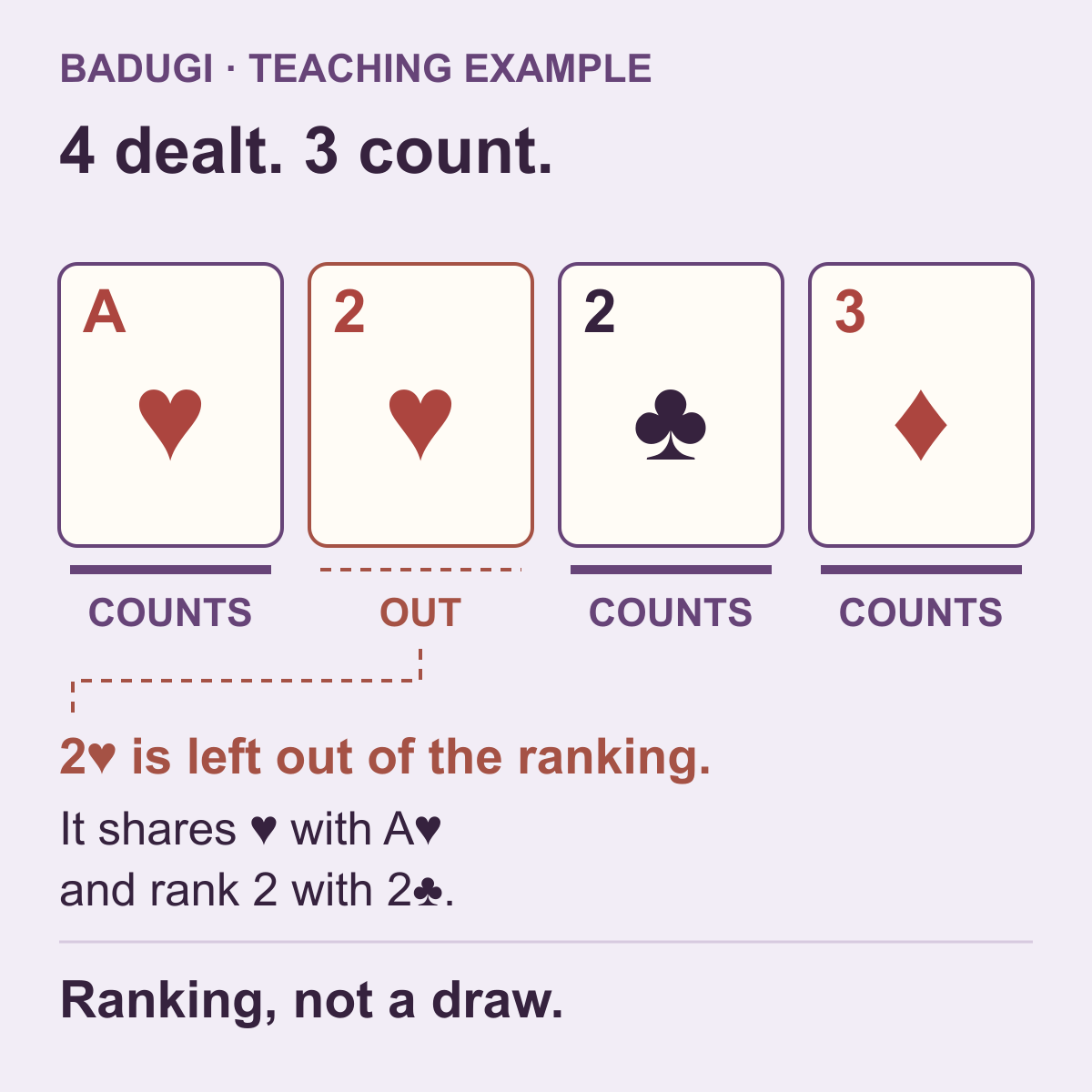
If more than one valid set has the same card count, choose the one that makes the lowest hand under the following comparison.
Then, Compare From the Highest Card to the Lowest
When the valid card counts are equal, compare from highest to lowest. The lower card at the first differing position wins. The ace is low. This procedure applies to both complete badugis and incomplete hands with equal valid card counts.
If all compared ranks are equal, the hands tie. Neither suits nor excluded cards provide a tiebreaker. [1]
Why Do Traditional Hand Rankings Not Apply?
Unlike the poker hand rankings used in high-hand games, Badugi is a lowball variant with its own four-card evaluation system. Neither high-hand rankings nor five-card lowball rankings apply. [1]
Comparing With Texas Hold’em
The explanation of kickers and splitting the pot shows how to resolve ties in Texas Hold’em, a variant with different comparison rules.
Recommended reading
- What Is Poker? Understand the Game and Its Basic Concepts
- Poker Hand Rankings: From Strongest to Weakest
- Kicker in Poker: Guide to Tiebreakers and Splitting the Pot
Sources
- [1] Badugi — Wikipedia
- [2] How to Play Badugi — World Poker Federation. Published on January 31, 2024.
- [3] Badugi Poker Rules | Learn How to Play Badugi — PokerNews

 20 hours ago