Poker Hand Rankings: From Strongest to Weakest

By the Editorial Team
From strongest to weakest, the order runs from royal flush to high card. To determine which hand wins, identify the category of the best five-card combination; if the categories are the same, apply that hand’s specific comparison criteria. Having the same type of hand does not necessarily mean a tie. [1][2]
This order applies to games in which the highest hand wins, using a standard 52-card deck without wild cards, such as Texas Hold'em. It guides comparisons at showdown, when hands are compared. Choosing which cards to play before the flop is a separate decision: the ranking below is not a preflop hand selection chart. [3]
Poker Hands Ranked from Strongest to Weakest: Complete Table
The table shows the ten usual ranks, with royal flush listed separately from straight flush. Each hand beats the categories below it. The tiebreaking criteria within each category appear after the example. [1][3]
| Rank | Hand | How to Recognize It |
|---|---|---|
| 1 | Royal flush | A, K, Q, J, and 10, all of the same suit. |
| 2 | Straight flush | Five cards of consecutive ranks, all of the same suit. |
| 3 | Four of a kind | Four cards of the same rank, accompanied by a fifth card. |
| 4 | Full house | Three cards of one rank and two cards of another rank: three of a kind and a pair. |
| 5 | Flush | Five cards of the same suit that do not form a straight. |
| 6 | Straight | Five cards of consecutive ranks that are not all of the same suit. |
| 7 | Three of a kind | Three cards of the same rank, with two other cards that do not form a pair. |
| 8 | Two pair | Two pairs of different ranks, plus one unpaired card. |
| 9 | One pair | Two cards of the same rank, plus three cards whose ranks differ from one another and from the pair. |
| 10 | High card | Five cards that do not form any of the combinations above. |
On the cards, A stands for ace, K for king, Q for queen, and J for jack. The symbols ♠, ♥, ♦, and ♣ correspond to spades, hearts, diamonds, and clubs, respectively. Rank and suit are different characteristics: one identifies the card’s value; the other identifies its symbol group. [1][3]
Example: A Full House Against a Flush
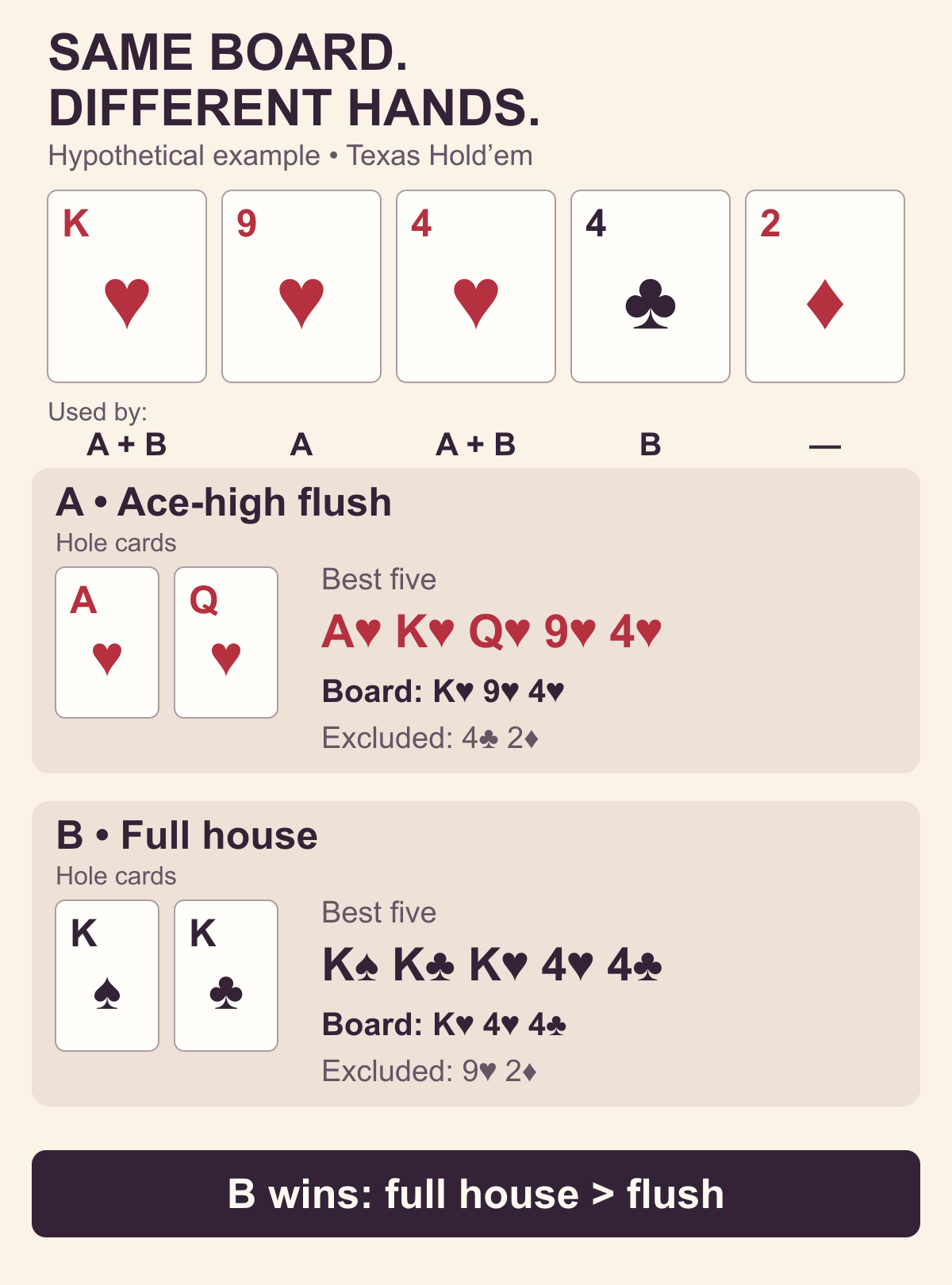
Hypothetical example: at a Texas Hold'em showdown, the board is K♥ 9♥ 4♥ 4♣ 2♦. Player A holds A♥ Q♥, and Player B holds K♠ K♣.
| Player | Best Five Cards | Category |
|---|---|---|
| A | A♥ K♥ Q♥ 9♥ 4♥ | Ace-high flush |
| B | K♠ K♣ K♥ 4♥ 4♣ | Full house, kings full of fours |
A has five hearts and makes a flush with an ace as the highest card. B has three kings and two fours, making a full house. B is the winner: the ace in the flush does not beat the higher category. Comparing that ace directly with one of B’s kings would ignore the first step of the evaluation.
Also notice which cards are left out. A does not use 4♣ or 2♦; B does not use 9♥ or 2♦. Each player selects their own best five from the available cards. Sharing the board does not require both players to use the same set of community cards.
How to Compare the Best Five Cards
The hand being evaluated contains five cards; a sixth card cannot break a tie. In Texas Hold'em, those five may all come from the board, without using either hole card. If the board is the best combination for every player who reaches showdown, they split the pot. [1][3]
Compare the category first. Within a category, follow the order below; suits do not break ties. A kicker is a side card compared when the main group matches. [2][3]
Straights and Straight Flushes: Compare the Top Card
Between two straights, compare the highest card in each combination. All five cards are already part of the straight, so there is no side card to decide the result. If both have the same highest rank, they tie; the suit provides no additional advantage. [2][3]
A straight flush must meet both the sequence and suit requirements: all five cards must be consecutive and belong to the same suit. Between two straight flushes, the one ending in the higher card also wins. A royal flush is the highest version of this combination, running from ten to ace in a single suit. No hand beats it in the standard rankings; if two players have a royal flush, the pot is split. [2][3]
Flush: Matching Top Cards Do Not End the Comparison
For a flush, compare the five cards from highest to lowest. The first difference determines the winning hand; if the highest cards match, the comparison continues with the next card. This is why two flushes described as “ace-high” can still differ in strength. Having an ace does not remove the need to check the other four cards. [2]
Four of a Kind and Full House: The Matching Group Comes First
For four of a kind, first compare the rank of the four matching cards. If the four of a kind ties, compare the fifth card in the best hand; if that also matches, the hands tie. This fifth card is the kicker, a tiebreaking card that is compared only after the main group ties. [2][3]
For a full house, the comparison starts with the three of a kind. The pair only comes into play if the three of a kind matches. Therefore, a higher pair does not make up for a lower three of a kind, and looking only for the highest card in the hand is not enough to compare two full houses. Since the three of a kind and the pair occupy all five cards, there is no kicker: if both groups match in rank, the hands tie. [1][2][3]
Three of a Kind, Two Pair, and One Pair: Follow the Order of the Groups
Two three-of-a-kind hands are compared first by the rank of the three matching cards. If that rank is the same, the remaining cards in the best five-card combination come into play. For two pair, the order is different: compare the higher pair, then the other pair, and only if both pairs match, the fifth card. [1][2]
There is also no “three pair” category. A third pair cannot be added to the other two in the final hand, because that would require six cards. You still need to select the best five-card combination; counting every available group does not change that limit. [3]
In a comparison between one-pair hands, the higher pair wins. If the pairs match, compare the unpaired cards that complete the hand in descending order. Matching on the first of those cards is not enough to split the pot: the others may still differ. Kickers come into play in categories with cards outside the main combination, once that combination has tied. They do not replace the specific criteria for a straight or a full house. [2][3]
High Card: The Name Does Not Mean Comparing Just One Card
A hand is classified as high card when it does not form any of the combinations above. Compare the cards from highest to lowest: if the top cards match, move to the second, then the third, and continue until you find a difference or finish all five. There is a tie only when the hands belong to the same category and all five ranks match. [2][3]
The Limits of the Rankings: Aces, Hand Formation, and Variants
When the Ace Acts as a Low Card
The ace normally counts as a high card. The exception is when it appears at the low end of the A–2–3–4–5 straight. In that combination, the top card is the five. A straight cannot wrap around from king to ace and continue to two: the ace can only appear at the permitted ends. This straight exception does not change its status as a high card in other comparisons. [2][3]
The Suit Can Change the Category
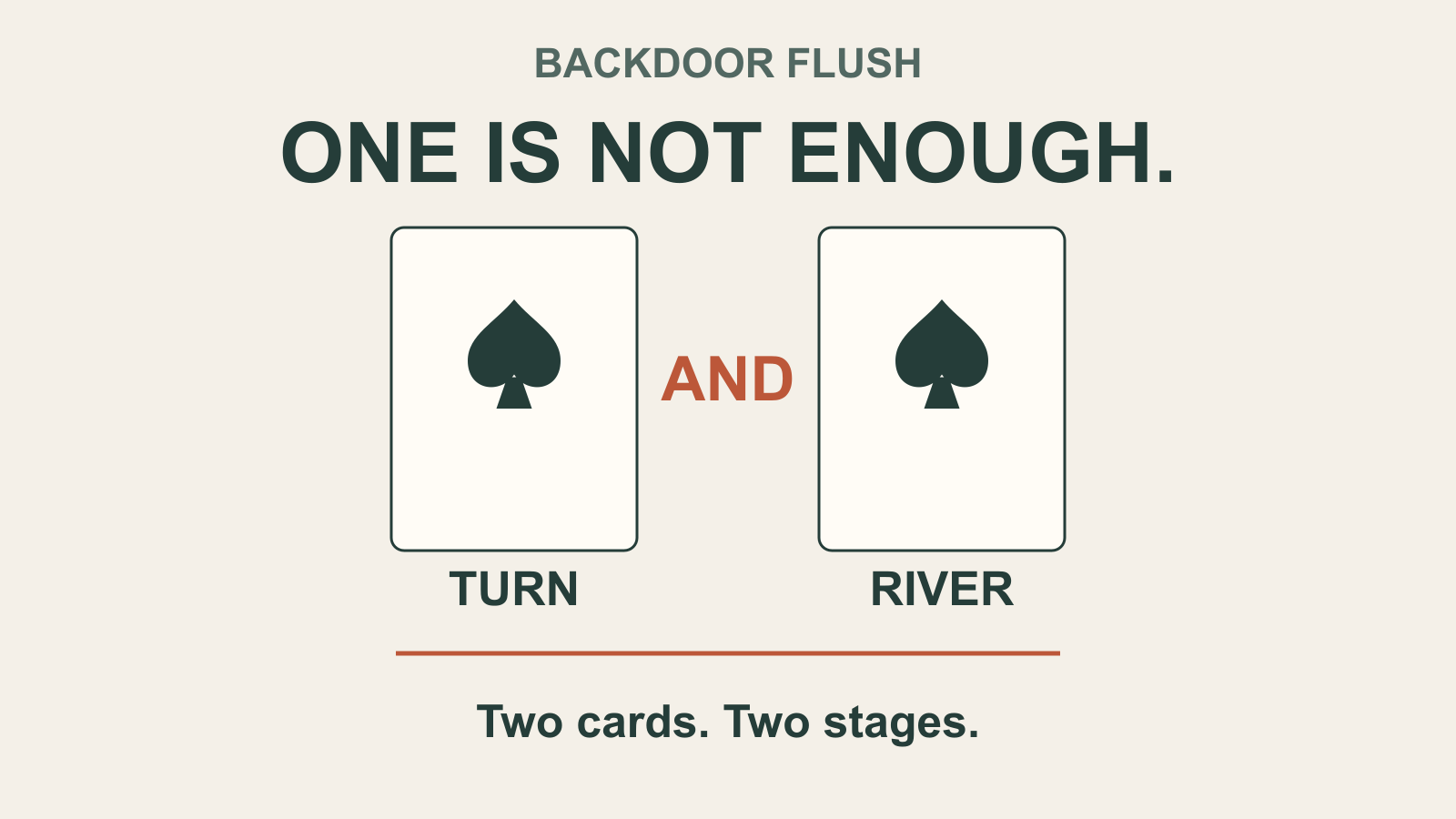
In Texas Hold'em, the board must contain at least three cards of the same suit for a player to be able to make a flush. This condition does not mean that any player already has a flush: the combination being evaluated still needs to contain five cards of that suit. [2]
The Variant May Require a Different Chart
This hierarchy is also used in Omaha, Five Card Draw, and Seven Card Stud, although hand-formation rules depend on the variant. Sharing the rankings does not make Texas Hold'em's card-use rules apply to those games. Short Deck, lowball, and wild-card games are outside this chart's scope. [2][3]
If you find a chart with nine categories, it may have included royal flush under straight flushes. The difference is in presentation: a royal flush remains the highest straight in a single suit. The ten-row listing simply highlights it separately. [3]
How to Use the Chart While Learning
Keep the chart nearby to check questions about categories as you learn. It lets you quickly confirm the order of the hands without relying solely on memory. [1][2]
 1 day ago