
The Independent Chip Model (ICM) converts a tournament player’s stack into an estimate of its monetary value, known as tournament equity. The calculation starts with two inputs: the stacks of the players still competing and the prize money still at stake [1]. Because payouts depend on finishing position, there is no fixed proportion between chips and monetary equity. The value of an increase in a stack also depends on the other stacks and the payouts [2].
Why this matters: ICM explains why gaining chips and losing chips do not carry equal weight in a tournament. Decisions that seem equivalent in chips can have different monetary values [1][2].
Example: What Happens to Chip Value in a US$100 SNG
To see the disproportion in a small calculation, consider a case published in [3]: a US$100 sit & go (SNG, a single-table tournament) with ten players and no rake. The total prize pool is 10 × US$100 = US$1,000, and only the top three finishers are paid: US$500 for 1st, US$300 for 2nd, and US$200 for 3rd. Each player starts with 100 chips, making 1,000 chips in total. With equal starting stacks, ICM estimates US$100 in prize-pool equity for each player: an average of US$1.00 in estimated equity per chip.
After five eliminations, five players remain with 200 chips each. The five eliminated players finished outside the three paid positions, so the full US$1,000 remains at stake. Under the model’s rule, each player’s chance of winning is 200 ÷ 1,000, or one-fifth [1]. Because all five stacks are equal, the model assigns each player the same estimated equity in the remaining prize money, as shown in the table below. This does not change the payouts of US$500, US$300, and US$200.
In the end, one of them wins and holds all 1,000 chips, but receives only the first-place prize of US$500. The other US$500 went to 2nd and 3rd place (US$300 + US$200).
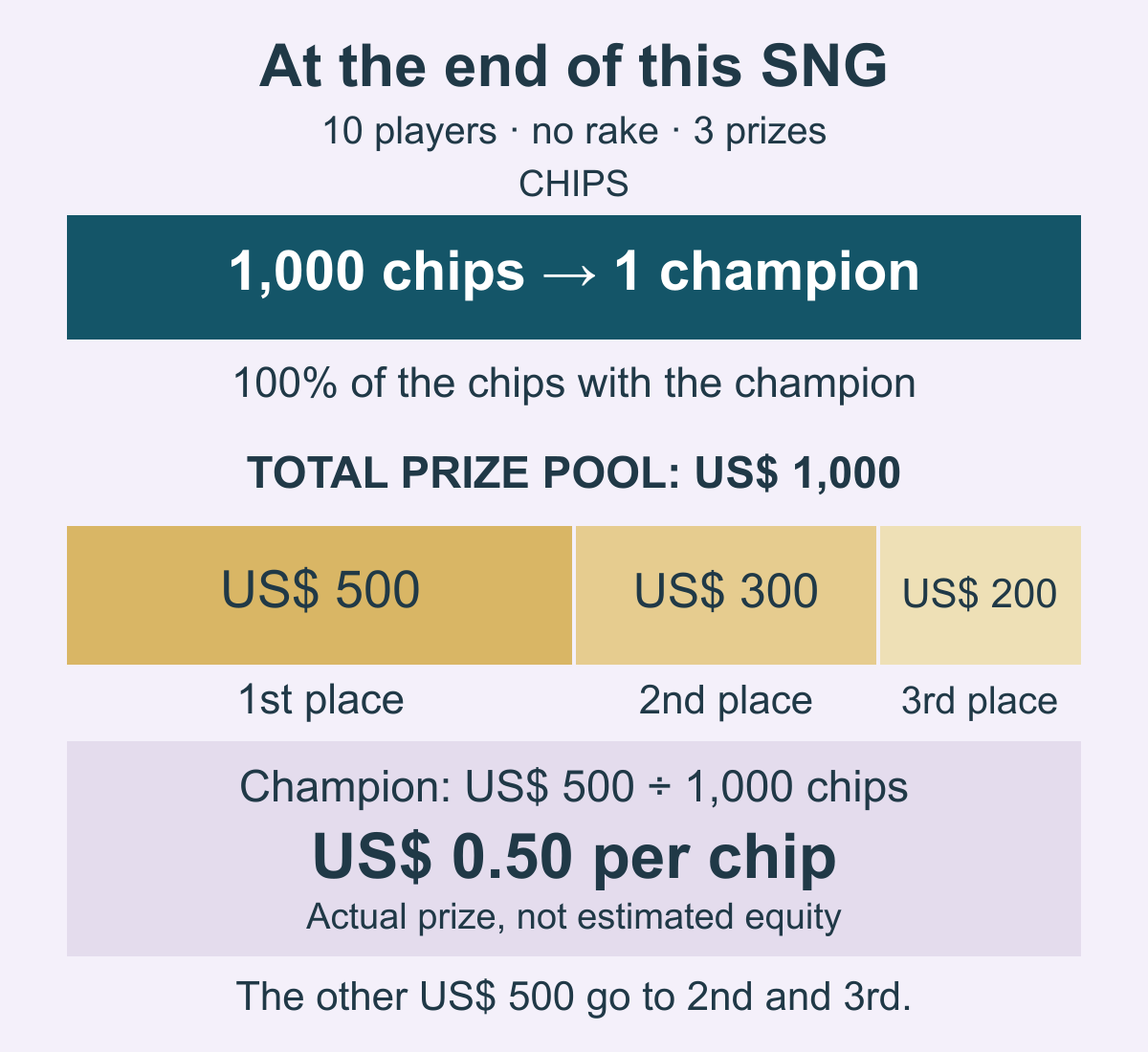
The first two rows show estimated equity; the last shows the champion’s actual payout.
| Stage of the SNG | Each player’s stack | Estimated equity / final payout | Average per chip: estimated equity / final payout |
|---|---|---|---|
| Start, ten players | 100 chips | US$100 (US$1,000 ÷ 10) | US$100 ÷ 100 = US$1.00 |
| Five players remaining | 200 chips | US$200 (US$1,000 ÷ 5) | US$200 ÷ 200 = US$1.00 |
| One player with all the chips | 1,000 chips | US$500 (first-place prize) | US$500 ÷ 1,000 = US$0.50 |
In this example, US$1.00 per chip is an average of estimated equity in the first two states, not a chip redemption rate [1][3].
What does this change in a decision? Calling an all-in can be profitable in chips yet lose monetary value, because elimination ends your opportunity to reach later pay jumps. ICM may therefore require more hand equity to justify a call: that increase over the chip-EV requirement is the extra requirement expressed by the risk premium [2].
How ICM in Poker Converts Stacks and Payouts into Equity
In a cash game, each chip retains its face value in money [1]. In a tournament, the buy-in does not buy chips with their own monetary value, but entry into a competition with a starting stack, a blind structure, and a payout structure. This difference in format creates the need for a model such as ICM [2].
The model combines the two inputs—the remaining stacks and the prize money still at stake—and assigns a single value to each player. Based on stack sizes, it calculates each player’s chances of finishing 1st, 2nd, 3rd, and so on, and multiplies those chances by the payout for each position. The result is not the payout for a specific finishing position, but a value for the entire stack that accounts for all possible finishing positions. For first place, ICM estimates the probability of winning by dividing the player’s chips by the total number of chips in play [1].
Why Chips and Money Do Not Change in the Same Proportion
Two concepts help here. Chip EV is expected value in chips: the net chip gain or loss from a decision. $EV is expected value in money; in a tournament, it depends on the payouts and the distribution of stacks. There is no linear relationship between the two. Twice the chip EV does not mean twice the $EV, and a play can gain more chips on average while still costing real money over a large sample of hands [1].
The payout structure, elimination risk, and stack distribution explain this difference. Gaining a given number of chips does not necessarily offset losing the same number in terms of prize-pool equity [2].
ICM’s Limits: What the Model Does Not Decide
ICM does not account for differences in player skill. Its estimate can inform a final-table deal negotiation, but does not by itself determine the final agreed payouts [1].
How to assess the pressure. Knowing whether your stack is big or short is not enough. Consider whether the opponent can eliminate you, whether there are even shorter stacks, and the size of the next pay jump [2].
Scope. This guide covers tournaments in which payouts depend on finishing position. Bounties, satellites, and winner-take-all formats are outside its scope, and nothing here should be extended to those formats.
Frequently Asked Questions
Does ICM Only Matter at the Bubble and the Final Table?
No. Thinking that ICM only comes into play near the bubble and at the final table is a common mistake. It plays a role from the start of the tournament, although it is particularly important in the later stages [1].
Are Bubble Factor and Risk Premium the Same Thing?
No. In the terms used by [2], bubble factor measures ICM pressure, while risk premium measures the strategic adjustment that pressure forces. Risk premium is the difference between the hand equity required under ICM and that required under chip EV in the same situation. One measure describes the pressure, and the other describes the adjustment it causes.
Next Step: How to Read Any ICM Number
Before interpreting an ICM number, check the inputs and what the result measures [1]:
- Who is still in the tournament, and how many chips do they have?
- What prize money is still at stake?
- Is the value expressed in chips (chip EV) or money ($EV)?
- At what stage and with what distribution of stacks was the calculation made? ICM pressure changes with these factors [2].
To look at the stack from other angles, the article on M ratio in poker measures the stack relative to the cost of blinds and antes. The article on short stack poker strategy covers decisions with few chips. Neither replaces an assessment of tournament equity, but both help put the stack in context before interpreting the number.
Recommended reading
- Buy-in in poker: what it means and how it differs between cash games and tournaments
- M Ratio in Poker: Stack, Cost per Orbit, and Calculation Limits
- Short Stack Poker Strategy: Decisions with Few Chips
Sources
- [1] What Is ICM in Poker? (EXPLAINED) | ICM Definition — PokerNews
- [2] ICM in Poker: Bubble Factor, Risk Premium, and Strategy — BBZ Poker (published on April 9, 2026)
- [3] Understand How ICM-Based Playing Strategy Works in Poker — GipsyTeam (published on February 1, 2023)

 1 hour ago