M Ratio in Poker: Stack, Cost per Orbit, and Calculation Limits
M Ratio in Poker in One Calculation: Stack Divided by the Cost of an Orbit
M compares your stack, the number of chips you have, with the mandatory cost of an orbit: one complete rotation of hands around the table. The formula is M = stack ÷ (small blind + big blind + total antes you pay per orbit). It therefore includes the antes left out of a big blind count. [1]
The calculation considers only those payments, with the current level’s structure held constant. It measures room to maneuver in orbits, rather than predicting your remaining time in the tournament or instructing you to go all-in. [2]
Example: 10,000 Chips, Blinds of 100/200, and an Ante of 10
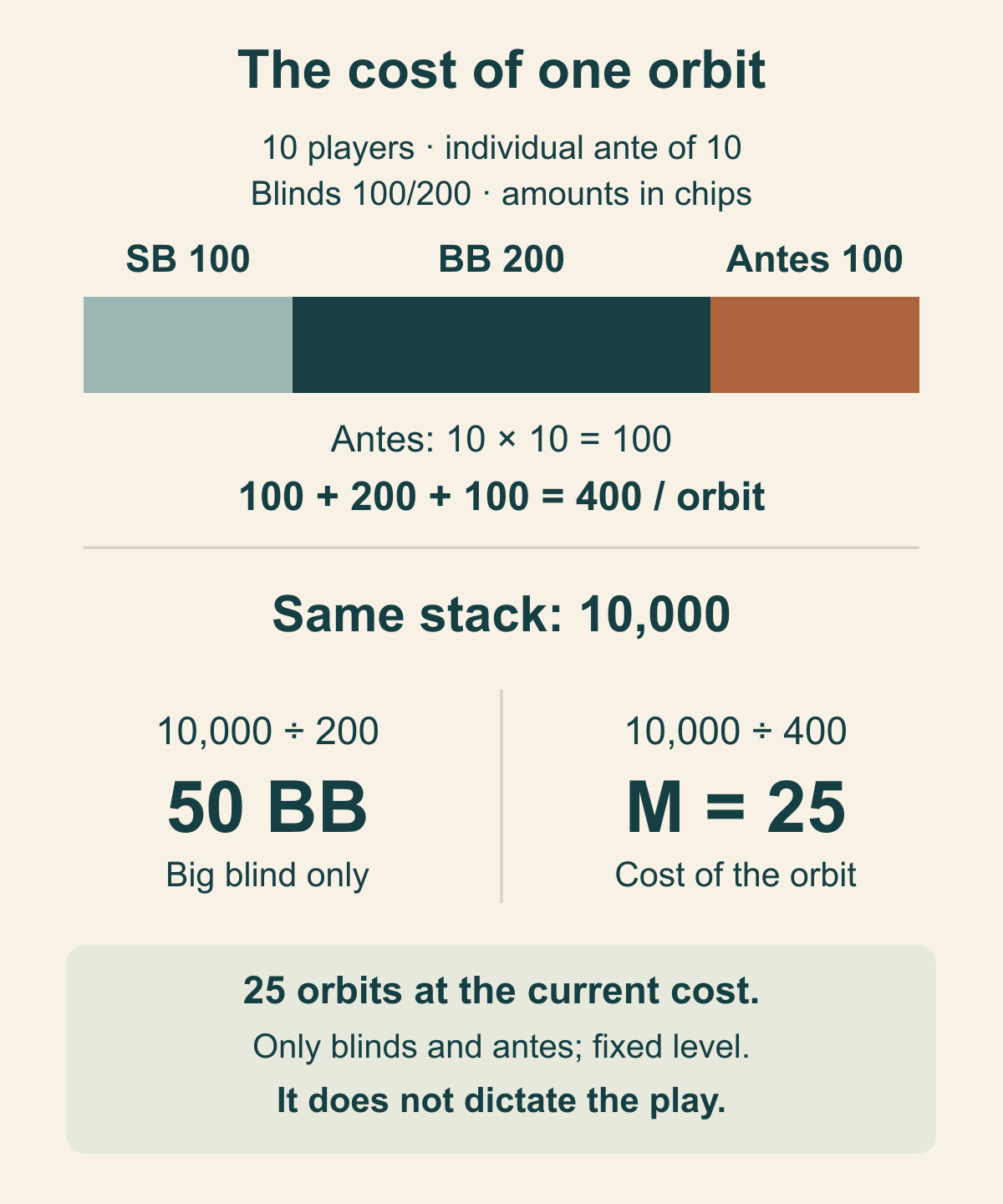
The Upswing Poker glossary gives this example: 10,000 chips, blinds of 100/200, an individual ante of 10, and 10 players at the table. [1]
| Orbit component | Chips |
|---|---|
| Small blind | 100 |
| Big blind | 200 |
| Antes: 10 payments × 10 | 100 |
| Cost per orbit | 400 |
M = 10,000 ÷ (100 + 200 + 10 × 10) = 10,000 ÷ 400 = 25. The stack covers 25 times the current cost of an orbit.
In big blinds, the same stack equals 10,000 ÷ 200 = 50 BB. The difference comes from the denominator: an orbit costs 400 chips, while one big blind is 200. Antes account for 100 chips, a quarter of the cost per orbit.
How to Count Antes and Players at the Table
With an individual ante, you pay the ante in every hand. The total per orbit is therefore ante × number of players. Each of the two blinds is counted once. If the structure collects antes differently, use the total you actually pay in one rotation, as explained in what an ante is in poker. [2]
With the stack and individual blind and ante amounts held constant, fewer players reduce the total individual antes per orbit and increase M. At the same time, each rotation contains fewer hands. [2]
M, Big Blinds, and SPR: What Each Measure Compares
| Measure | Calculation | What the cost includes |
|---|---|---|
| M | Stack ÷ cost per orbit | Small blind, big blind, and total antes paid in the rotation |
| BB count | Stack ÷ big blind | The value of one big blind |
A BB count expresses stack size in big blind units; M shows the pressure of mandatory payments. The distinction becomes especially relevant when antes account for a large share of that cost. [3]
SPR, meanwhile, divides the remaining effective stack by the current pot. It compares resources for contesting a hand, whereas M compares your stack with the cost of a rotation. [4]
Frequently Asked Questions
Does M Ratio Apply Only to Texas Hold’em?
No. It is a tournament measure used in Texas Hold’em and other tournament games. [3]
What Is a Good M Ratio?
In Dan Harrington’s traditional classification, M above 20 is the green zone, with more room to maneuver; M from 10 to 20 is the yellow zone, where pressure on the stack begins to increase. Below 10, there is even less room. These bands provide a reference for interpreting the number. [2]
When to Recalculate
Update M when your stack, the blind level, or the number of players under an individual-ante structure changes. To explore how a smaller stack affects decisions at the table, continue with short stack poker strategy.
Recommended reading
- What Is an Ante in Poker: How It Is Paid and How It Differs from Blinds
- SPR in Poker: How to Calculate the Ratio of Effective Stack to Pot
- Short Stack Poker Strategy: Decisions with Few Chips
Sources
- [1] What is M-ratio in Poker? — Upswing Poker (published on June 9, 2025)
- [2] Using M-Ratio to Crush Poker Tournaments — Chad Holloway, 888poker (date shown by the source: November 11, 2025)
- [3] Magriel's M Definition: All You Need to Know About Magriel's M — PokerStrategy
- [4] 3 Hand Histories That Highlight a Sneakily Crucial Poker Concept (Stack-to-Pot Ratio) — Upswing Poker (published on June 15, 2018)

 1 day ago