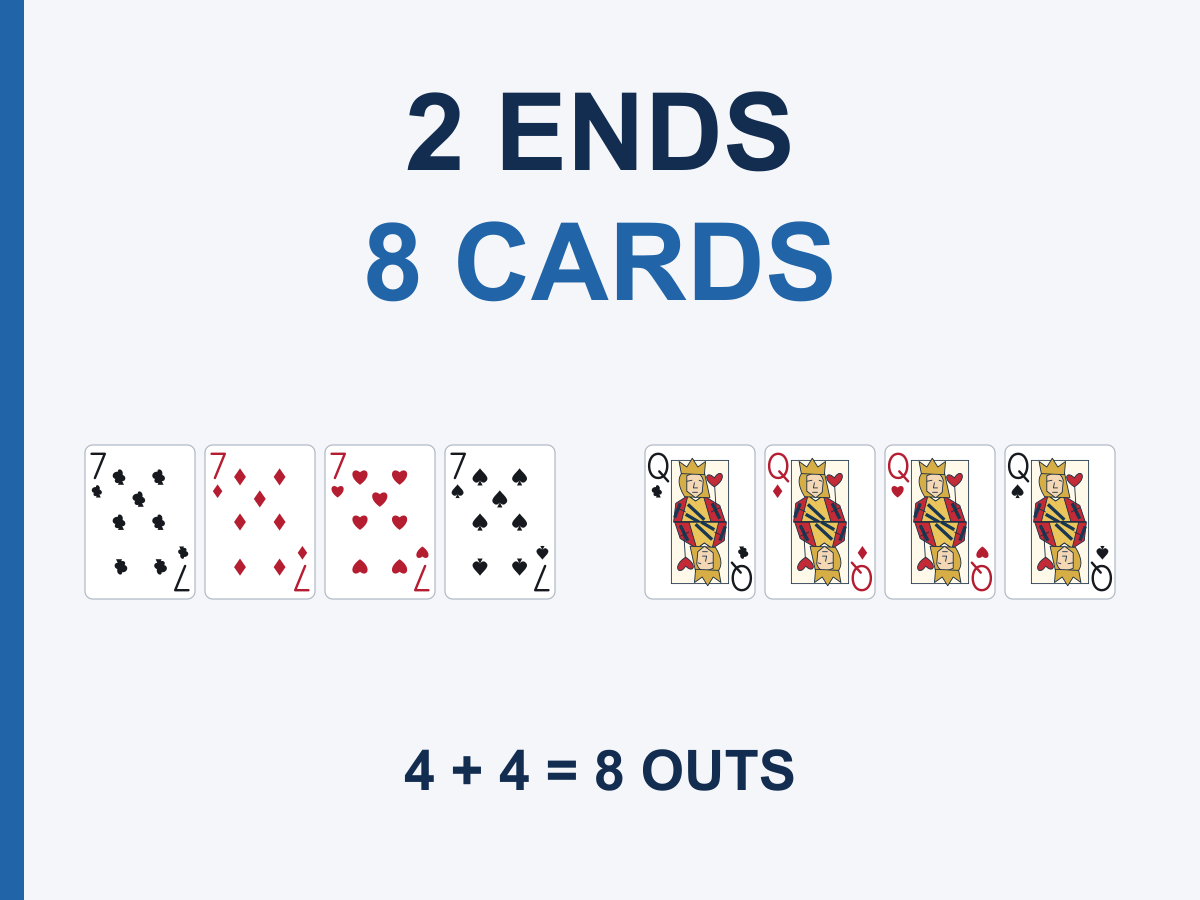
An open-ended straight draw is a straight draw in which you already have four cards of consecutive ranks and complete the straight with any card at either end. In Texas Hold’em, those four cards come from your hole cards and the board combined. Since the deck has four cards of each rank, the two ends add up to 4 + 4 = 8 nominal outs, meaning before subtracting any card you know is in another hand. An out is a card that completes the combination you are aiming for when it comes. Counting outs answers a practical question: how many cards can still turn the draw into a made straight?
This count only concerns completing the straight. Whether the made straight will win the pot is another question, and the answer depends on your opponents’ hands.
An Open-Ended Straight Draw in Practice: Hole Cards, Flop, and the Eight Cards
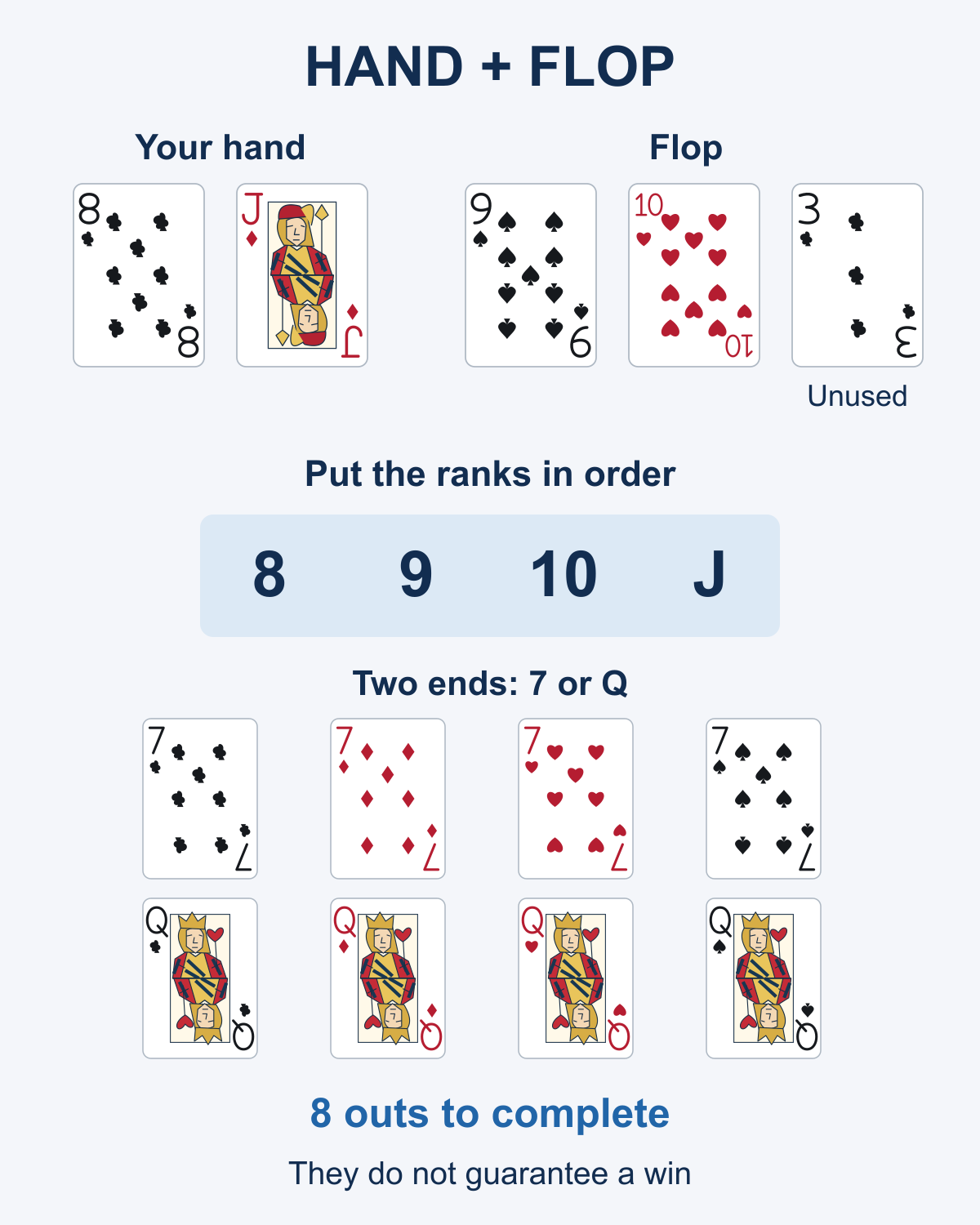
Hypothetical example: you hold 8♣ J♦ and the flop comes 9♠ 10♥ 3♣. Combining your hole cards and the board gives you 8-9-10-J, four consecutive ranks, with the 3♣ playing no part. Any 7 makes 7-8-9-10-J, and any queen (Q) makes 8-9-10-J-Q: those cards are 7♣ 7♦ 7♥ 7♠ and Q♣ Q♦ Q♥ Q♠, eight in total. Since you do not know your opponent’s hand, the count includes only cards you cannot see, with no guarantee that all of them are still in the deck.
The suit does not matter: a straight only requires consecutive ranks. With a 7 or a queen on the turn, the draw becomes a straight. If the turn does not help, the same eight cards remain outs on the river.
Notice where the four consecutive cards come from: your hole cards sit at the ends of the row, and the board cards sit in the middle. Where each card comes from does not matter; what counts is the combination of your hole cards and the board.
How to Count the Outs of an Open-Ended Straight Draw
Two terms underpin the calculation. A straight consists of five cards of consecutive ranks, of any suits, such as 5-6-7-8-9. A draw is an incomplete hand that can still improve with the cards to come. With an open-ended draw, you have four of the five cards of a straight, and there is an available rank at each end of the row. That explains the name: the draw is “open” at both ends, unlike an inside straight draw, where the missing card sits between the others.
The method is the same on the flop, when both the turn and river are still to come, and on the turn, when only the river remains. What changes is how many cards are still to come, not how you count. There are four steps.
- Look for four consecutive ranks. Combine your two hole cards with the community cards and check whether four ranks form a row with no gaps, like the 8-9-10-J in the example. If there are already five consecutive ranks, you have a made straight and there is nothing to count. Also check that a card can be added at either end. A-2-3-4 completes only with a 5, and J-Q-K-A only with a 10: each of these rows has just one open end. An ace can be the lowest or highest card of a straight, but it cannot connect a king to a two.
- Name the two ends. These are the rank immediately below the lowest card and the rank immediately above the highest. With 8-9-10-J, the ends are the 7 and the queen. If a rank were missing from the middle of your cards, the draw would have just one rank that completes it and would no longer be open-ended: it would be an inside straight draw, also called a gutshot.
- Multiply each end by four. The deck has four cards of each rank, one of each suit. Four sevens plus four queens make eight outs.
- Subtract the cards you know are no longer available. The eight outs are nominal because they assume none of the cards you need is elsewhere. When you know an opponent holds a card you need, it no longer counts as an out and the count drops. While your opponent’s hand is unknown, the nominal count remains eight and does not try to guess their cards; that estimate is a matter of judgment, not arithmetic.
Ranks and cards are different units: two ends, eight cards. Someone who says “I have two outs” is counting ranks; the count that matters is the number of cards.
With eight outs, an open-ended draw has twice as many cards as a gutshot, which has four. That is why it is often described as one of the strongest draws.
Eight outs alone do not identify an open-ended draw, either. A double belly-buster, or double gutshot, has the same eight outs, but they come from two draws each missing one card, one on either side, rather than four consecutive ranks. The test for an open-ended draw is a row of four consecutive ranks with an available rank at each end.
To learn how to count outs in general and avoid counting the same card twice when you have more than one draw, read what outs are in poker.
It is still a draw, not a made hand. An open-ended straight draw is a strong draw, but a hand that has not yet materialized: if the card does not come, you may end up with nothing. The eight outs measure the path to a straight, not the hand you have now.
Completing does not mean winning. A made straight can lose to a better hand. Two situations show how:
- one of your cards also completes an opponent’s flush;
- on connected boards, your opponent already has or makes a higher straight.
In both cases, you hit your draw and remain behind. This risk of completing your draw and still losing chips is the subject of reverse implied odds.
It is neither an instruction on how to play nor a probability. Counting eight outs does not tell you to bet, call, or fold: that decision depends on position, other players’ actions, and the size of the pot, factors the count does not show. It also does not tell you the chance of completing the draw, which starts with the outs but depends on how many cards are still to come. That is why the number eight alone does not answer “what is the probability?”
Example: The Straight That Completes and Loses to a Flush
Poker Skill presents the situation with 9♦ 10♠ in the big blind and a flop of A♣ 7♥ 8♥. To analyze that case, assume your opponent holds K♥ 2♥. With 7-8-9-10, you have four consecutive ranks, and any 6 or J completes the straight. Before separating those eight candidates, check the known cards: neither K♥ nor 2♥ is a 6 or J, so this opponent’s hand removes none of the eight nominal outs from the list.
If the turn is 6♥ or J♥, you complete your straight. Your opponent makes a flush with the three hearts on the board (7♥, 8♥ and the turn card) and the two in their hand (K♥ and 2♥). Their flush beats your straight. That makes 6♥ and J♥ dirty outs: they complete the hand you were drawing to without giving you the best hand.
The other six cards are 6♣, 6♦, 6♠, J♣, J♦, and J♠. Any of them completes your straight without bringing the third heart. Against K♥ 2♥, you are ahead on the turn. With 6♣, your straight is 6♣ 7♥ 8♥ 9♦ 10♠; your opponent has only four hearts available, one short of a flush. There are therefore eight cards that complete the straight, but only six that complete it while putting you ahead of this opponent on that next card. This conclusion applies to the specified hands and flop; it does not include what might happen on the river.
The practical lesson: when counting outs, keep two lists.
- The first contains the cards that complete your straight. It applies without information about your opponents and is the one this article teaches.
- The second removes dirty outs from the first: cards that, in addition to completing your straight, complete a superior hand for an opponent, such as the flush in the example. A card that only improves their hand without beating your straight is not a dirty out. This list only exists when you have an assumption about your opponent’s hand, and that assumption is a matter of judgment, not arithmetic.
Next Step: Separate Completing from Winning
In the hand we just analyzed, with 9♦ 10♠ against K♥ 2♥ on an A♣ 7♥ 8♥ flop, who is ahead if the turn is 6♣? What about 6♥? Explain the difference using the five cards of the straight and the five of the flush.
The questions that follow the count are different. The chance of completing with one or two cards to come is the subject of the poker odds chart, which starts with outs to arrive at probabilities.
 2 days ago