Reverse implied odds account for how much you could still lose on later betting rounds, whether you complete a draw and remain behind or call with a hand that is already dominated [1][2][3]. They are the opposite of implied odds, which estimate how much you expect to win after completing your draw [2]. The loss does not come from missing the card you wanted. It comes from hitting it, ending up with the second-best hand, and continuing to put chips into the pot [3].
Completing a draw does not guarantee winning the pot: you may improve and still pay off a better hand [3]. When assessing a call, separate three questions:
- How often does the card you want arrive?
- Will your completed hand be ahead of the hands your opponent could have?
- How many more chips could go into the pot afterward?
Reverse implied odds estimate the future losses associated with the last two questions. Consider the range your opponent could have and how many chips remain available to bet. As with implied odds, you cannot assign an exact amount to the future gain or loss [2].
Reverse Implied Odds in Poker: Completing, Winning, and Paying
When you call with a draw, three quantities enter the decision, each answering a different question:
- The chance of completing your draw. This concerns making the combination you are aiming for. To calculate the chance of completing a draw, see the probability chart. Here, separate that chance from another question: will the combination you make win?
- The chance of winning after completing your draw. This depends on having the best hand when you complete it, which can only be assessed against what your opponents could have [2].
- The chips that could still go into the pot. These depend on the stacks and betting on later streets [3].
The first does not translate into the second. Completing your draw simply takes you to the next question: is your made hand the best? Reverse implied odds increase as the chance that your hand will not be best after completing your draw rises, and decrease as that chance falls [2].
The third quantity amplifies the others. Deep stacks leave more chips behind to lose when you are second best, and bets on later streets can commit both players even after you have improved [3]. This often comes up in no-limit Hold'em, where deep stacks allow large payouts. One example from the source: you make a king-high flush on the river, but your opponent has an ace-high flush and can bet all their chips (jam) to win the pot [3]. With short stacks, the absolute loss is limited and the effect matters less [3]. SPR (stack-to-pot ratio) summarizes this depth: it is the effective stack divided by the pot size, and a high SPR turns small advantages into large swings [3].
Pot Odds, Implied Odds, and Reverse Implied Odds Side by Side
To assess the immediate call, start with pot odds. If you need to examine what could still happen after completing your draw, assess implied odds, which estimate the additional gain, and reverse implied odds, which account for future losses if you are still behind [2]. If you believe you have the implied odds to call, it is also worth estimating reverse implied odds to weigh whether the call still holds up [2]. None of the three decides the matter alone: each looks at one part of the money involved.
| Concept | Question it answers | Where it looks | What it does not provide |
|---|---|---|---|
| Pot odds | Is the assessment of the immediate call favorable? [2] | The current decision, before analyzing future payments | An estimate of gains or losses after completing your draw |
| Implied odds | How much do I expect to win after completing my draw? [2] | Future money in your favor | An exact amount |
| Reverse implied odds | How much could I lose if I complete my draw and my opponent still has a better hand? [1][2] | Future money against you | An exact amount or the chance of winning |
When Completing Your Draw and Still Being Behind Is More Likely: What Changes the Risk
The risk of completing your draw and still being behind is not uniform. It grows in specific situations, and almost all share the same root: there is a plausible opponent hand that your improvement does not beat.
- Weak draws. A low flush draw may be up against someone drawing to a higher flush, and the same applies to someone aiming for the low end of a straight [2].
- A board that pairs. With a flush or straight already made or still drawing, a paired board opens up the possibility that an opponent could make, or has already made, a full house [2].
- Several players in the pot. In a pot with several players (multiway, meaning more than two), it is worth checking whether your draw holds up against others who may also be calling to complete theirs [2].
- A dominated made hand. The concept is not limited to draws. With top pair (a pair matching the highest card on the board) and a weak kicker in a multiway pot, the more players there are, the greater the chance that someone has a better kicker (a side card used to break ties) or two pair [3].
In all these situations, a “better hand” is a possibility conditional on the opponent’s range, not a fact. The same draw can carry high reverse implied odds against one set of hands and low reverse implied odds against another. The benchmark is the nuts, the best possible hand given the board [3]. When you do not have the nuts, at least one possible hand beats yours, and what matters for the decision is whether that hand is in your opponent’s range.
The result is an estimate of future money lost after completing your draw and still being behind. Compare that cost with your assessment of the call: very good pot odds may support a call despite some future risk; poor pot odds combined with poor reverse implied odds weigh toward looking for a fold. This is guidance for judgment because future gains and losses have no exact value, not a direction to avoid every draw [2].
Example: When Your Straight Loses to a Higher Straight
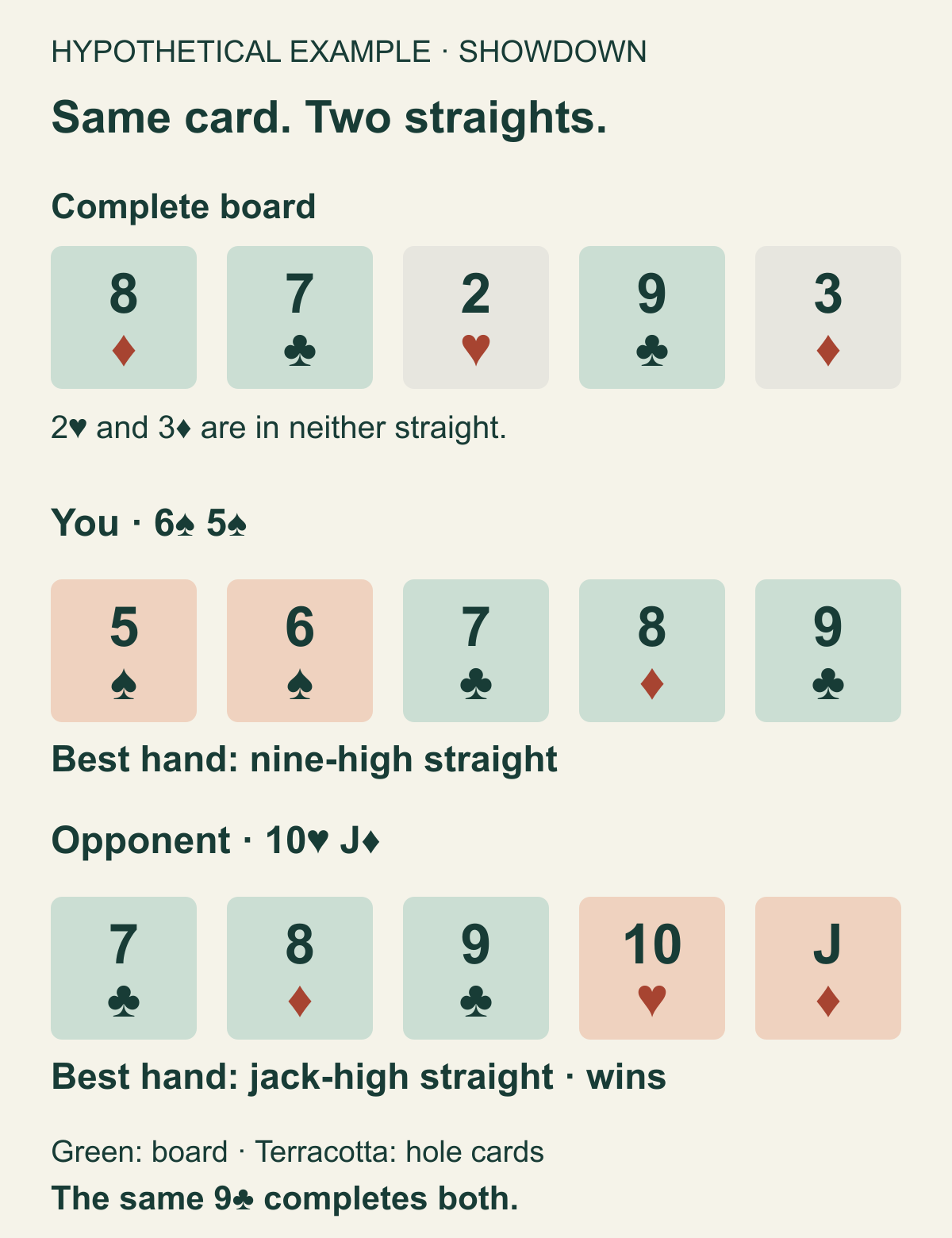
Compare the two straights in the hypothetical showdown below: making a hand is not the same as winning with it. The possibility of completing the low end and losing to a higher straight is described in [2].
Hypothetical example: you hold 6♠ 5♠ and your opponent holds 10♥ J♦. The complete board is 8♦ 7♣ 2♥ 9♣ 3♦. Your best hand is the nine-high straight 5-6-7-8-9; your opponent’s is the jack-high straight 7-8-9-10-J. Both depend on the same 9♣, and their straight is higher, so your opponent wins the showdown.
Applying the three questions to the outcome of the example:
- Draw result. In this outcome, the card arrived and you ended up with a straight, 5-6-7-8-9. The hand shows one instance in which the draw completed, without indicating how often that would happen.
- Showdown result. The straight was not enough because your opponent also made one, and theirs was higher. Their hand was chosen for the example; against a real opponent, a “better hand” remains a possibility conditional on their range.
- Chips that still go in. Imagine that, over the course of the hand, you called your opponent’s bets through to this showdown. Since the example does not specify stacks or bet sizes, it does not calculate a loss. With more chips remaining, there could be a larger loss if you keep calling with the inferior hand. If no additional chips go in after the improvement, there will be no such extra cost [3].
The lesson from the example is directional: the more your draw depends on a card that also helps plausible opponent hands, and the more chips remain behind, the more reverse implied odds weigh against the call [2][3]. The example does not say that calling was right or wrong; it shows what needs to enter the calculation beyond the price of the call.
Next Step: Review the Call Before the Card Arrives
The next time you call with a draw, or review a hand in which you called, work through three questions in this order:
- What do the pot odds indicate about the call I am assessing now? After this initial assessment, examine the future gain that would help justify the call and the future loss that could weigh against it [2].
- When my card arrives, which hands in their range remain ahead, or also complete because of it? Weak draws, the low end of a straight, a board that pairs, and a pot with several players increase this possibility [2].
- How many more chips could go into the pot afterward? Deeper stacks leave room to call larger bets on later streets. With fewer effective chips, the possible additional loss is smaller [3].
None of the three questions produces a number that decides the matter on its own. If the answers are uncomfortable—for example, with much of their range ahead and many chips still behind—the call needs more justification than the price alone offers. If they are favorable, the risk of completing your draw and still being behind carries less weight in the decision.
Recommended reading
- Implied Odds in Poker: Calculating the Future Payout You Need
- How to Calculate Pot Odds in Texas Hold’em: A Practical Guide to Calling or Folding
- Poker Odds Chart: Probabilities, Outs, and Conditions in Hold’em
 6 hours ago