

Implied odds account for the extra money you expect to win after completing a draw. Pot odds compare only the current pot and the cost of calling; implied odds help assess whether future payment can make up for a call that direct odds do not justify [1][2].
Example: Why You Need Another $22
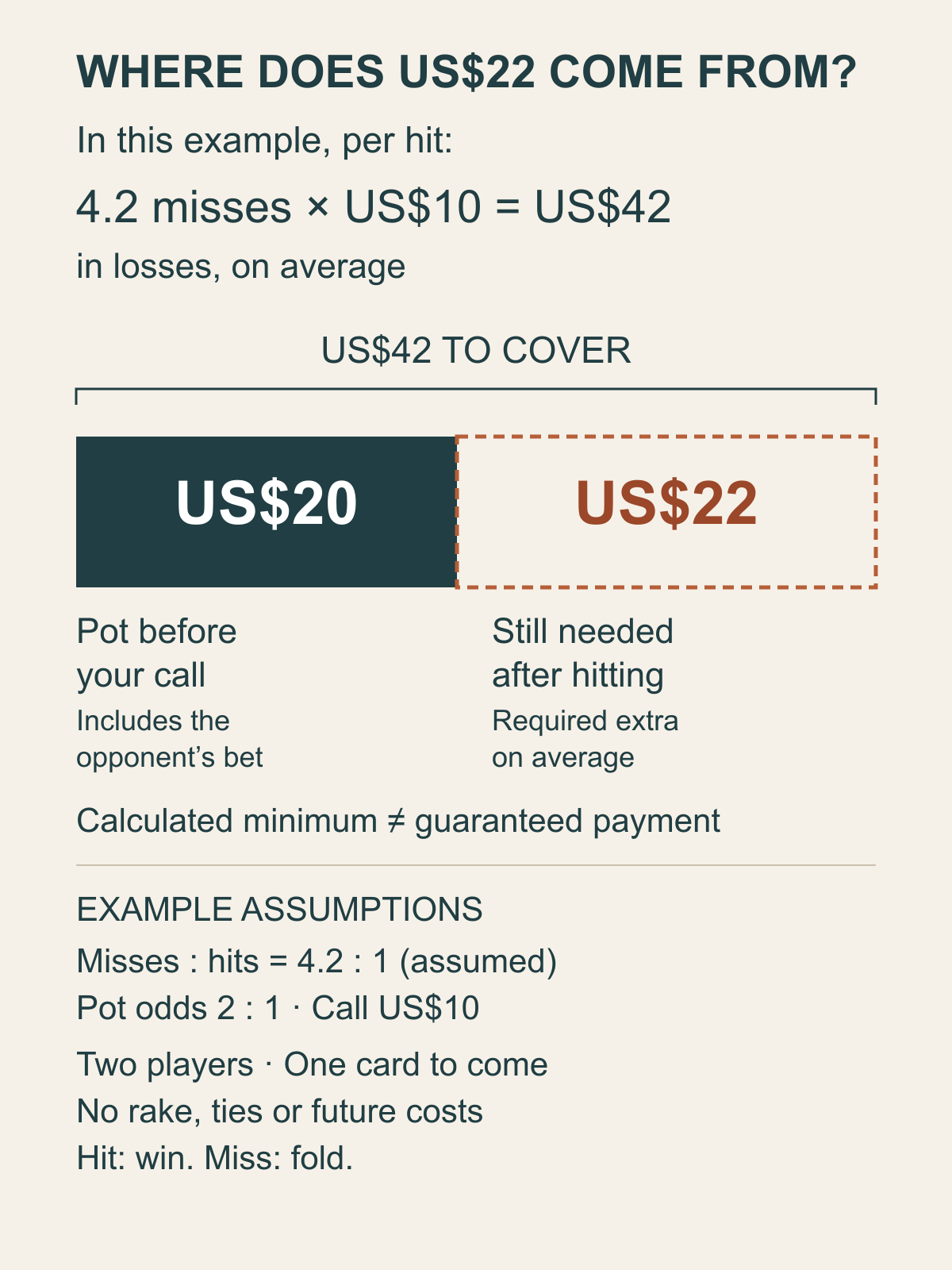
Use the numbers from The Poker Bank’s example: an opponent bets $10 into a $10 pot. You must call $10 to contest the $20 already in the pot, so you receive pot odds of 2:1. The example uses odds of 4.2:1 against completing the draw: an average of 4.2 misses for each hit [1].
Conditions for the calculation: two players, one card to come, no rake or ties; you win when you complete the draw and fold when you miss. The calculation excludes future losses beyond the current call; the extra payment means the opponent’s chips, without counting your own bets again. The 4.2:1 ratio is the approximate value used in the example, not an exact probability for every draw.
| Step | Calculation | Result |
|---|---|---|
| Pot odds | $20 ÷ $10 | 2:1 |
| Gap between the draw odds and pot odds | 4.2 − 2 | 2.2 |
| Extra payment needed | 2.2 × $10 | $22 |
To understand the result, each hit corresponds to an average of 4.2 lost $10 calls, totaling $42. The pot already provides $20; the missing $22 must come from the opponent after you hit. This is the average additional payment, counting only the occasions when the draw completes, needed to break even.
After calculating the $22, assess whether the opponent is likely to pay that much extra on average when you hit.
How to Judge Whether That Payment Is Plausible
First Check the Chips Still Available to Win
Look at what each player will have left after the call. The smaller of those two stacks limits how much more you can win from the opponent: that is the remaining effective stack. As a variation of the example, if you can win at most another $15, you cannot meet the $22 requirement. A stack larger than $22 only makes that payment possible; you still need to extract it [3].
If the opponent is already all-in and you are the only two players in the hand, there are no more of their chips to win on later streets. In that case, do not use future payment to justify the call [1].
Consider the Card That Completes Your Hand
The less obvious your strength, the better your chance of getting value may be. A card that makes a straight or flush very visible can cause the opponent to stop betting or fold to your bet. Ask whether they could still pay with a worse hand on that board [1][3].
Consider the Opponent and Your Position
A player who avoids calling large bets with weak hands offers less prospect of payment than someone willing to continue with those hands. Base that assessment on observed behavior rather than assuming that every completed draw will get a call [2].
In position, you first see whether the opponent bets or checks and can then decide how to seek value. That helps you choose an action; the amount you can win is still capped by the effective stack.
The Formula for Other Values
When direct odds are insufficient, use:
Extra payment needed = (odds against completing the draw − pot odds) × call cost [1].
Express both numbers as ratios to 1: in the example, 4.2 and 2. Do not subtract a percentage from a ratio. If the draw, pot, or call cost changes, recalculate. If pot odds are already sufficient under the same model, no extra payment is needed.
To find the appropriate probability, check the outs and number of cards to come in the Hold’em probabilities and outs guide. The chance of hitting by the river with two cards to come should not be used as though one call buys both cards for free.
Allow for Completing a Hand That Still Loses
A low flush can complete and lose to a higher flush. If you then call a bet, that is a future loss instead of the gain assumed in the model: this is reverse implied odds [3].
After doing the calculation, compare the required amount with the plausible payment and that risk. When neither the available chips nor the opponent’s behavior supports the amount needed, implied odds do not justify the call.
Recommended reading
- How to Calculate Pot Odds in Texas Hold’em: A Practical Guide to Calling or Folding
- Poker Odds Chart: Probabilities, Outs, and Conditions in Hold’em
- Calling in Poker: What It Means to Match a Bet
Sources
- [1] Poker Implied Odds — The Poker Bank, by Greg Walker
- [2] What Are Implied Odds and How to Use Them — SuperPoker (published on May 7, 2025)
- [3] What Are “Implied Odds”? — Polarize Poker

 1 day ago