Playing in Position in Poker: Information and Post-Flop Decisions
By the Editorial Team
Being in position means acting after a particular opponent in a betting round. Post-flop in Texas Hold’em, this lets you see whether they check or bet before deciding how to respond. The player acting first does not yet have that response available. [1][3][4]
Playing in Position in Poker: How Action Order Improves Decisions
Controlling the Pot Depends on Being Able to Close the Action
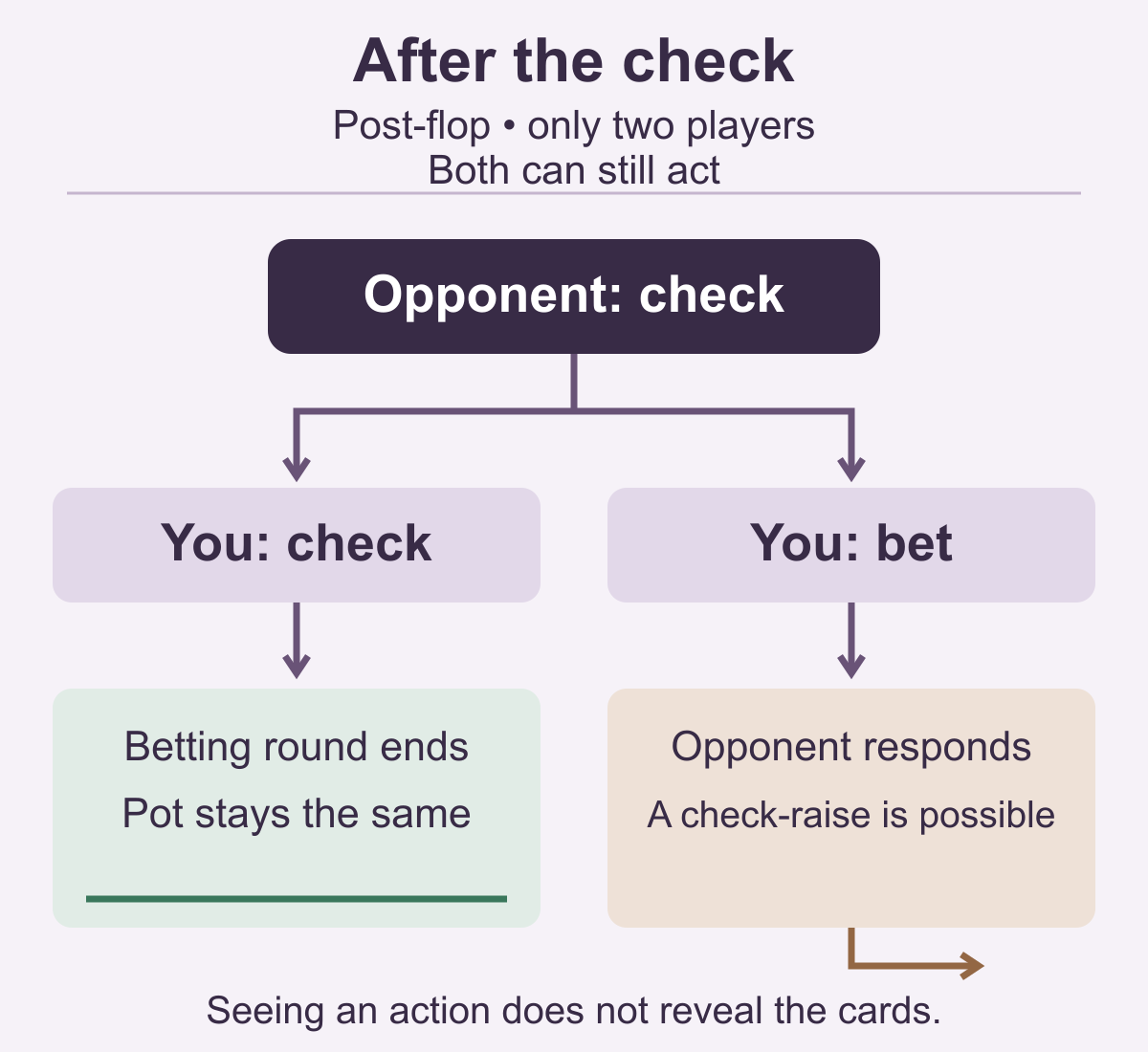
Post-flop in no-limit Hold’em, with only two players still able to act, you can check back after your opponent checks and keep the pot as it is. If they bet and you call, the call ends that betting round. [4]
Out of position, checking still leaves the opponent free to bet. This difference makes pot control easier for the player acting last, especially when unsure whether they are ahead. [1][4]
Information Also Helps You Bet
The information available before your action also helps you choose value bets and identify bluffing opportunities. [1][4] A value bet aims to win more chips by drawing calls from worse hands; a bluff aims to make a better hand fold. [5]
What Position Does Not Tell You
A Check Does Not Prove Weakness
A check does not prove weakness: the opponent can still respond to your bet with a check-raise, meaning they check and then raise. Betting after their check therefore gives them another action. [4]
Acting After Someone Does Not Always Mean Acting Last
In multiway pots, acting after the bettor does not guarantee that your call ends the round: another player may still have to act. [3][4]
The button provides the most direct reference point in Texas Hold’em: when still in the hand and able to act, the button acts last post-flop. This description should not be extended to pre-flop, when the button is not the last to act. [2]
More Information Does Not Eliminate Mistakes
Having position does not guarantee a correct decision. As GGPoker emphasizes, the action you observe needs to be interpreted alongside the hand’s development from pre-flop through the river. [1]
Example: Taking a Free Card After a Check
In the PokerNews example, you have a draw—a hand that still needs to complete a combination—and the opponent checks. Post-flop, before the river, with only two players still able to act, you can check back to end the betting round. This lets you see the next community card without paying another bet: the opportunity known as a “free card.” [4]
The Next Step Is to Connect the Observed Action to the Decision
Before choosing your action, check:
- What did the opponent do in this round?
- Is anyone still to act after me?
- Does my check or call end the round, or does a bet leave the opponent a response? [3][4]
Sources
- [1] The Beginners Guide Series: How to Play Poker in Position — GGPoker — Jackpot; published: June 23, 2025.
- [2] Position Definition | What is Position in Poker? — PokerNews
- [3] Position (poker) — Wikipedia)
- [4] Poker Positions Explained: the Importance of Position in Poker — PokerNews
- [5] Value Betting: Maximizing Profit — PokerStars Learn

 1 day ago