Heads-Up Poker Strategy: Decisions by Position, Stack, and Opponent
By the Editorial Team
To make decisions in heads-up No-Limit Hold’em, start with position and the effective stack, reconstruct the previous action, and check the price of continuing. Then compare your hypothesis about the opponent’s range—the set of possible hands they could hold—with the responses they have been showing. The choice depends on these conditions: your opening strategy changes with the big blind’s reaction, and your defense changes with the size of the raise you face. [1][2][3]
In heads-up play, adjust to your opponent’s responses: if they often fold their big blind to your opens, you can attempt to steal the blinds more often; against an opponent who calls too much, bluff less and prioritize value bets. [2][3]
Before the Decision: Identify the Situation
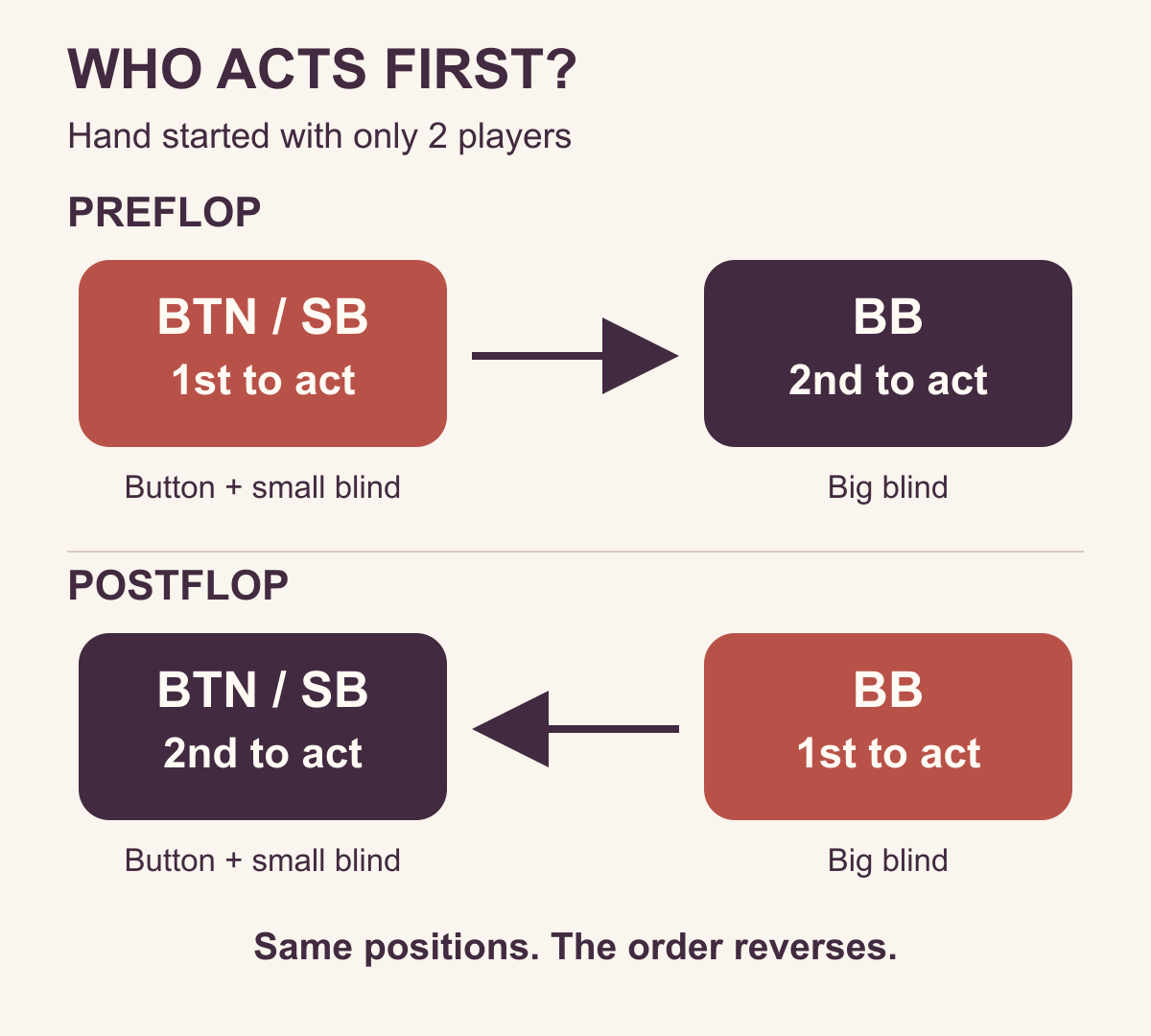
Confirm that the hand began at a two-player table. In this heads-up setup, the button also posts the small blind, acts first preflop, and acts last on postflop streets. The other player is the big blind. This configuration is the starting point for this guide; a pot reduced to two players after folds at a larger table should not be treated as though it began in this configuration. [1][2]
Look at both stacks. The effective stack is the smaller of the two. Looking only at your own chips is therefore not enough to identify the depth of play. Paying attention to the effective stack is one of the central recommendations in the material on heads-up sit & go, or SNG, play. [3]
Identify the format. Apply short-stack advice according to the game format and effective stack; for the final heads-up stage of an SNG, use advice for that format. [2][3]
For your review, have the position, stacks, action sequence, bet amounts, and observed opponent responses at hand. Separate what happened from your interpretation: a fold to an open is an observation; the hypothesis that the player folds frequently needs to be checked against their behavior. Recommendations for adjusting on the button depend on precisely these tendencies. [2]
In tournaments that follow Poker TDA rules, players are entitled to a reasonable estimate of an opponent’s stack. This reference helps separate observable stack depth from a hypothesis about the range. [4]
Heads-Up Poker Strategy: A Guide for Each Decision
1. Use Position to Organize Your Plan
On the button, you make the first preflop decision, but you will have information about your opponent’s action before acting on later streets. In the big blind, the reverse applies postflop: you will be out of position. This difference helps explain why advice for opening on the button and defending the big blind is not interchangeable. [1][2][3]
Position also lets you choose when to stop betting. In a PokerStrategy example for heads-up SNGs, you raise on the button with K8 offsuit, get called, and see an A–K–Q flop. The recommendation is generally to check back on the flop or turn, because few opponents would call bets on all three streets with a hand worse than your second pair. [3]
The point of this example lies in the relationship between your hand, the board, and what can call your bets. Making a pair does not, by itself, answer how many streets you should bet. The same material explains that checking on one or more streets can help induce bluffs and limit the size of the pot.
Use this distinction when interpreting your opponent’s actions as well: a check is an action that can be part of a plan. Do not treat it, in isolation, as confirmation of weakness.
2. Check the Effective Stack Before Choosing a Line
Identify the smaller stack before applying a recommendation. This step prevents you from transferring advice for deep stacks to a short-stack situation simply because the position is the same. [3]
In heads-up No-Limit Hold’em with effective stacks above 40 BB, prefer opening with a raise on the button over limping—completing from the small blind to the big-blind amount without raising. Limping lets the big blind check and see the flop without putting in additional chips; raising makes the opponent play a larger pot out of position. A limping range made up only of weak hands is also vulnerable to aggression from the big blind. [2]
In the discussion of short stacks in SNGs, however, the composition of an all-in reraising range depends both on the hands the button opens and on those with which they would call the all-in. These are two different questions: what do they play initially, and what do they continue with under pressure? [3]
3. Reconstruct the Action Before Assigning a Range
Start with the actual sequence of the hand: was there a limp, an opening raise, a call, or a reraise? A 3-bet is a reraise over the initial raise. In the analysis of button play, how frequently the big blind uses this response is one of the factors highlighted when choosing an opening range. [2]
Against a big blind who uses an aggressive 3-betting strategy, the opening guide recommends tightening your initial range so you can continue with a larger portion of it against reraises. The problem it identifies is opening many hands that will have to be folded when this response comes.
Against a conservative 3-betting strategy, the same text allows for opening a wider range, because the opponent tends to force fewer button hands out before the flop. This recommendation is conditional on the big blind’s behavior, rather than an instruction to open any hand. [2]
4. Relate the Price to Your Opponent’s Response
In the big blind, check the opening size before deciding how to defend. The Pokercode material distinguishes between defending against minimum raises and defending against larger raises: the latter offer less favorable pot odds, meaning a less favorable relationship between the amount to call and the pot being contested, and require more folds. [1]
This advice does not mean automatically calling a small raise. It shows that different opening sizes should not receive the same price assessment. The text also includes 3-betting among the big blind’s responses, rather than limiting defense to calling.
From the button’s perspective, opening size and hand selection should be analyzed together. The opening guide recommends smaller raises against players who frequently fold to blind-steal attempts. Against players who defend frequently, it proposes increasing the size and tightening the range. The justification differs in each case: risking less to generate folds, or playing a larger pot with a stronger range against an opponent who is out of position. [2]
There are therefore two behaviors to distinguish: defending by calling and defending by reraising. If the opponent responds with many 3-bets, your hands’ ability to continue becomes more important. If frequent defense takes the form of calls, the plan needs to account for postflop play. Simply recording that they “won’t give up their blind” is not enough.
5. Choose Your Postflop Objective Before Betting
After the flop, define what you intend to achieve with a bet or a check. The SNG material recommends building a plan for the hand, including situations where controlling the pot or inducing bluffs is worthwhile. It also advises against pure bluffs across multiple streets without a good reason. [3]
For a value bet, the question is whether you believe you have the best hand and can get action from worse hands. In its advice against loose-passive players—those who enter many hands and play passively—the text prioritizes value betting and recommends bluffing very little. The relevant tendency is the opponent’s willingness to call.
Against a tight, more selective player, the proposal is to contest more pots aggressively, but quickly give up marginal hands when they show strength. The two recommendations point in different directions because they respond to different behaviors. [3]
This also limits how you interpret a bet you face. Instead of assuming that your opponent has nothing because the contest is heads-up, put the action back into its sequence: how did they enter the pot, what did they do on earlier streets, and which tendency supports your read? The recommendation to adapt your play to your opponent requires this context, rather than just an “aggressive” label. [2][3]
6. Adjust the Hypothesis Based on the Observed Response
The adjustment should identify which behavior you intend to exploit. Against frequent folds in the big blind, the target is folding to opens. Against excessive calls, the SNG advice favors extracting value. Against frequent 3-bets, opening hand selection needs to account for the response to a reraise. [2][3]
A loose-aggressive player, who plays many hands aggressively, calls for a more specific analysis. The SNG material recommends looking for concrete weaknesses, such as defending weak hands out of position. It does not offer a single antidote to every form of aggression. [3]
How to Check the Decision and Correct a Read
To review the hand, check the points in the table. If your read of the opponent is not yet supported by what you have observed, keep it as a hypothesis. [1][2][3]
| Decision Point | What to Check in the Review |
|---|---|
| Advice for deep stacks | Check whether the hand’s stack depth met that condition, especially in the discussion of limping on the button. [2] |
| The price of defending the big blind | Recheck the opening amount and verify that you considered the price you actually faced. [1] |
| An adjustment based on frequent folds, calls, or 3-bets | Check which of these responses was observed, without grouping them as though they were equivalent. [2] |
| A plan to bluff across multiple streets in a heads-up SNG | Identify the specific reason, rather than using the general aggression of heads-up play as justification. [3] |
Sources
- [1] Heads-Up Poker Strategy: How to Win 1-on-1 — Pokercode.
- [2] The Beginner’s Guide to Opening the Button in Heads-Up No Limit — Upswing Poker. Published on February 24, 2017.
- [3] The 6 Keys to Winning Heads-Up Sit ‘n Go Play — PokerStrategy.com. PokerStrategy Editorial. Published on March 11, 2026.
- [4] View Poker TDA Rules, Procedures, & Addendum — Poker Tournament Directors Association. 2026 version.

 1 day ago