To follow a hand of Texas Hold’em, you need a short vocabulary, and it appears in the same sequence as the hand progresses: button and blinds, two hole cards, betting rounds with check, bet, call, raise or fold, flop, turn, river and, if the hand gets that far, showdown. This poker glossary defines each term in one or two sentences and follows that order, rather than the alphabet, so you can find the word when it is used at the table.
Why this matters: when someone announces the turn or checks, the hand keeps moving, and understanding the word immediately prevents you from losing track of what is happening. If you do not yet know the full sequence or the hand rankings, the basic Texas Hold’em rules cover those points. Here, the focus is on what each term means.
Poker Glossary: Find the Term by the Stage of the Hand
Use the table to find a term by the stage of the hand. If your question is about an action, first check whether there is a bet to call.
| Stage of the hand | What happens | Terms to look up |
|---|---|---|
| Setup | The button identifies the dealer; the blinds are posted before the cards are dealt [1] | button, blinds, ante, position, pot |
| Before the flop | Each player receives two hole cards, and the first betting round begins [1] | hole cards, UTG, check (when there is no bet to call), call, raise, fold, all in |
| Flop | Three community cards are revealed at once, and the second betting round begins [1] | board, flop |
| Turn | The fourth community card is revealed [1] | turn |
| River | The fifth and final community card is revealed, followed by a final betting round [1] | river |
| Showdown | Hands are compared to decide who wins the pot [1] | showdown, play the board, kicker, muck |
The Terms in a Texas Hold’em Hand, in the Order They Appear
Setup: Button, Blinds and Hole Cards
- Button (dealer button): a marker that identifies who actually or nominally serves as the dealer for the hand. It moves clockwise to the next player after each hand and serves as a reference for locating the blinds, which, at tables with three or more players, are to the dealer’s left [1].
- Blinds (small blind and big blind): forced bets made before the cards are dealt. At a table with more than two players, the blinds usually come from the two players to the left of the button: the small blind immediately beside it and the big blind in the second position, counting from the dealer [1].
- Ante: a mandatory contribution to the pot before receiving cards, when the game’s structure uses it [3].
- Hole cards (pocket cards): the two cards each player receives face down at the start of a Hold’em hand, which only that player can see [1].
- Position: your place in the betting order [2].
- Under the gun (UTG): at tables with three or more players, the first player to act in the preflop round [2], immediately to the left of the big blind [1].
- Pot: the total amount wagered in a hand [2].
- Heads-up: playing against a single opponent [2].
Actions: Check, Call, Raise, Fold and All In
When facing a bet, the basic choices are to fold, call or, when permitted, raise [2].
- Bet: to place the initial wager in a round, before another player has made a bet in that round [1][2].
- Check: to pass the action without putting in more chips, when there is no bet to call [1][2].
- Call: to put in the amount needed to match the bets already made [2].
- Raise: to increase the bet in a round after another player has already bet. A reraise is a further raise made after another player’s raise [2].
- Fold: to give up your hand when it is your turn. When folding, the player returns their cards to the dealer [2][3].
- All in: to bet all your chips in one action [3].
- Check-raise: to check and then raise when a player acting after you bets [1][2].
Community Cards: Board, Flop, Turn and River
Community cards are the cards placed face up in the middle of the table and shared by the players. They are also called board cards [1]. In Texas Hold’em, each player receives two hole cards, and up to five community cards can be revealed as the hand progresses [1].
- Board: the community cards already revealed on the table. There are three on the flop, four on the turn and five on the river [1][2].
- Flop: the first three community cards, revealed at once; the term also refers to the second betting round [1]. To see where the flop fits into the sequence and how community cards are used, see the guide to using community cards on the flop.
- Turn (fourth street): the fourth community card, revealed face up by the dealer [1][3].
- River (fifth street): the fifth and final community card, followed by a final betting round and, if necessary, a showdown [1].
- Rainbow and monotone: on a rainbow flop, all three cards have different suits [2]. On a monotone flop, all three cards are the same suit [2].
- Top pair, middle pair and bottom pair: on the flop, a pair made with one hole card and, respectively, the highest, second-highest or lowest card on the flop [1][2].
- Draw (drawing hand): a hand that is not yet made but can improve to something considerably stronger with cards still to come on the flop, turn or river [1][2]. Outs are the cards that can be revealed to improve the hand [2].
- Flush draw, open-ended and gutshot: a flush draw means having four cards of the same suit while waiting for a fifth [1][2]. With an open-ended straight draw, four consecutive cards need one more at either end. A gutshot, or inside straight draw, is missing a card in the middle [1][2].
Showdown: How the Hand Is Decided
- Showdown: the comparison of hands to decide who wins the pot. Requirements for showing cards depend on the rules of the game [1].
- Five-card hand: in Hold’em, a player has their two hole cards and the five community cards available [1], and the best five-card hand is what counts in the comparison [1].
- Play the board: when a player’s best five-card hand consists entirely of community cards, with no hole cards [1].
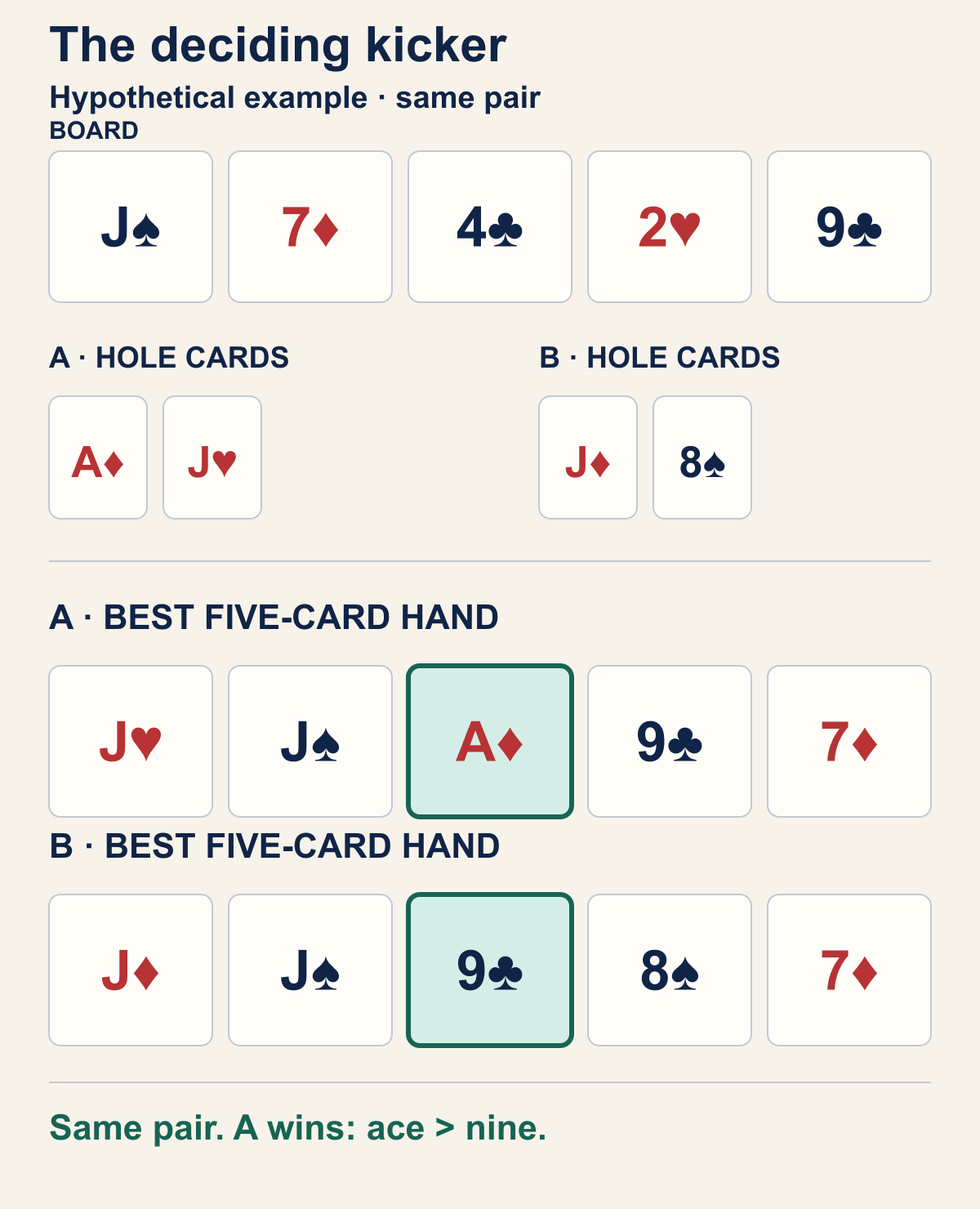
- Kicker (side card): an unpaired card that can break a tie between hands of similar strength. When pairs of the same rank compete, for example, a higher side card can make the difference [1][3]. Having hands in the same category is not enough to require a kicker: you must first compare the ranks that form the combination. The full example below shows a contest in which both players have the same pair.
- Muck: to discard your cards without showing them, when the rules allow it [1][2].
- Hand names: a pair is two cards of the same rank; a straight is five consecutive cards of any suits; a flush is five cards of the same suit; a full house is three of a kind and a pair; a straight flush is five consecutive cards of the same suit; a royal flush is the sequence from ten to ace in the same suit, the strongest hand in poker; high card is a five-card hand without a pair or a higher combination [2][3]. The order of strength among these categories appears in the hand rankings in the basic rules guide.
Hypothetical example: in a Texas Hold’em hand, the flop was J♠ 7♦ 4♣, the turn was 2♥ and the river was 9♣, making the complete board J♠ 7♦ 4♣ 2♥ 9♣. Two players remain at showdown. Player A shows A♦ J♥, and Player B shows J♦ 8♠. A’s best five-card hand is J♥ J♠ A♦ 9♣ 7♦, a pair of jacks with an ace, nine and seven as side cards. B’s best hand is J♦ J♠ 9♣ 8♠ 7♦, also a pair of jacks, with a nine, eight and seven as side cards. Here, the pair has the same rank in both hands. A’s highest side card is an ace, while B’s is a nine: that comparison alone decides the outcome, and A wins the pot.
Who shows their cards first, mucking and other procedural questions are covered in the guide to showdown in poker.
Summary: The Hand in Order and How to Use This Poker Glossary
The terms follow three parts of a hand: the setup with the button, blinds and hole cards; the betting rounds and the reveal of the flop, turn and river; and showdown, when it happens. To recognize the actions, distinguish between bet (opening the betting), raise (increasing an existing bet), call (matching), fold (giving up) and check (passing without betting when there is no bet to call) [2][1]. At showdown, the best five-card hand counts.
The practical lesson: when you hear a term you do not know, ask yourself which stage of the hand you are in and whether there is a bet to call. With those two reference points, you can locate the word in the roadmap table and find it in the right block of the list.
Recommended reading
- Big Blind in Poker: Values, Positions, and Order of Action with the Small Blind
- Poker Card Dealing: The Button, Blinds, and Sequence in Texas Hold'em
- Texas Holdem Poker Rules: Cards, Betting, and the Sequence of a Hand
Sources
- [1] Poker Dictionary — Brasil Poker, published September 30, 2016
- [2] From A to Z: Check Out the Poker Dictionary! — Copag
- [3] Poker Slang: Understand “Cravar”, “Flop” and More Terms — ge, published November 16, 2023

 1 hour ago