Top Pair in Poker: The Direct Answer
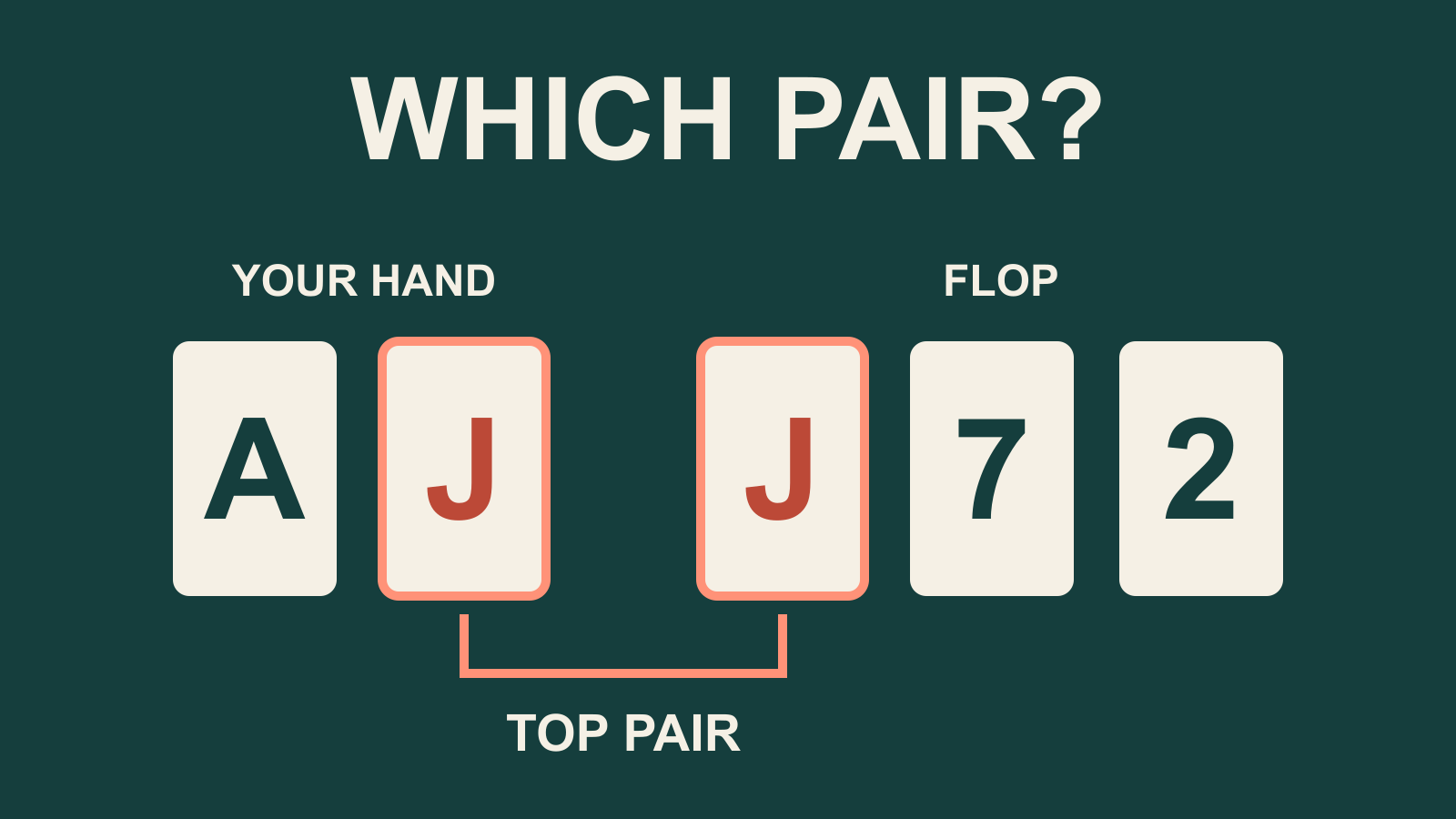
In Texas Hold’em, you have top pair when one of your hole cards pairs the highest card on the board and your best five-card combination is still only one pair [1][2][3][4]. To check, start with one question: what is the highest card on the board, and does either of my cards match its rank? If so, your pair combines a card from your hand with the highest card on the board. Also check your best five-card combination [4]: if you already have two pair, three of a kind (three cards of the same rank), or a straight, you have a hand in a higher category than one pair [2].
In Lobbyze’s example [2], you hold A-J and the flop is J-7-2. The jack in your hand pairs the highest card on the board: you have top pair, jacks. The ace accompanies that pair as a kicker: this is top pair top kicker, the highest pair with the highest kicker.
For a hypothetical contrast, keep A-J and change the flop to J-J-2: your jack combines with the two on the board, giving you three of a kind, jacks, rather than just a pair. This uses one hole card and two board cards; a set instead uses a pocket pair and one board card [4].
What this means: top pair describes where the pair comes from, not how much it is worth in every situation. It is one of the most common and important hands in Hold’em [2], but its actual value depends on factors such as board texture, opponents’ behavior, and position [3].
How to Identify Top Pair in Three Checks
The process is brief and always based on the board currently showing:
- Find the highest card on the board. On the J-7-2 flop in the example, it is the jack. That card is the reference point: top pair is defined only in relation to it, not to the other community cards [1][3].
- Compare it with your hole cards. If one matches its rank, the pair combines a card from your hand with the highest card on the board [3]. If neither does, you do not have top pair, even if you pair a lower board card or hold a high card that has not made a pair. If your hand already makes two pair, three of a kind, or a straight, it beats top pair [2], and you have more than that.
- Check the kickers in the best five cards. In a one-pair hand, the kickers are the three cards accompanying the pair. A hole card only counts toward breaking a tie if it is among those five; community cards can also fill those spots [4]. In the example with A-J on a J-7-2 flop, the ace accompanies the pair of jacks [2].
The kicker deserves its own check because top pair’s strength depends heavily on it [2]: the same pair with a weak kicker is much more vulnerable than with a strong kicker [3]. With equal pairs, compare the three kickers in order, from highest to lowest; there is a tie only if all five ranks match [4]. The kicker guide explains these tiebreakers in detail.
Top pair and overpair. With top pair, one hole card pairs the highest card on the board [1][4]. An overpair is a pair formed by both hole cards, ranking higher than every card on the board [4]. Having a pocket pair is therefore not enough: it must rank above all the community cards to be called an overpair.
The reference point is the board shown. The question applies to the cards visible now. If a card higher than the one you paired appears later, the reference card changes, and the same pair is no longer top pair. The turn and river can also complete opponents’ draws [3].
When Top Pair Loses Strength
Top pair names a type of pair, not a guarantee of victory: the same top pair can be the best hand in one situation and a vulnerable hand in another because its value is highly contextual [3]. Three factors change that value.
The hands that beat it. Top pair is often the best hand on the flop, but two pair, three of a kind, and straights beat it [2]. If your hand consists of only that pair, these combinations rank above it.
Board texture and the cards still to come. On a dry board, with few straight and flush possibilities, top pair is relatively stronger and more likely to hold up. On a wet or coordinated board, opponents may be drawing to a straight or flush, or already have two pair or a set, and even top pair with a strong kicker becomes very vulnerable [3]. This is the situation illustrated by the third hypothetical example below, on a board with connected cards. Calling a bet with vulnerable top pair can lead to losing more chips if opponents complete their draws on later streets [3]. This is the risk described by reverse implied odds.
The kicker and the number of players. The kicker problem arises when you have top pair and an opponent has the same pair with a better kicker. Failing to recognize that your kicker is weak can be costly, especially in multiway pots (with more than two players) or against tighter opponents who bluff less [3]. The more players in the pot, the lower top pair’s relative strength, because the chance increases that someone has a better made hand: the same pair with a better kicker, two pair, or a set [3]. A strong draw can threaten to improve on later cards; it is not yet, by itself, a made hand that ranks above a pair [3].
Hypothetical Examples: Top Pair Against Different Hands
In the first two examples, the board and A’s hand stay the same. See what changes when we swap B’s cards.
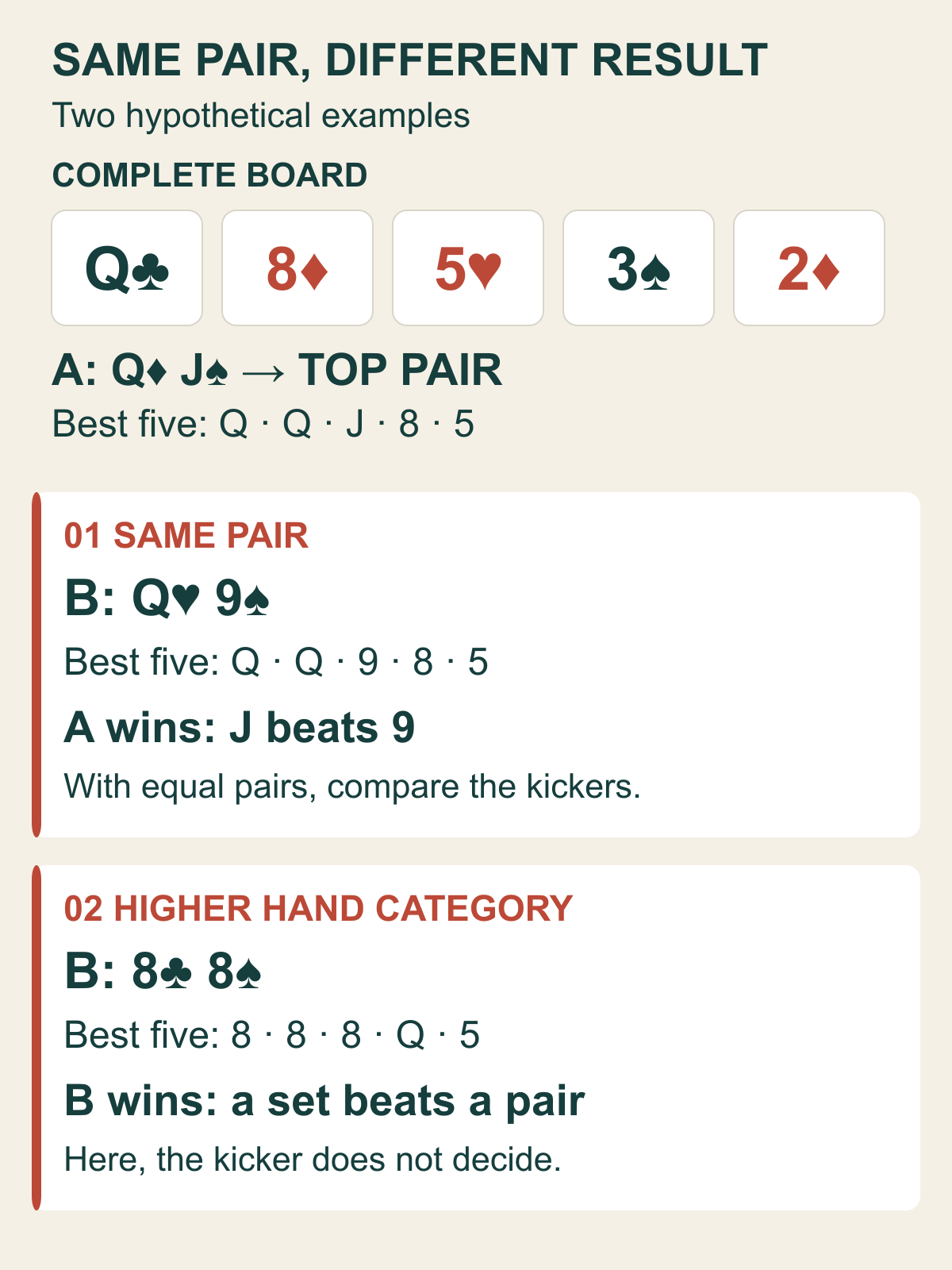
Hypothetical example: the complete board is Q♣ 8♦ 5♥ 3♠ 2♦. Player A holds Q♦ J♠, and Player B holds Q♥ 9♠. Both have top pair, queens, because each pairs the queen on the board with a hole card. A’s best hand is Q♦ Q♣ J♠ 8♦ 5♥, and B’s is Q♥ Q♣ 9♠ 8♦ 5♥. The pair is the same, and each player’s side card is part of their best five, so the higher one decides the outcome: A’s jack beats B’s nine, and A wins the pot.
Hypothetical example: on the complete board Q♣ 8♦ 5♥ 3♠ 2♦, Player A holds Q♦ J♠, and Player B holds 8♣ 8♠. A’s best hand is Q♦ Q♣ J♠ 8♦ 5♥, top pair, queens, with a jack kicker. B’s best hand is 8♣ 8♠ 8♦ Q♣ 5♥: two eights in hand and the third on the board make a set of eights, one of the hands that beat top pair. A’s kicker does not even come into the comparison, and B wins the pot.
Hypothetical example: on the complete board 9♠ 7♦ 6♣ 4♥ 2♠, which has connected cards, Player A holds 9♥ A♣, and Player B holds 8♠ 5♦. A has top pair, nines, with an ace kicker, a strong side card. A’s best hand is 9♥ 9♠ A♣ 7♦ 6♣. B’s best hand is 5♦ 6♣ 7♦ 8♠ 9♠, a five-to-nine straight using both hole cards and three board cards. The straight ranks above the pair, and B wins the pot.
What the three cases show. A’s hand was the same in the first two, and the result changed because top pair’s value depends on what is on the other side of the table. In the first case, the kicker only matters because both players have the same pair. In the second, B has a hand in a higher category, so comparing kickers serves no purpose. In the third, even top pair with a strong kicker lost to a straight on a board with connected cards, reinforcing the importance of texture. After recognizing top pair, the useful next question is which hands beat that pair on this board.
Next Step: Name the Pair, Then Assess the Context
When reviewing a hand, make a written record: the board, the highest card, your card that pairs it (or “none”), and the best five-card combination. If the pair comes from your hole cards, check whether it ranks above the entire board before calling it an overpair; for tiebreakers, use only the kickers in the best five [4]. Then list what could beat the pair: which combinations does the board favor, how many players are still in the hand, and which draws could improve on later cards? This separates recognizing the pair from assessing its strength.
To look up the other categories, the poker hand rankings provide the complete table.
Recommended reading
- Poker Hand Rankings: From Strongest to Weakest
- Kicker in Poker: Guide to Tiebreakers and Splitting the Pot
- Reverse Implied Odds in Poker: When Improving Costs More
Sources
- [1] What is Top Pair in Poker? — Upswing Poker, published June 9, 2025
- [2] Top Pair / Highest Pair: What It Means in Poker — Lobbyze, published July 13, 2026
- [3] Top Pair Strategy: Poker Hand Strength & Avoid Mistakes — SoMuchPoker
- [4] One pair — Poker.org, by Adam Hampton, published January 20, 2026.
 2 days ago