A value bet is a bet you make because you believe you have the best hand and expect a weaker hand to call. The purpose is to receive a call, meaning a match of your bet. The central question is: facing this bet, which hands worse than mine would call? Having a good hand and expecting a call from a worse one are two different parts of that assessment.
Value Betting in Poker: Compare Your Hand with the Calling Range
Your opponent may hold many hands, but only some of them would call the bet you are considering. The set of possible hands is called a range. The portion that calls is the calling range. Comparing your hand with all of your opponent’s possible holdings is different from comparing it with the hands that continue by calling.
This distinction is central to the assessment. GTO Wizard’s analysis explains that the main measure of the value gained by building the pot when called is your hand’s equity against the calling range. Here, equity is used to assess how the hand performs against the calling range at showdown, the final comparison of cards; it is not the same as the total value of betting. The reference point for this analysis is the calling range, rather than simply the entire range your opponent could hold before the bet.
Betting for Value and Other Reasons to Bet
A value bet is made in the hope that your opponent will call with the second-best hand; when bluffing, you hope for a fold, meaning the opponent gives up the hand. If only better hands called, those calls would not provide the source of value a value bet seeks. This does not eliminate every other possible reason to bet: getting folds is another source of value. The guide to bluffing in poker explores that other purpose.
Hypothetical Example: One Pair of Kings Against Another
A matchup helps separate the two parts. The rule for comparing one pair and its kickers considers the best five-card combination: first the pair and, if the pairs are equal, the other three cards in descending order. Those remaining cards are the kickers; suits do not break ties.
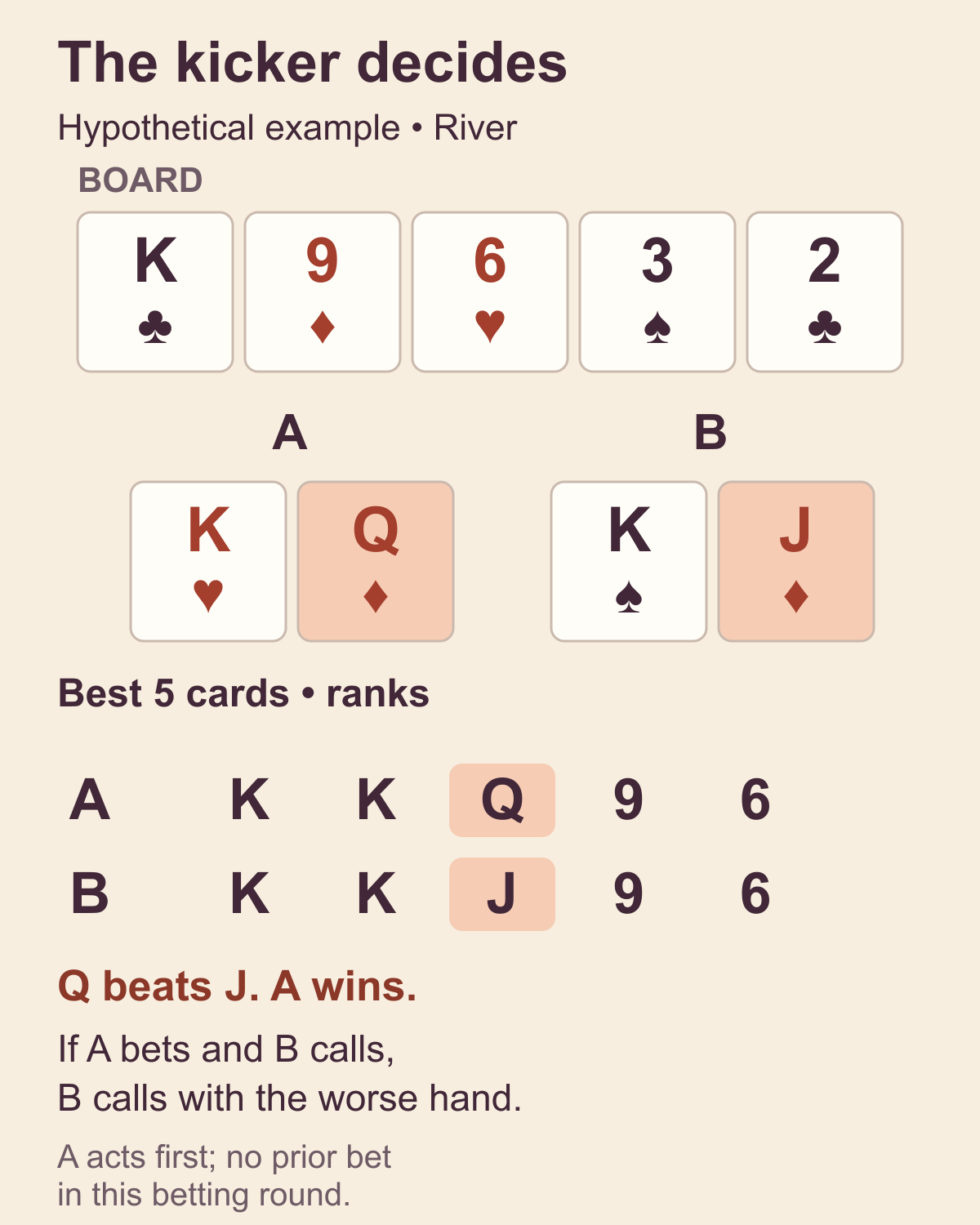
In a hypothetical Texas Hold’em example, the complete river board is K♣ 9♦ 6♥ 3♠ 2♣. Player A holds K♥ Q♦ and player B holds K♠ J♦. A’s best hand is K♥ K♣ Q♦ 9♦ 6♥, a pair of kings with a queen kicker. B’s best hand is K♠ K♣ J♦ 9♦ 6♥, a pair of kings with a jack kicker. The pairs are equal, but the queen beats the jack at the first difference between the kickers: A wins this matchup.
Now consider A as the first to act on this river, with no previous bet in the round. If A bets and B calls with that K♠ J♦, the call comes from a worse hand: it is the response a value bet seeks. Imagine that, against this opponent, KJ and KT call a half-pot bet but fold when you bet the full pot. In that case, KQ can still extract value from those pairs with the smaller bet. If you bet more, which worse hands would still call?
Thin Value, Sizing, and Number of Players
Thin value. This is a value bet made when you believe you are only slightly ahead. The purpose remains to get calls from worse hands; the difference is the small edge. When analyzing the value that comes from a call, the relevant comparison is still against the calling range. The guide to thin value in poker addresses this marginal decision.
Having both better and worse hands in the range does not tell you how much of an edge you have. It may be large, small, or nonexistent. When you believe you are behind the calling range, you lack the edge required for a thin value bet; when you believe you are far ahead, the edge is not small. The label depends on that assessment, rather than merely on the presence of both types of hands.
Sizing. The amount is one factor in a value bet. Good value bets are described as large enough to build the pot while still encouraging weaker hands to call. This does not make any particular size a value bet. Sizing and willingness to call belong to the same assessment. The guide to poker bet sizing explores how to choose the amount.
Number of players. There is a difference between heads-up pots, with two players, and multiway pots, with three or more. With more participants, the possibility that someone has a strong hand increases.
Assess the Decision Against the Range That Would Call
With KQ on this board, you might bet expecting KJ to call and end up getting called by AK. To assess the decision, consider the hands that would call that amount, including the times you would lose.
In the early postflop rounds, the value of betting also involves opportunities on later streets. A semi-bluff may win through a fold now or improve later; a value hand may have further betting opportunities. Showdown equity therefore does not, by itself, capture the full value of the decision.
Next Step: Check the Factors Behind the Bet You Are Considering
Assessing a value bet brings together hand strength, the likely range, the tendency to call or fold, and bet size. These questions concern the specific bet being considered:
- Strength: What hand do you have, and how does it compare with your opponent’s possible holdings?
- Range: Which hands do you consider possible, and which of them would belong to the calling range? Keep this distinction: assessing all possible holdings and assessing the group that calls answer different questions.
- Tendency: How do you assess this opponent’s willingness to call or fold?
- Amount: What size are you considering in this situation? The purpose of winning chips from weaker hands and their willingness to call need to be examined together. The definition does not provide a fixed size that works for every value bet.
 7 hours ago