
Equity in Poker: Hands, Ranges, and Share of the Pot
By the Editorial Team
Equity in poker is the expected share of the pot, accounting for wins and the share received from ties, assuming the hand reaches showdown with no further betting. Showdown is the comparison of hands after the final betting round, when more than one player remains in the hand. [1][2]
Three ways to compare hands
A range is a set of hands considered possible. The comparison changes depending on whether you enter a specific hand or that set. [1][3]
| Comparison | What goes into the calculation | What question it answers |
|---|---|---|
| Hand versus hand | One specific hand for each side | How do these hands perform against each other under the specified conditions? |
| Hand versus range | A specific hand on one side and a set of hands on the other | How does this hand perform against the set being considered? |
| Range versus range | A set of hands for each side | How do the two sets compare under the specified conditions? |
What to enter in a calculator
Enter your cards, the opponent’s hand or the range you are considering, and the known community cards. If you do not know their hand, use the range you want to analyze: the calculator evaluates that selection rather than discovering the opponent’s cards. [3][4]
Why ties count toward equity
For a matchup between two sides, with the pot split equally in ties, the formula is: [1]
Equity = win% + 0.5 × tie%
win% is the frequency of outright wins; tie% is the frequency of ties. The factor 0.5 counts the half of the pot each side receives when they tie.
GTO Wizard’s arithmetic example for two sides with an equal split in ties: wins 50%, ties 20%, losses 30%; equity = 50% + 0.5 × 20% = 60%. [1]
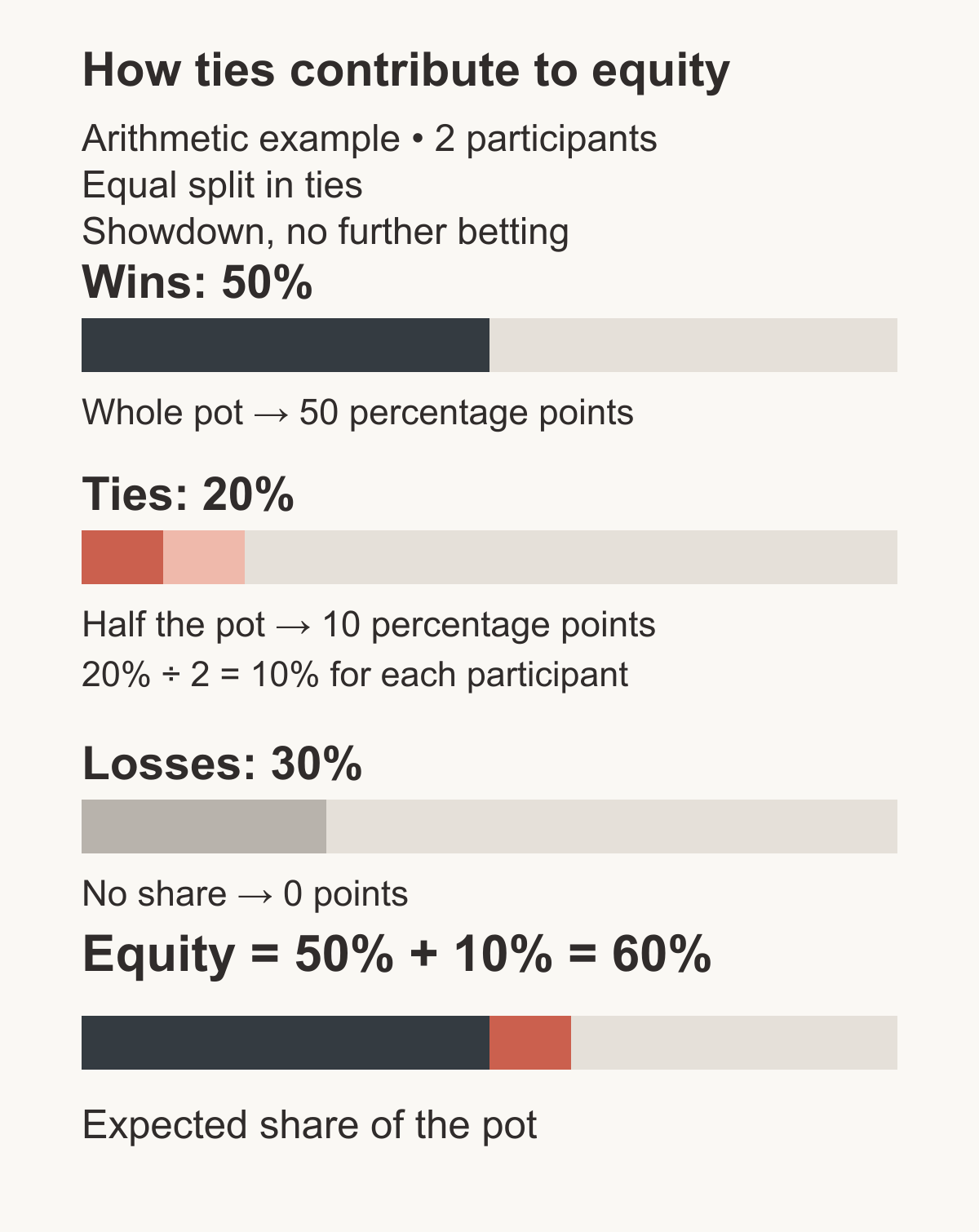
This is an illustrative distribution, not a calculation for specific hands or ranges. Ties contribute 10 percentage points on top of the 50 from wins, bringing the expected share to 60%. The factor 0.5 is not a general rule for pots with more participants.
Application: compare equity with the price of a call
Hypothetical cash-game example with two players, one pot, and no rake or fees. The opponent is all-in; you have not contributed in this betting round, can match the full bet, and there will be no further betting after your call. [1][2]
| Point in the hand | Amount |
|---|---|
| Pot before the bet | R$ 60.00 |
| Opponent’s all-in bet | R$ 30.00 |
| Pot before your call, including the all-in | R$ 90.00 |
| Amount you need to call | R$ 30.00 |
| Final pot after the call | R$ 120.00 |
You risk R$ 30.00 to contest a final pot of R$ 120.00. The price is 30 ÷ 120 = 25.00%; the pot odds before calling are 90:30 = 3:1. The 25.00% is the minimum equity needed to break even in chip expectation in this scenario, not the equity of a hand. [1][2]
To make the comparison, use the 60% from the earlier exercise as the given equity: 60% > 25%, so the call is above the break-even point in this scenario. In a real hand, compare the price with the equity calculated for your hand against the opponent’s hand or the range you are considering. This compares expectations; it does not guarantee winning that hand. [1]
Equity and equity realization
The all-in example removes future betting. When decisions remain, you may fold later or face further bets and fail to capture the entire share predicted by the cards. This difference is called equity realization; position and a range disadvantage can reduce it. [1]
That is why having enough equity for the current price does not automatically make a call profitable when more betting can follow. Likewise, holding the best hand now does not guarantee staying ahead after the next cards. [1]

 2 hours ago