Texas Holdem Poker Rules: Cards, Betting, and the Sequence of a Hand
In Texas Holdem, you receive two private cards and can use the community cards to make your best five-card combination. There are two ways to win the pot: remain in the hand after all your opponents fold or show the best hand at showdown, the final comparison of cards. If the best hands tie, the pot is split. [1][2]
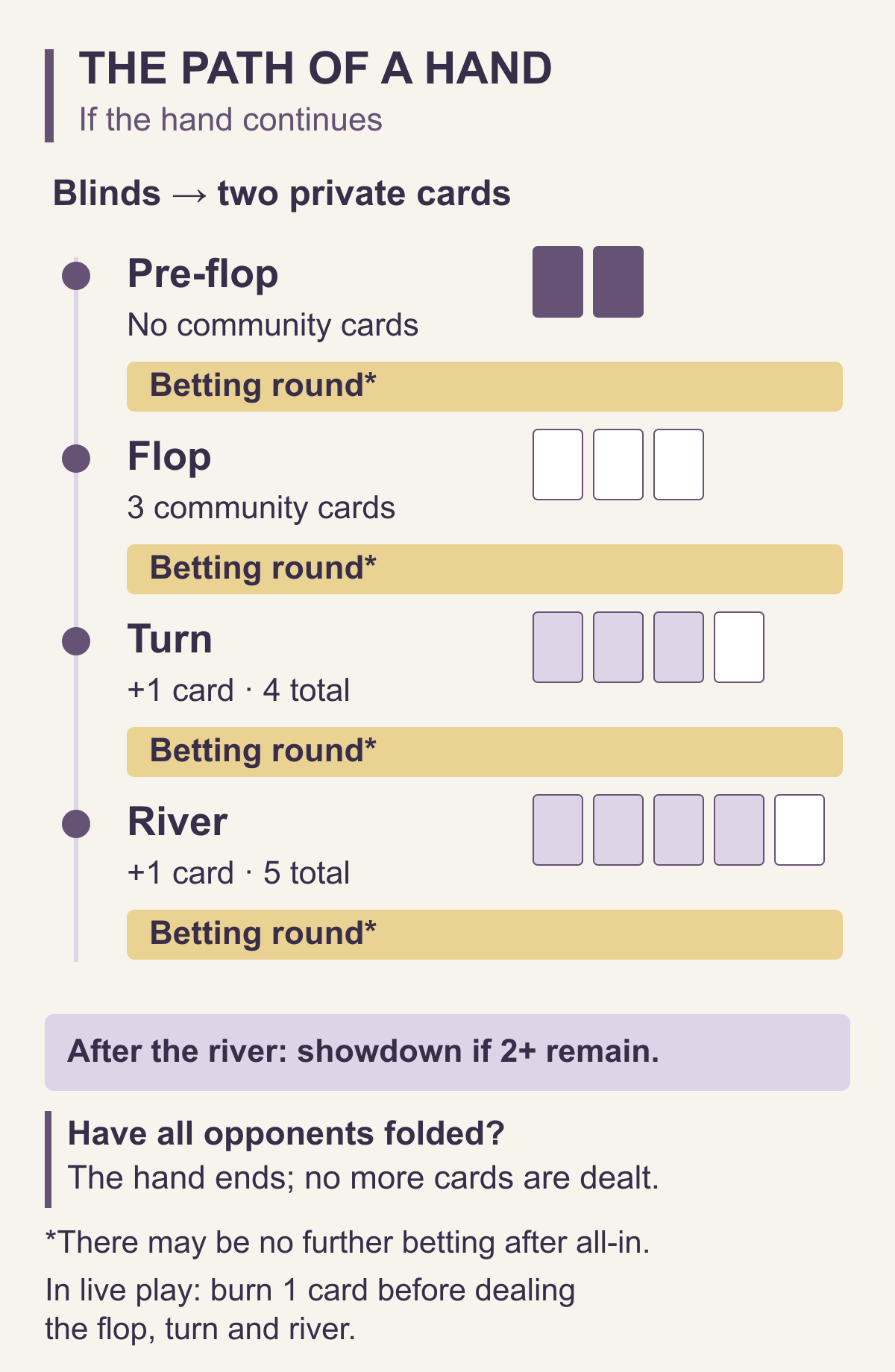
To follow a hand, you need to recognize whose turn it is, which actions are available, and when the next card can be dealt face up. The sequence starts with the blinds, moves on to dealing the hole cards, and continues through the betting rounds. The flop, turn, and river are only needed if the hand continues; a hand can end earlier when opponents fold. [1][4]
Before You Start: Cards, Positions, and Actions
Texas Holdem uses a 52-card deck. Each player’s two face-down cards are called private cards or hole cards. The face-up cards in the center of the table are community cards: all players still in the hand can use them. This set of cards is also called the board. [2]
The button, or dealer button, marks the dealer’s position. It serves as the reference point for locating the blinds and determining the order of action. [1][2]
Before playing, check the table’s blind amounts and betting structure. The big blind is usually twice the small blind, but this ratio can vary. Some formats also require an ante, an additional forced bet posted before the hand. Therefore, having blinds does not rule out having an ante. [1]
What Each Action Means
Your options depend on what has already happened in the round. These are the terms you will encounter during a hand:
| Action | What it means | Main condition |
|---|---|---|
| Check | Stay in the hand without betting at that moment | There must be no outstanding bet for you to call |
| Bet | Make the first bet of the round | No bet has been made in that round yet |
| Call | Match the current bet | There is an amount to match |
| Raise | Increase the current bet | The raise must comply with the betting structure |
| Fold | Give up your hand | Chips already committed remain in the pot |
| All-in | Put all your available chips into play | The player remains in contention, but their eligibility is limited to the amount they have covered |
Checking and calling have different effects. A check adds no chips; a call matches a bet. When facing a bet, before committing to your action, you can fold, call, or raise when raising is available. The mere absence of a raise does not allow you to check: there may still be an outstanding opening bet. [1][2]
The structure also matters. In Fixed-Limit, bet and raise amounts are predetermined, with smaller amounts pre-flop and on the flop and larger amounts on the turn and river. In No-Limit, you can bet all your available chips. These differences do not change the card sequence, but they do change the amounts allowed for each action. [2][3]
Texas Holdem Poker Rules: Follow a Hand Step by Step
1. Post the Blinds Before Dealing the Cards
The blinds are forced bets that start the pot before players receive their cards. There are two: the small blind and the big blind. Their amounts are set by the table or tournament structure, rather than by a single amount that applies to every Holdem game. [1][2]
With three or more players at the start of the hand, locate these positions from the button: first the small blind to its left, then the big blind. At a table that begins the hand heads-up, with only two participants, the button posts the small blind and the other player posts the big blind. [1][2]
These positions need to be identified before the deal because they also determine who starts the first betting round.
2. Deal Two Hole Cards to Each Player
Each participant receives two face-down cards. In a hand with three or more players, dealing begins with the small blind and proceeds clockwise until everyone has two cards. In heads-up play, the button/small blind receives the last card. [2][4]
No community cards have been dealt face up yet. This stage is pre-flop, which is also the name of the first betting round. Hole cards belong only to the player who received them; the community cards that appear later will be available to everyone still in the hand. [1][3]
3. Conduct the Pre-flop Betting Round
With three or more players, the first to act is the player immediately to the left of the big blind, a position called under the gun, or UTG. Action proceeds clockwise. Since the big blind is already a live bet, the first player can fold, call, or raise. [1]
The posted blinds count toward this round. If the big blind has posted the full amount and no one raises, they can check when their turn comes because there is no difference to pay. They can also raise, subject to the game’s structure. [2][3]
In heads-up play, the initial order changes: the button/small blind acts first pre-flop. The big blind acts next. This exception applies when the hand begins with two players; if a hand began with more participants and only two remain after folds, the button and blind positions do not change during the hand. [2]
The round does not necessarily end after each person has acted once. A raise can require further decisions from players who have already acted. To continue, players need to match the current bet, except those already all-in. Anyone who folds takes no part in subsequent actions. [1][4]
4. Deal the Flop and Start Another Round
In a standard live deal, after pre-flop betting ends, the dealer takes the top card from the deck and places it face down in the discard pile without using it in the hand: this is burning a card. The dealer then reveals three community cards at once, the flop. [5] All players still in the hand can use them. From this point on, action begins with the first player clockwise to the left of the button who is still in the hand and able to act. Players who have folded or are already all-in take no part in betting decisions. When the button is still in the hand and able to act, they are last in the post-flop order. [1][2]
With no outstanding bet, a player can check or bet. After a bet, the others must choose between folding, calling, or raising when a raise is available. If all players able to act check, the round ends without any additional chips being bet. [1]
In a heads-up hand that began with two participants, the big blind acts first on the flop and the button/small blind acts last. The same order applies on the turn and river. [2]
5. Deal the Turn After Flop Betting Ends
The turn is the fourth community card. In a standard live deal, after the flop betting round ends, the dealer burns another card and only then reveals the turn. A new betting round follows. [5] The button remains the reference point for the order: the first to act is the nearest player clockwise to its left who is still in the hand and able to act. The options follow the same logic as on the flop, depending on whether there is a bet to call. [1]
The turn adds a card to the available set, but it does not yet end the hand. If all opponents fold during this round, the remaining player wins the pot without needing to wait for the river. [2][4]
6. Deal the River and Conduct the Final Betting Round
The river is the fifth and final community card. In a standard live deal, once turn betting ends, the dealer burns a third card before revealing the river. The final betting round follows. [5] There is no sixth community card in the normal Texas Holdem sequence. With the board complete, each player has their two hole cards and the five community cards available. Even so, the hand being compared contains only five cards. The river betting round must end before the final comparison if more than one player remains. [1]
If a bet causes all opponents to fold, the remaining player wins without needing to show their cards. This outcome can occur in any round, not just on the river. [4]
7. Compare the Best Five Cards at Showdown
When two or more players remain after the final betting round, showdown takes place. Each player uses the best five-card combination available from their two hole cards and the five community cards. [1]
You can make this combination with:
- Two hole cards and three community cards.
- One hole card and four community cards.
- No hole cards and all five community cards. [4]
Receiving two cards therefore does not require you to use both. There is also no requirement to use exactly three community cards. This freedom to build your hand is a Texas Holdem rule; it should not automatically be applied to other poker variants.
The hands rank as follows, from strongest to weakest. A royal flush is the highest straight flush. [2][4]
| Hand | Composition |
|---|---|
| Royal flush | 10, J, Q, K, and A of the same suit. |
| Straight flush | Five cards of consecutive ranks, all of the same suit. |
| Four of a kind | Four cards of the same rank and a fifth card. |
| Full house | Three of a kind and a pair. |
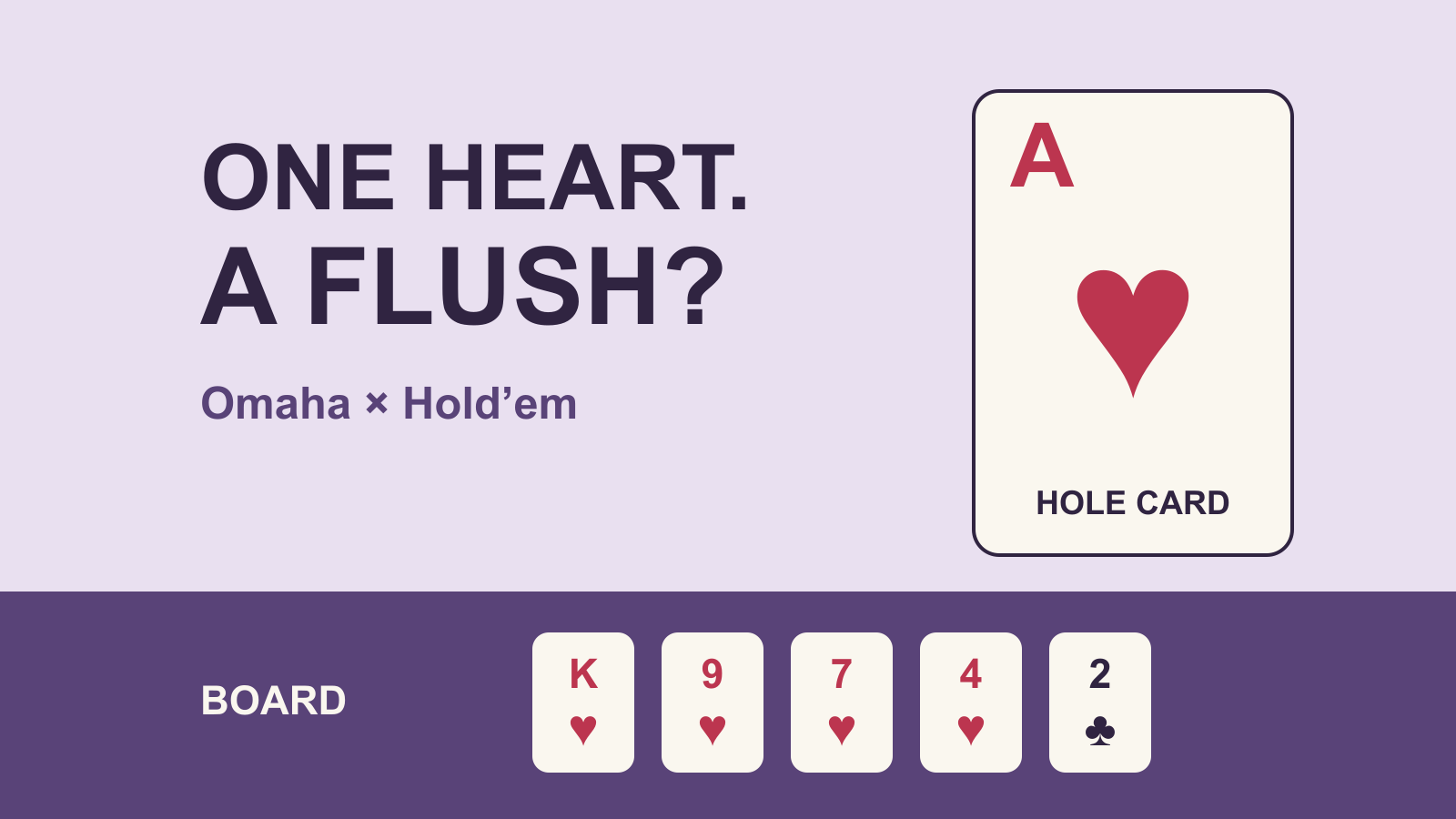
| Flush | Five cards of the same suit that do not form a straight. |
| Straight | Five cards of consecutive ranks that are not all of the same suit. |
| Three of a kind | Three cards of the same rank, plus two cards of different ranks from each other and the three of a kind. |
| Two pair | Two pairs of different ranks and a fifth card of another rank. |
| One pair | Two cards of the same rank, plus three cards of different ranks from each other and the pair. |
| High card | Five cards that do not form a pair, straight, or flush. |
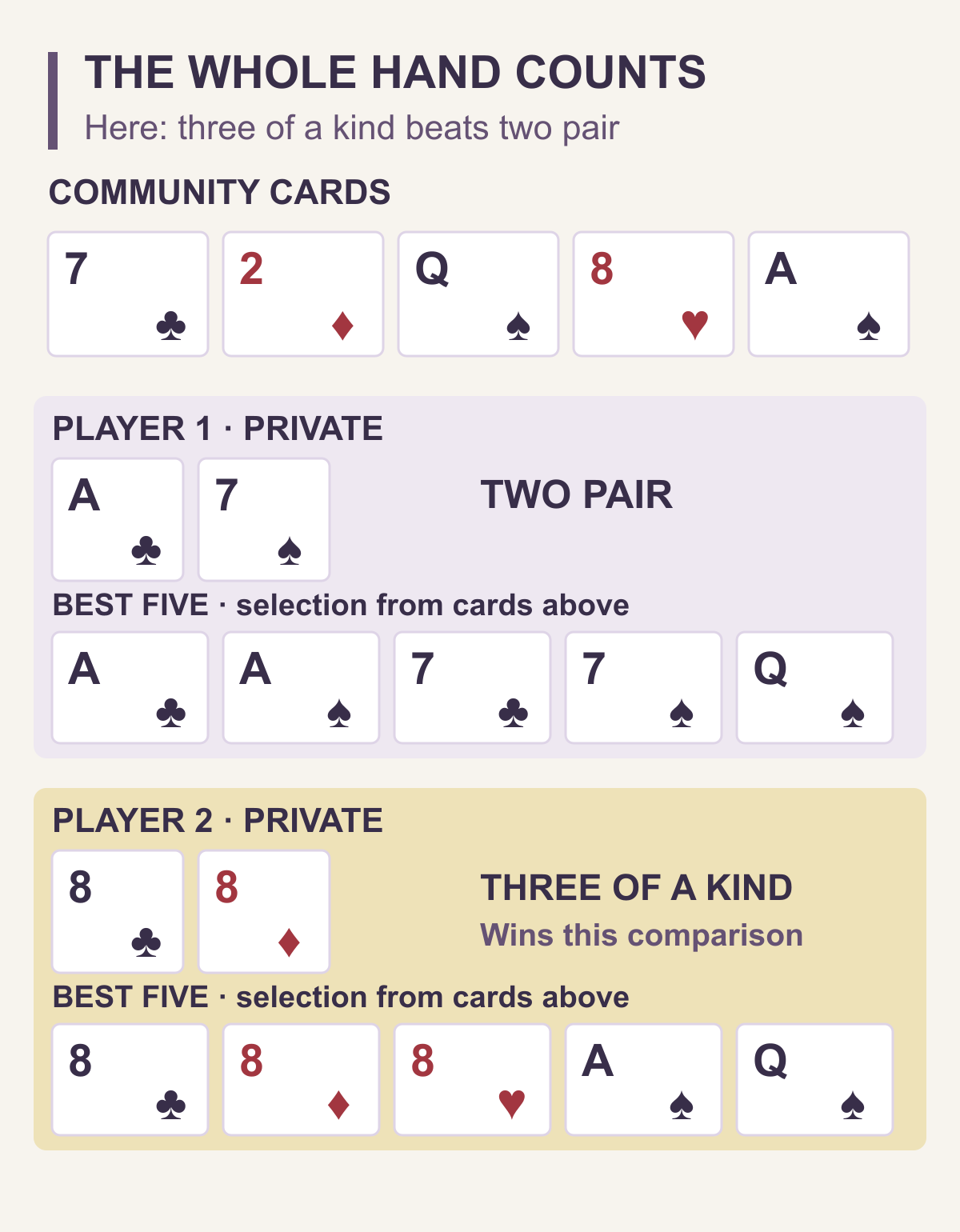
An example published by PokerNews shows the board 7♣ 2♦ Q♠ 8♥ A♠. The player with A♣ 7♠ has two pair, aces and sevens. The opponent with 8♣ 8♦ has three of a kind, eights, and wins this comparison. The example shows why you need to identify the complete hand category before comparing individual high cards. [4]
When the categories are the same, the comparison order for that combination applies. Between two full houses, the higher three of a kind wins; if the three of a kind is the same, compare the pairs. Between two four-of-a-kind hands, the higher-ranked four of a kind wins. If the four of a kind is on the board, the fifth card breaks the tie. In this case, it is the kicker, a card that can break a tie without being part of the main combination. The kicker is not a universal tiebreaker for every category. [2]
The pot is split when the best five cards tie in category and in every rank relevant to the comparison. No suit takes priority to break this tie. [1][2]
How to Check the Result and Resolve Questions During a Hand
When following a game, use the question that comes up to find the corresponding rule:
- Unsure whose turn it is? Check the button, the current round, and who can still act. Before the flop, the reference point is the big blind; after the flop, it is the button. If the hand began heads-up, apply the specific order for two players. [1][2]
- Unsure whether checking is allowed? Check whether that player has any outstanding amount to call. A fully posted big blind with no pre-flop raise is one case where there is no difference left to pay. [2]
- Has someone put in all their chips? Going all-in is not the same as folding. That player remains in contention but can only win the portions covered by their contribution; having no chips left does not require them to leave the hand. [2]
- Unsure who wins? Separate each participant’s best five cards and identify the category before applying tiebreakers. At showdown, what the cards show counts, even if someone announces a different combination. [2]
A hand is over when only one participant remains after folds or when the showdown result determines who receives the pot, including any split. After the chips are awarded, the button moves clockwise, the blinds and any antes are posted again, and another hand begins. [1][2]
Sources
- [1] Texas Hold’em Poker - Play Free Texas Hold’em Poker Games — PokerStars
- [2] Texas Hold'em Rules: Complete Guide — CBTH, July 21, 2024
- [3] How to Play Texas Holdem Poker | Texas Holdem Rules — 888poker
- [4] Texas Hold'em Poker Rules — PokerNews
- [5] Basic Poker Rules Every Player Should Know — CardPlayer, November 18, 2024.
 1 hour ago