To play poker at home, the host needs to settle four things before dealing: who is coming, where the game will take place and what equipment it needs, what agreements apply at the table, and how the first hand begins. The quick route is to confirm your guests, set up the space with a deck and chips with no monetary value, agree on the format, and start the first hand with the button, the blinds, and two face-down cards for each player.
This guide covers an evening of in-person Texas Hold’em with friends and ends when the first hand is underway.
How to Play Poker at Home: What the Group Agrees On and What an Official Event Already Defines
Separate the rules of the game from your house agreements. Texas Hold’em rules govern how cards are dealt and the order of action. To organize the gathering, the group can put the schedule, format, and who will resolve questions in writing. That way, anyone still learning knows where to check the agreement before sitting down.
In a tournament, consult the event’s specific rules. Under the Brazilian reference rules, the supervisory team, known as the floor, makes the final decision when a question arises. The first rules column in the table below describes that tournament context. The last offers suggestions for the host to adapt to a home game.
What You Need Before Inviting Guests
Get these essentials together before sending the first invitation:
- Knowledge of the rules. The host guides the first hand, so they need to know Texas Hold’em rules and hand rankings. If you will be handling the deal, it is worth reviewing the Texas Holdem poker rules: cards, betting, and the sequence of a hand.
- A comfortable place without distractions. The living room or dining room is a good option. Decide beforehand on two things that can divide guests: pets at the table and a soccer game on TV, which some people want and others prefer to avoid.
- A deck and chips. Set aside a deck in good condition and chips that players can distinguish at the table.
- The dealer button. This disc marks the dealer position, the reference point for the blinds and the order of action.
- Someone to shuffle and deal. Confirm that whoever will deal knows how to shuffle and deal the cards so that questions can be resolved quickly.
- Snacks and drinks. Taking care of food and drinks is part of hosting.
Step by Step: Organizing the Game
1. Set the Date, Time, and Duration
Choose a day and time, and tell everyone how long the evening is expected to last. Starting early in the evening is a good option, leaving some flexibility for people who arrive as the game progresses. Decide in advance whether the session will run late or have a set end time so it does not drag on. If a guest has never played, let them know the evening could be long, depending on the format.
2. Confirm Your Guests
Create a group chat or another shared channel for everyone. That way, you know who is taking part and can notify everyone at once if anything changes. In the first invitation, include the date, time, address, and expected duration. Use the confirmations to agree on the format in step 4. Then let the group know what was chosen.
Ask for confirmation and finalize the list before the day. The number of confirmed guests determines how many seats you prepare and influences the choice of format: the PokerNews guide suggests a tournament when there are more than 10 players and room for two tables.
3. Prepare the Space, Deck, and Chips
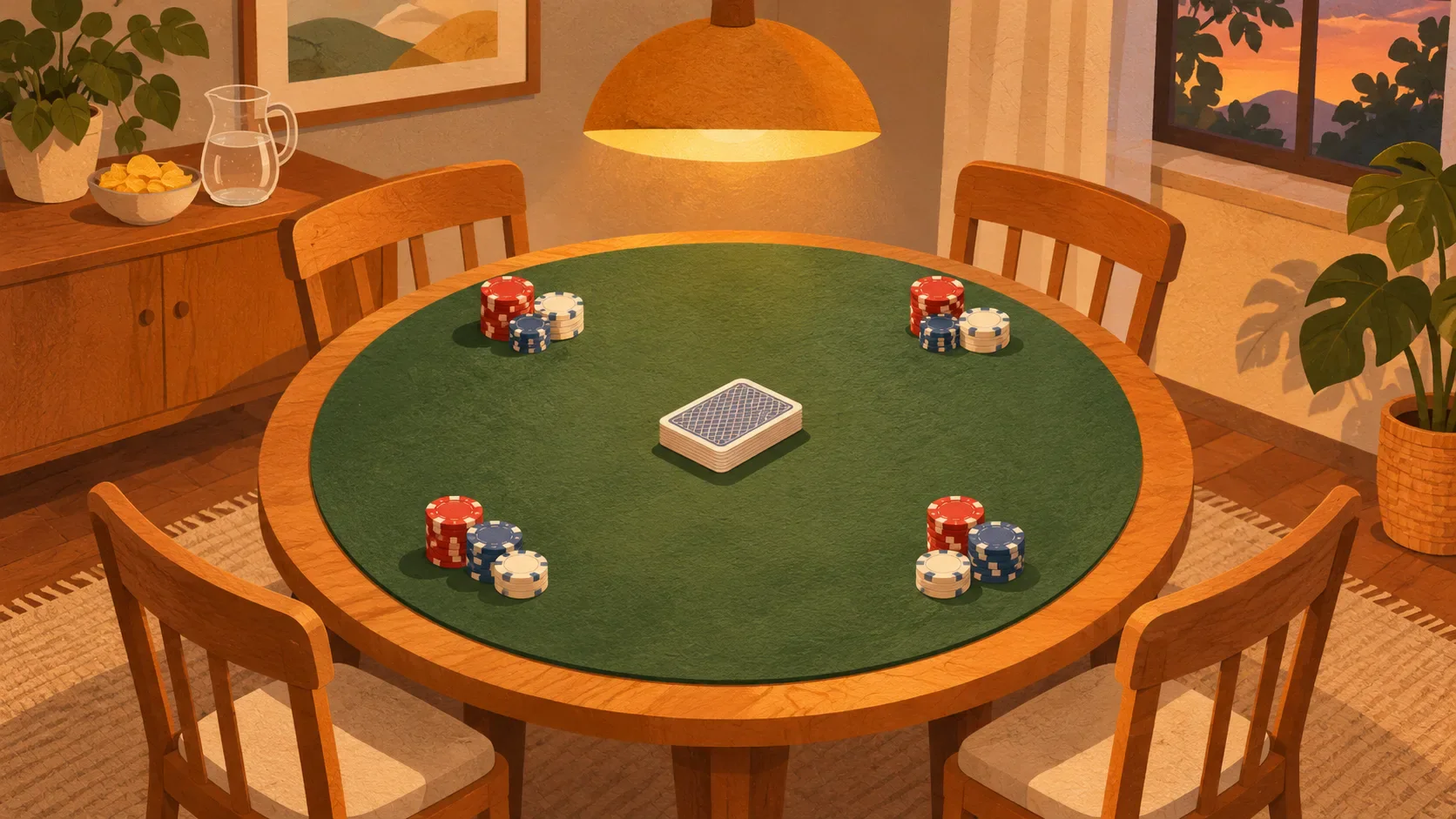
Arrange a seat for each confirmed guest, leave room for the chips and dealer button, and settle the TV question. Before guests arrive, check the full deck for all 52 cards, with no duplicates or jokers. If a card is missing or duplicated, replace the deck and check the new one before dealing.
4. Agree on the Format
If the group chooses a tournament format, everyone starts with a predefined number of chips, the blinds increase at each level, and players are eliminated until one winner remains.
For the tournament, the host decides:
- Starting chips: decide the total value each player starts with and prepare stacks of equal value. Explain what each color or denomination is worth. Include enough small chips to post the starting blinds and make change.
- Starting blinds: two chip amounts, one for the small blind and another for the big blind.
- Ante: an additional mandatory bet posted before the hand. Some formats use it, but you can play with blinds alone.
- Blind increases in the tournament: agree on how often they will rise. With the same starting chips and blind schedule, longer levels give players time for more hands at lower blinds and usually leave more room for postflop decisions.
- Eliminated players: anyone who goes out early may have a long wait until the game ends. Plan how to include these guests in the rest of the gathering.
5. Agree on Table Arrangements
Use the tournament column to understand the reference rule and the last column to settle the organizational decisions for your table.
| Topic | At an Official Event | At Your Home Table |
|---|---|---|
| Seats | In tournaments and satellites, seats are assigned randomly | Choose a method, such as a random draw, before sitting down |
| Rules questions | The supervisory team (floor) decides, and its decision is final | Choose who will consult the reference rules and guide the table when a question arises |
| Phones and apps | Players involved in a hand may not operate electronic devices. Anyone with a live hand also may not use betting apps, reference charts, or other poker strategy tools | Decide whether to adopt the same rule or a different one |
| Declaring actions | Simple, unmistakable terms (bet, raise, call, fold, check, all-in); tapping the table lightly means check | Adopt the same terms and gestures |
| Placing chips | A single chip larger than the bet, without an announced raise, counts as a call; string bets are not allowed | State aloud whether the same will apply |
| Blinds and ante | In a tournament, blinds increase at each level; the ante is an additional mandatory bet posted before the hand | Agree on starting blinds, whether and how often they will increase, and whether there will be an ante |
The first four rows of the official event column summarize the ADTP tournament rules (2025 edition). The remaining rows come from the Texas Hold’em rules guide. In that guide, a string bet means betting “in several trips”: putting in some chips, returning to your stack, and adding more without having announced the amount beforehand. To see how to recognize this at a table, read the article on string bets in poker.
6. Deal the First Hand
Hand out the agreed starting stacks before anyone posts blinds or deals cards. At a table with three or more players, follow this order:
- Each guest sits in their assigned seat.
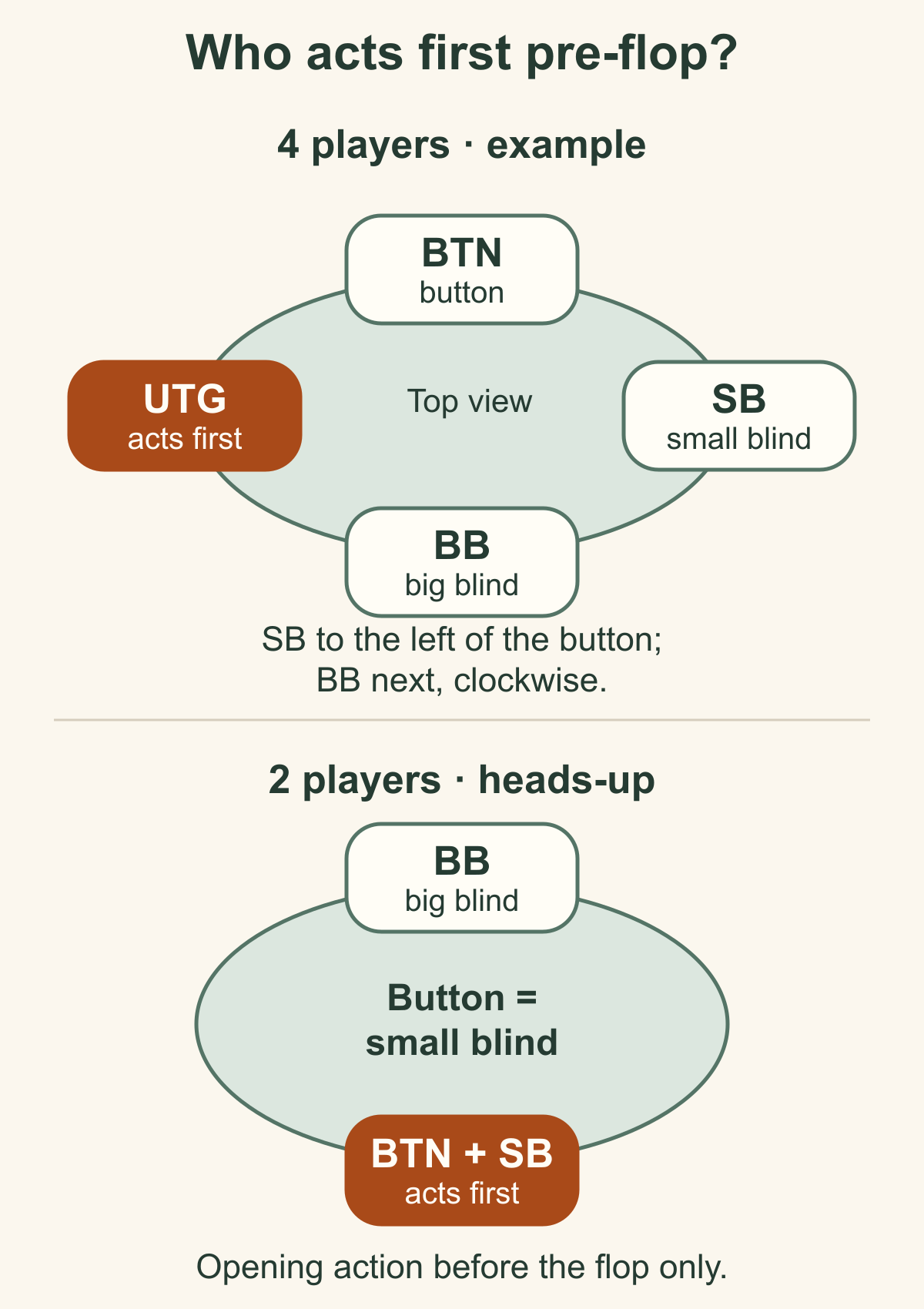
- Place the dealer button in front of a player. The small blind is immediately to the left of the button, and the big blind is next, also to the left.
- The small blind and big blind post their blinds, and the ante is posted if agreed.
- The dealer gives each player two face-down cards, and everyone checks that they received the correct number of cards.
- Action begins to the left of the big blind, in the position called UTG, and moves clockwise, following the preflop rules. If there is a raise, action continues among players able to act who still need to respond. Anyone who has folded or already committed all their chips by going all-in does not act again in that hand.
- On their turn, when facing a bet, a player can call, raise, fold, or commit all their remaining chips (go all-in), depending on the situation. If there is no outstanding bet for them to match, they can check. Before the flop, if action reaches the big blind without a raise, they can check because the amount they have already posted covers the current bet.
Once the cards have been dealt and the first player able to act has been identified, the game has begun. Preparation ends there.
Practical example: the group is down to two players. Use the heads-up case in the CBTH rules guide. With only two players, the same person has the button and posts the small blind. They receive the last card of the deal and act first before the flop. The other person posts the big blind. To check the setup, point to the button first and see whether it is with the person who posted the small blind. If the button is at the big blind’s seat, correct its position before dealing.
How to Use This at Your Table: Final Checks and a Backup Plan
Check things at two stages. Before dealing, you can check the table and what everyone agreed on. Only after the deal can players check the cards they received.
Before Dealing
- People and seats: check who has arrived and reserve a place for each participant. With two players, use the button placement from the example.
- Equipment: set aside the checked deck and make sure everyone has received their agreed starting stack.
- Starting the hand: review the agreed schedule and format, identify who will deal, and confirm the small blind, big blind, and ante, if any.
- Questions: keep the rules the group chose to consult accessible, and confirm who will guide the table if an error occurs.
After Dealing and Before the First Action
- Cards and amounts on the table: ask each person to check, without revealing the card faces, that they received two face-down cards. Check that the agreed blinds have been posted.
- First action: identify who acts first for the table’s configuration. At a table with three or more players, look for the position to the left of the big blind. In the example’s configuration, the person with the button acts first. Check these positions before accepting a bet.
If something does not go as planned, address the problem you can identify:
- The number of guests has changed: rearrange the seating and check the button and blind positions before dealing.
- There is a question about an action or the deal: ask the table to wait, identify the error, and consult the rules the group chose to use. If you adopted the tournament rule for a deck containing two cards of the same rank and suit, the hand is stopped and the bets are returned. Discuss changes to your agreements between hands, after resolving the current situation.
- An action seems ambiguous: check with the person guiding the table how the chosen rule applies to what the player announced. For the next hand, review the way of declaring actions agreed on at the start.
Write down what the group adjusted: next time, the invitation can go out with the agreements already in place.
 2026-11-15