
A string bet is a bet or raise in which a player places chips on the table in more than one motion without announcing the total aloud before starting [1][2]. When placing chips, if you declare the amount before moving them or push them all forward at once, there is no string bet.
The rule governs the procedure—how the actions of betting and raising are performed at a live table—and not how much to bet. To assess how the chips were placed, two questions are enough: was the total announced before the first chip left your hand? If not, did the chips go in with a single motion? Only when both answers are “no” does placing chips in stages constitute a string bet.
A binding verbal declaration, however, takes precedence over that test. Declaring the total before acting defines the entire action at once. Announcing a call and then trying to raise is the verbal form of a string bet: the spoken word has committed the player to calling, and the subsequent raise is not allowed, regardless of how the chips are placed [3].
Example: Three US$5 Chips, Then Two More
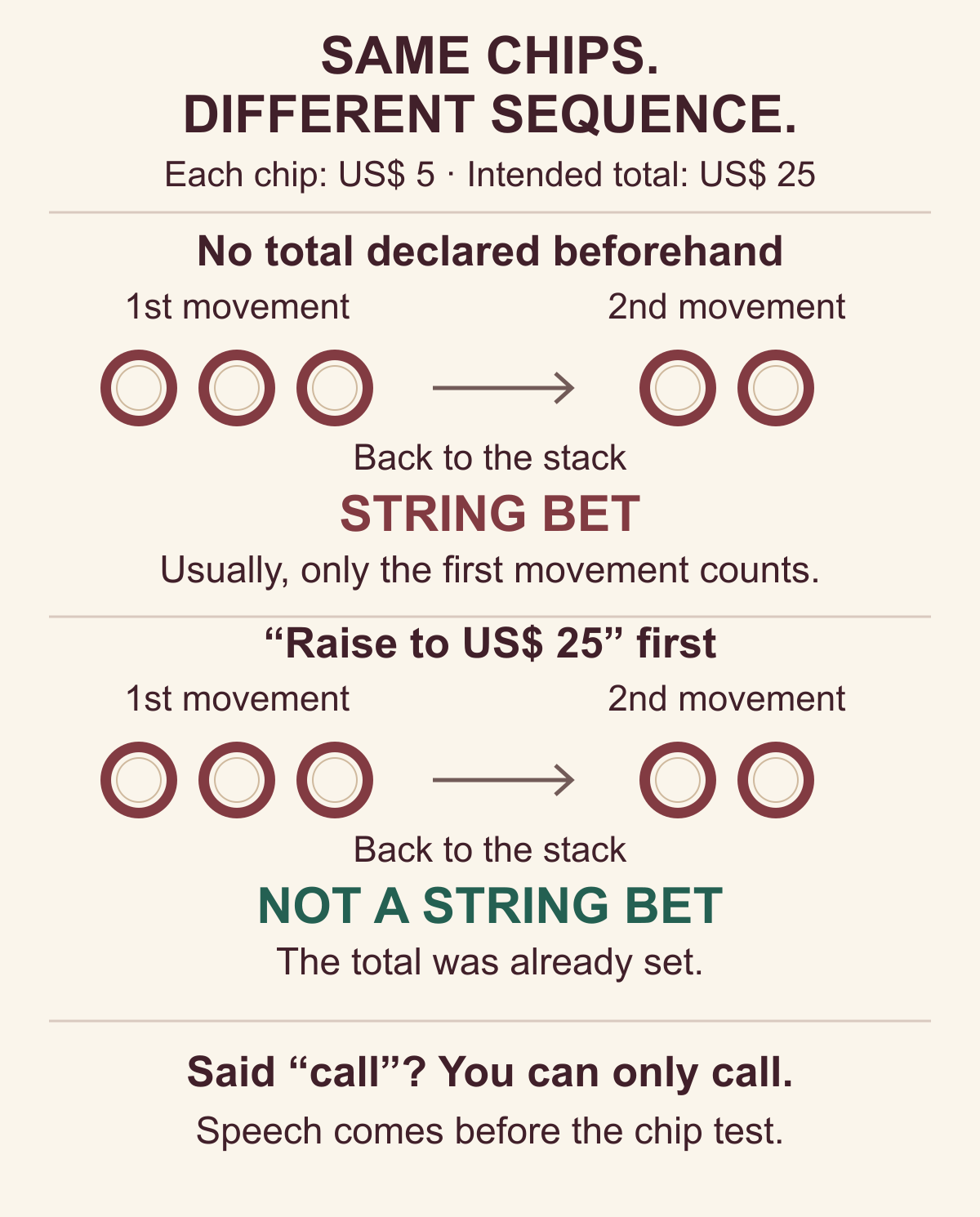
On the flop, nobody has bet yet. In this example, the table permits opening bets of US$15 and US$25. Without announcing an amount, you put three US$5 chips into the pot. You then return to your stack for two more. Generally, the initial US$15 bet stands [1][2]. If you wanted to bet US$25, you could have announced that amount first or placed all five chips in a single motion [1][2].
Apply the two opening questions: the total was not announced before the first chip, and the chips went in through two motions. The second trip to the stack therefore does not complete the opening bet to US$25 [1][2].
The first two rows keep that flop with no earlier bet. The third shows a different situation, with a bet to call:
| Player’s choice | Interpretation |
|---|---|
| Says “I bet US$25” before moving the chips, then places the five US$5 chips in one or several motions | Not a string bet: the opening-bet total was declared before the first chip [2] |
| Says nothing and pushes the five US$5 chips forward together in a single motion | Not a string bet: the US$25 opening bet went in at once [1] |
| Facing a bet, says “call” and then tries to add chips for a raise | The call stands: the verbal declaration has already defined the action [3] |
In the first two rows, the intended total remains US$25; what changes is the sequence of speaking and moving the chips. The first row shows that, with the total announced beforehand, placing the bet through several motions does not create a string bet [2].
The upper panel illustrates the opening bet placed in stages. The lower panel uses a separate raising situation: its US$25 total assumes a raise permitted at that table. Both focus on the movements of the same five chips; when facing a bet, saying “call,” as in the footer, still commits the player to calling [1][2][3].
String Bets: The Two Conditions That Define Them
Returning to your stack to put in more chips through another motion, without announcing the total before the first chip, combines the two conditions of a string bet; declaring the total first or placing all the chips in a single motion avoids this chip-placement violation [1][2].
Declaring the Total or Announcing a Call: Why They Are Different
When you state the total before touching the chips—for example, “raise to” followed by the amount—the entire action is defined before the first motion, and the chips simply carry it out [2]. When you announce a call and then try to raise, the action has already been defined as a call, and the raise comes too late.
In the spoken version, verbal declarations are binding at the table: anyone who says “call” can only call and must complete the call, even if they add “and I raise…” afterward. The phrase “I call and raise you this much,” which appears in many movies with poker scenes, is treated as the verbal form of a string bet and is not allowed in any game [3].
In the version involving chips, the term is string raise. It occurs when a player declares “raise”—or pushes forward enough chips to call—and, in another motion, adds the chips needed to complete the raise, without having stated the total at the outset. The most common scenario is pushing forward the call amount, withdrawing the hand, and only then pushing more chips forward for the raise [2]. In both cases, the safe approach is the same: announce the raise and the total before moving any chips or saying “call.”
Why the Rule Exists
The main purpose is to prevent angle shooting—actions that exploit loopholes to gain an unfair advantage. Someone who deliberately puts in part of a bet, observes an opponent’s reaction, and only then decides whether to complete the amount gains information they would not legitimately have [1][2].
The rule also protects the pace and clarity of the hand. Hesitation and multiple motions delay decisions for everyone at the table and cause frustration, while clear procedures reduce uncertainty about what the player intended to do, lowering the chance of disputes [2][3].
What Changes from Table to Table
String betting is not allowed in most organized games [1], but what happens when it is identified does not follow a single standard. The typical outcome is that only the first motion of chips counts as the bet or raise, and the player cannot complete the amount afterward, having seen other players’ reactions. Chips placed after the first motion are generally returned to the player, reducing the intended amount, which can force them into a less favorable action [1][2].
That “generally” depends on the house. Enforcement varies with the room, the dealer—the person running the hand—and the players at the table. In some rooms, the dealer must enforce the rule whenever they see a violation, even when the player’s intended bet is obvious and everyone agrees. In others, such as some rooms in New Hampshire, the dealer cannot even point out a string bet: a player at the table, whether in the hand or not, must speak up, and only then does the dealer explain that only the first amount placed beyond the line counts. In those rooms, the issue overlaps with etiquette, because most players who are out of the hand say nothing [3].
There is also the point at which the bet becomes final. Without a prior declaration, the amount placed in the first continuous motion stands, and the player generally cannot add more based on other players’ reactions [1]. When chips are released one at a time, the bet becomes final when the first chip crosses the betting line—or leaves the hand toward the middle of the table when there is no line—but this exact cutoff depends on the house [3]. That is why the question “what is the penalty?” has no single answer: the applicable answer is the one at the table where you are playing.
Frequently Asked Questions
Is a string bet the same as angle shooting? Not necessarily. A player can make a string bet accidentally. If they deliberately put in part of the chips to observe an opponent’s reaction before deciding how much to bet, that is angle shooting [2][3].
Does the rule apply only to bets? No: it applies to both bets and raises [1]. For a raise, the violation is also known as a string raise [2].
Is someone penalized for making a string bet accidentally? It depends on the table. The slip can happen to someone new to live poker who is still struggling with placing chips and making verbal declarations [2]; some casinos enforce the rule for every player, but many dealers and players overlook a beginner’s mistake and explain the rule after the hand [3].
Next Step: How to Bet or Raise Without String Betting
The next time you bet or raise at a live table, decide how you will do it before touching the chips:
- Define the action first. If you intend to raise, start with the raise and the total, rather than a call: anyone who announces a call is bound to it [3].
- State the total, then carry it out. With the amount declared, the order in which the chips go in no longer matters, and your intention is clear to the table, reducing misunderstandings [2].
- Or say nothing and push everything forward at once. In that case, the necessary chips need to go in with a single motion; organized stacks make it easier to get the exact amount without returning to the main stack [1][2].
To review a play you saw or made, first check what was said—a spoken “call” already defines the action—and only then apply the two opening questions to the chips.
Recommended reading
- Calling in Poker: What It Means to Match a Bet
- Texas Holdem Poker Rules: Cards, Betting, and the Sequence of a Hand
- Poker Straddle: Blind Bet, Action Order, and Table Rules

 12 hours ago