The stop and go is a two-stage play in Hold'em tournaments. Before the flop, you simply call an opponent's raise: that is the "stop." When the flop, the first three community cards, is dealt, you act first and go all-in with all your remaining chips: that is the "go." The definition of a stop and go as a call out of position with a plan to bet as soon as the flop is dealt captures the idea and notes that the play usually appears in tournaments, rather than cash games.
Why delay the all-in? The price your opponent pays is the same in both lines. What changes is the decision they face. Calling your all-in before seeing the flop is one choice. Calling after seeing three cards that may not have helped them is another, very different one. For someone playing with few chips, this two-part play used by short stacks in tournaments can produce an extra fold.
The Stop and Go in Poker: From the Raise to the Flop All-In
Follow the hand from the preflop raise to the flop shove.
- The button raises preflop. The earlier players have folded. After the raise, the small blind folds as well.
- You call from the big blind. You match the raise and keep the chips you plan to bet on the flop. Only the two of you remain in the hand.
- On the flop, you act first and shove. As soon as the three community cards are dealt, your opening bet is for your entire remaining stack.
What makes this sequence a stop and go is the plan. The flop all-in is decided before you see the cards and applies, in principle, whatever the flop brings, whether it helps your hand or not. Calling without that plan is simply a call.
Why not shove before the flop? If you reraise all-in now, your opponent decides whether to call before seeing any board cards. Calling the raise and keeping chips back for the flop delays that decision. If your opponent folds to the flop bet, you can win the pot without a showdown, even with the weaker hand. That chance to win because the other player folds is called fold equity.
A Tournament Example Against a Single Opponent
The following case comes from the PokerNews article on the stop and go: a tournament, a nine-player table with an ante, and a single opponent. The cards and amounts come from that example and illustrate how the play works, rather than serving as a benchmark for other hands.
- The blinds are 500/1,000, with a 100 ante per player. You are in the big blind and, after paying the ante and posting the blind, have 7,000 chips behind.
- The earlier players fold. The button, one of the table's chip leaders with more than 70,000, raises to 2,500. The small blind folds, and you look down at A♦ J♣, an above-average starting hand.
- The pot contains 4,900 chips: 900 in antes (100 per player at a nine-player table), 1,500 in blinds, and the 2,500 raise. The hand continues between the two of you.
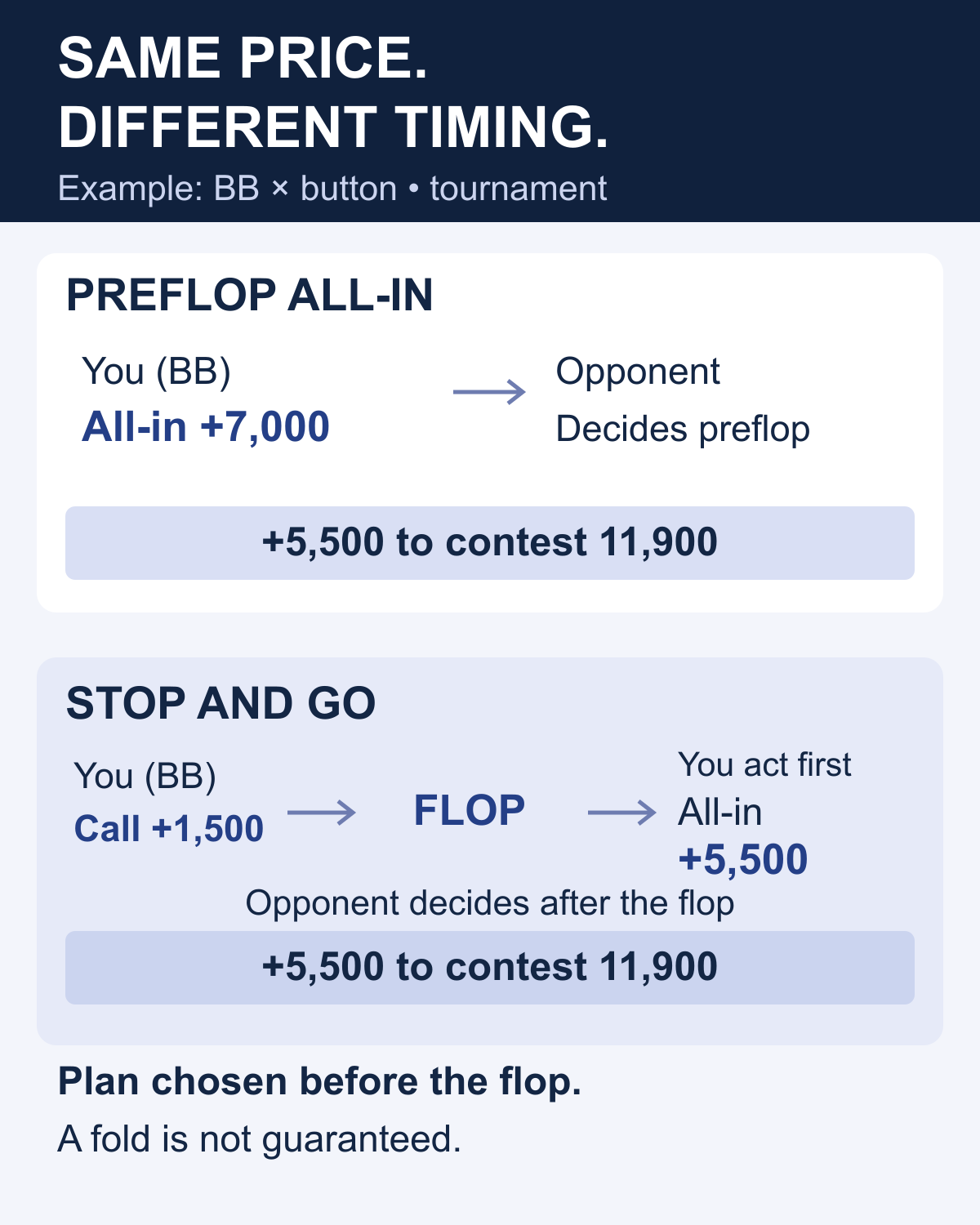
If you reraise all-in before the flop, you add the 7,000 chips behind to the 4,900 pot: that makes 11,900 before the button responds. Your total bet reaches 8,000, including the 1,000 big blind already posted. Since your opponent has already put in 2,500, they must add 5,500 to call.
If you only call, you add 1,500, the pot reaches 6,400, and you have 5,500 left. Betting those 5,500 first on the flop again brings the pot to 11,900 before your opponent responds.
The price is exactly the same in both lines: your opponent calls 5,500 to contest 11,900. Dividing 11,900 by 5,500 gives roughly 2.16 to 1, slightly better than 2 to 1 for the caller. If they call, the final pot will be 17,400. What changes between the lines is when your opponent makes the decision.
Before the flop, if your opponent thinks they have two live cards and you have two high cards, such as A♦ J♣, they may consider calling even with 8♣ 3♦, especially since they have chips to risk. After a flop that does not help them, with only two cards to come, the same price may look less inviting.
Suppose the button holds 5♦ 5♣. Before the flop, they might be willing to call an all-in with their pair. On a K♦ 10♣ 7♥ flop, all three board cards are higher than a five. Is it still worth another 5,500 to continue with the same pair? If the button folds, your A♦ J♣ wins the pot with just ace-high, even though it was behind the pair. The hand ends there and you cannot bust on it. If the button calls, the fives are still ahead and you can still be eliminated.
Out of Position, Preflop Order, and Open-Shoving: What Each Term Explains
Three ideas appear together in this play and answer different questions. The table applies them to the example hand: you in the big blind against the button, who raised.
| Idea | Question it answers | In the example hand |
|---|---|---|
| Preflop order | Who acts, and in what sequence, before the flop? | The action reaches the button, who raises to 2,500, and the small blind folds. Only then do you, in the big blind, respond, having already seen the raise. |
| Position on the flop | Who acts before or after the opponent in this round? | With both players still in the hand and able to act, you act before the button on the flop: you are out of position and act first. |
| Open-shove or all-in reraise | Is the all-in the first raise of the hand, or does it respond to a raise? | When the earlier players have folded and you are the first to enter voluntarily, shoving everything is an open-shove. Facing the button's raise, shoving everything before the flop would be an all-in reraise. The stop and go replaces that reraise with a call now and an all-in later. |
Two points help avoid confusion. The first is that "out of position" is always relative to a specific opponent in a specific round. In the example hand, you respond after the button's raise before the flop, but act first against them afterward. Responding last in one round does not guarantee the same advantage in the next. To review this order carefully, see the article on the big blind, small blind, and order of action.
The second point concerns the term heads-up. Here it means a hand against a single opponent, like the example, which began with nine players at the table and came down to you and the button when the small blind folded. This is the scenario in which the play is recommended.
How to Judge Whether a Stop and Go Fits the Hand
The play depends on conditions, and each one changes the answer. Ask yourself these questions before calling the raise:
- How many chips will I have left after calling? In this hand, you have 5,500 left to bet into 6,400. A flop shove is about 86% of the pot, nearly nine tenths. Compare that with a hand where calling leaves you only a few chips behind. Your opponent would have to add very little to continue, so your shove would have less chance of getting a fold.
- How big is your opponent's stack? To the chip leader, the player with the most chips, the call may look relatively low-risk compared with what they hold. Facing someone with a medium stack is more appealing. The button in the example, with more than 70,000 chips, illustrates what to watch for: having plenty of chips may make them more willing to risk a preflop call.
- How do they react after putting chips in the pot? If they are the type who never folds after putting some chips in the middle, calling your all-in before or after the flop may amount to the same thing for them. Assess whether seeing the cards can actually change their decision.
- Will you really follow through on the flop? The plan is to pull the trigger on the flop, whatever it brings. The exception is flopping something big, such as a straight, two pair, or better. In that case, you may prefer your opponent not to be so eager to fold.
Defending the big blind against someone who raises frequently is another context in which the play can be considered, even with weak hands. This does not make hand strength irrelevant: the example's A♦ J♣ and a weaker defending hand create different situations. Assess the hand and opponent together, without turning the name of the play into an obligation to call.
Next Step: Build the Plan Before Calling the Raise
When reviewing a tournament hand in which you called a raise while short on chips, write the plan in three lines before looking at the result:
- The preflop sequence: who raised, who called, and who folded. This shows whether the hand came down to a single opponent.
- Your position on the flop: do you act before or after that opponent? In the example hand, the small blind folded, and you, in the big blind, act first against the button.
- The all-in plan: did you define it before seeing the flop, or decide after seeing it? Only the first version is a stop and go.
To compare this play with another in which you call now to act later, read Floating in Poker: Understanding the Call with a Plan to Bluff.
 3 days ago