VPIP in Poker: Meaning, Calculation, and Limits of the Statistic

VPIP is the percentage of hands in which a player voluntarily put chips into the pot before the flop, out of those in which they had an opportunity to participate. Calls, which match a bet, and raises, which increase it, count. Mandatory blinds and antes alone do not. The acronym stands for “Voluntarily Put Money In Pot.” [1][2]
The statistic is useful for observing how frequently a player participates preflop. It helps distinguish players who voluntarily entered more or fewer hands in the sample, but it does not identify the cards in a specific hand. Participation must also be distinguished from raising: calling a bet and raising it are different actions, although both can contribute to VPIP.
VPIP in Poker: How to Calculate the Percentage
The calculation relates two counts. The numerator includes hands with a voluntary preflop contribution. The denominator, the base by which that total is divided, includes hands in which the player had an opportunity to contribute. Under the convention that excludes walks, the formula is:
VPIP = hands with a voluntary preflop contribution ÷ (hands in the sample − walks received in the big blind) × 100.
A walk occurs when everyone folds and the player in the big blind wins the pot without facing a decision. That hand is removed from the denominator because the player had no opportunity to put chips in voluntarily. [2][3]
PokerOrg provides a straightforward example: in a sample of 50 hands, a player puts chips into the pot by calling or raising in 10 of them. The calculation is 10 ÷ 50 × 100 = 20%. This result represents the VPIP for the sample used in the example. [2]
The unit counted is the hand, not each movement of chips. A hand with more than one voluntary preflop contribution still counts as a single hand in the numerator. Likewise, the amount put into the pot does not give participation greater weight: the formula identifies whether a voluntary contribution occurred, without adding up the money invested.
VPIP Describes Participation but Does Not Reveal the Cards
A higher VPIP represents more frequent voluntary participation in the corresponding sample. This can help build a read on an opponent, but it does not turn the percentage into an exact list of hands. To estimate a hand range, meaning the set of hands considered possible, position and stack size also need to be part of the analysis. [2][3]
Its scope also remains preflop. Bets and calls made after the flop do not count toward this VPIP. The statistic may be considered when reading the hand later, but using preflop information postflop does not change the betting round it measures. [2]
The Calculation Can Be Correct While the Sample Is Still Limited
A small sample may reflect a run of favorable or unfavorable cards. During that stretch, the player may have participated more or less often than they would over a larger set of hands. The calculated percentage describes what happened in that record; the difficulty lies in knowing how well that record represents a more lasting tendency. [1]
A larger sample helps support the assessment, but it should not become an automatic stamp of accuracy. There is no need to establish a fixed number of hands to recognize this limitation: an initial impression deserves less confidence than a tendency supported by more observations. This also avoids turning a short run into a permanent label for the player. [1]
Format and Positions Are Part of the Context
Full-ring and 6-max tables are different contexts when interpreting VPIP. A benchmark used to describe participation in one format should not automatically be carried over to the other. Comparing percentages without identifying the format leaves out a relevant condition of the assessment. [3]
Another consideration is the distinction between overall VPIP and an observation by position. The aggregate number combines participation across the positions present in the sample. It does not assert that the player uses the same frequency in every seat. An average across all positions does not replace information about where an action occurred.
Stack size—the amount of chips available—also matters when assessing the hands an opponent might play. The overall percentage therefore does not eliminate the need to look at the specific situation. Position and stack size add information that a single frequency cannot provide on its own. [2][3]
Actions Included and Excluded in Practice
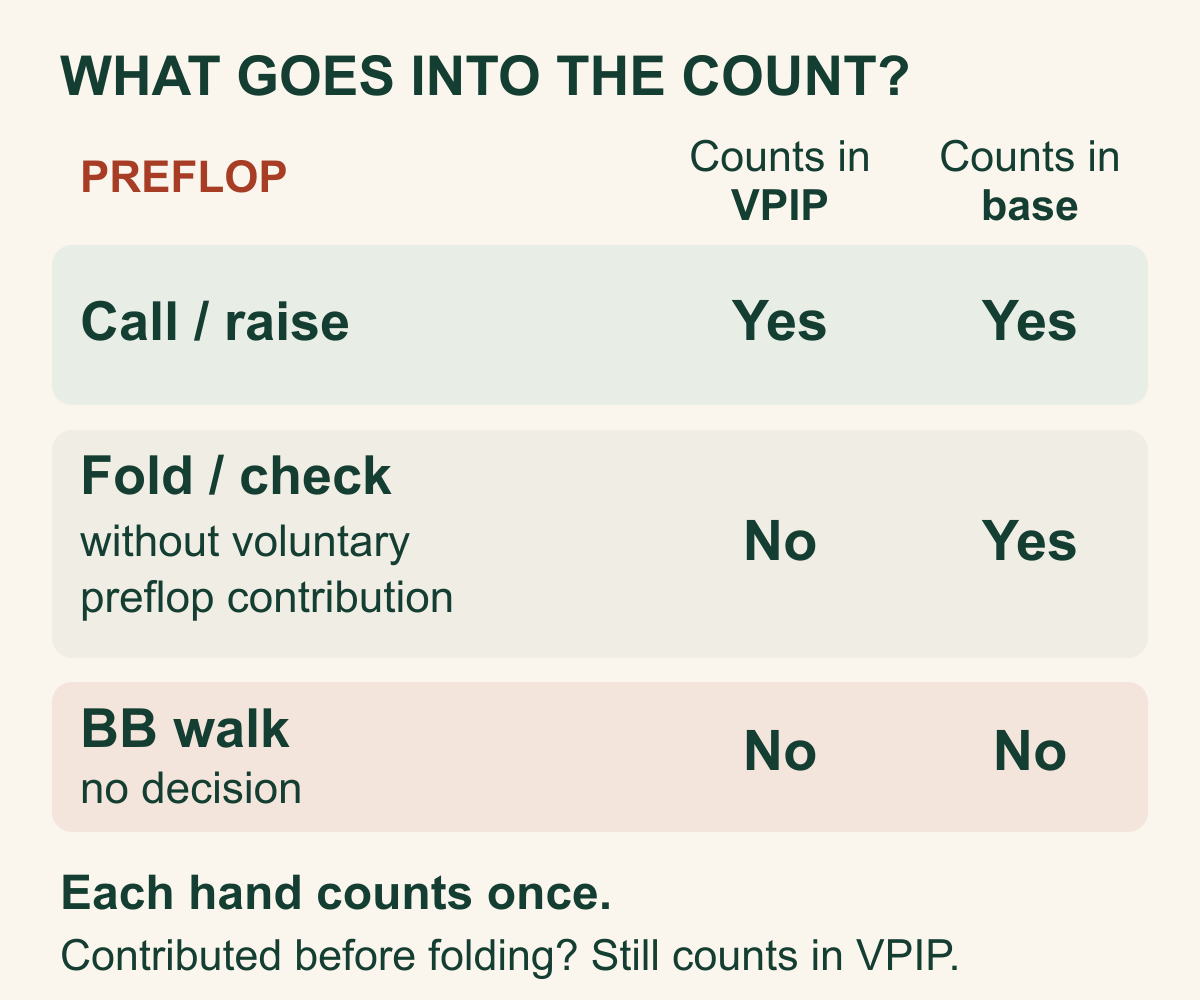
In the table, a limp means entering by calling before anyone has raised; a 3-bet is a preflop reraise. For players in the small blind or big blind, the count distinguishes mandatory posts from chips added by choice. [2][3]
| Preflop action or situation | Treatment in VPIP |
|---|---|
| Limp or call | The hand enters the numerator because there was a voluntary contribution. |
| Raise or 3-bet | The hand enters the numerator, including when there has already been another voluntary contribution in it. |
| Only the mandatory posting of a small blind, big blind, or ante | The mandatory amount does not count as participation in the numerator. |
| Big blind checks, with no voluntary preflop contribution | The hand stays outside the numerator but enters the denominator: there was an opportunity to act. |
| Fold before any voluntary contribution | The hand stays out of the numerator but remains in the base when there was an opportunity to participate. |
| Fold after a voluntary preflop contribution | The hand remains in the numerator; the fold does not erase the earlier participation. |
| Walk received in the big blind | The hand is excluded from the calculation, including the denominator. |
Read VPIP Alongside PFR to Understand Participation
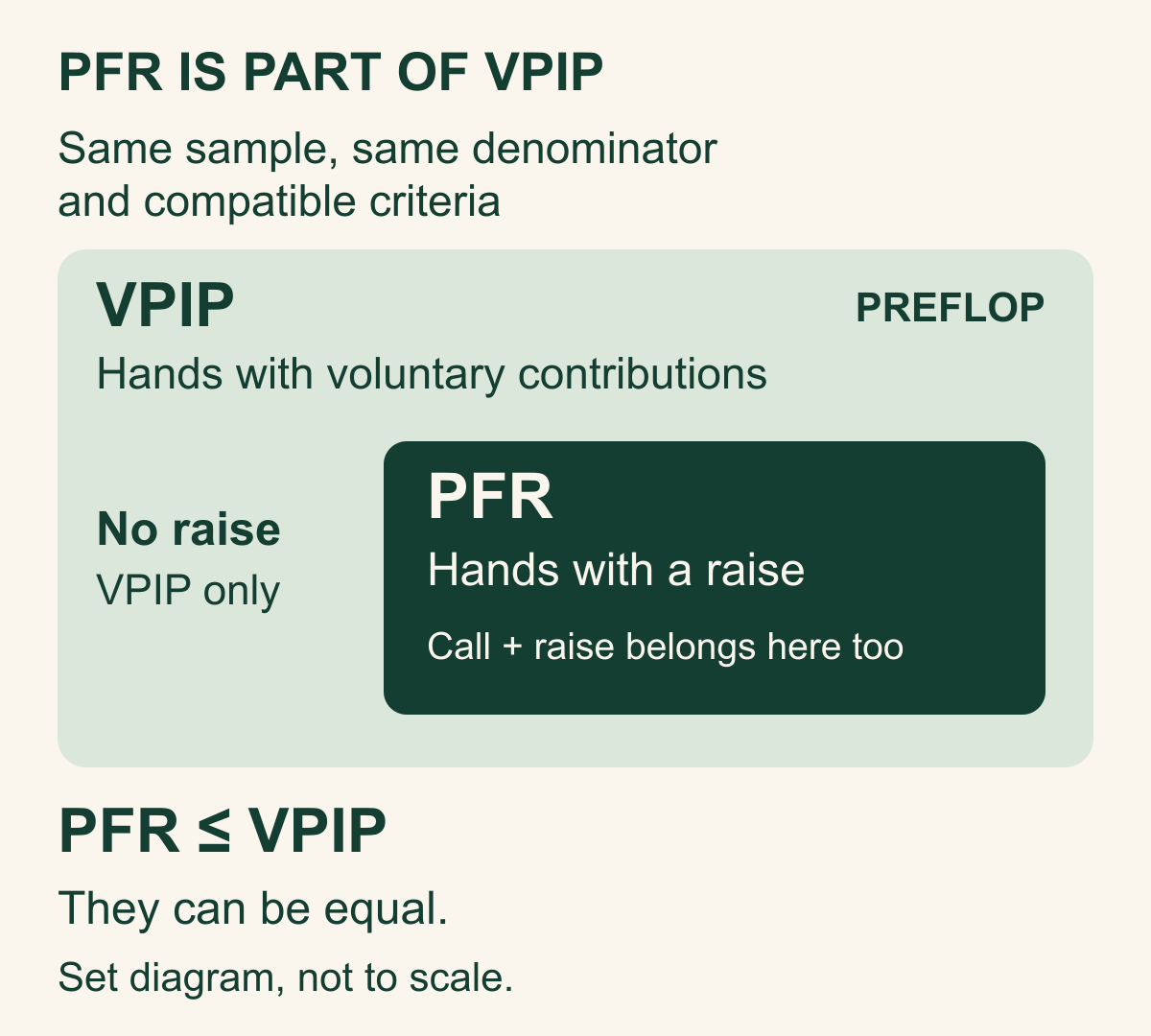
PFR in poker stands for Preflop Raise and measures the percentage of hands with a preflop raise, including reraises. A hand with a call followed by a raise counts in both statistics, once in each. [2]
With the same sample, the same denominator, and compatible criteria, PFR ≤ VPIP. They are equal when every hand with voluntary participation also included a raise.
Hypothetical example: two players each had 100 valid opportunities to participate. Player A voluntarily entered 30 hands and raised in 25 of them: 30% VPIP and 25% PFR. Player B also entered 30 hands but raised in only 10: 30% VPIP and 10% PFR.
Their VPIP is the same, but B participated more often by calling without raising: 20 hands, compared with A’s 5. The comparison shows how they entered pots; by itself, it does not show who played better.
Recommended reading
- PFR in Poker: Meaning and Limits of the Preflop Statistic
- Big Blind in Poker: Values, Positions, and Order of Action with the Small Blind
- Poker Hand Ranges: Reading and Making Decisions in Context
Sources
- [1] Understand How the Feared VPIP Works in Online Poker — GipsyTeam — November 3, 2022.
- [2] Understanding VPIP in Poker — PokerOrg — March 30, 2022.
- [3] Most Important Poker HUD Stat: VPIP In 2026 — SplitSuit — James “SplitSuit” Sweeney, January 2, 2021.

 1 day ago