
Poker Straddle: What It Is and What Changes Before the Flop
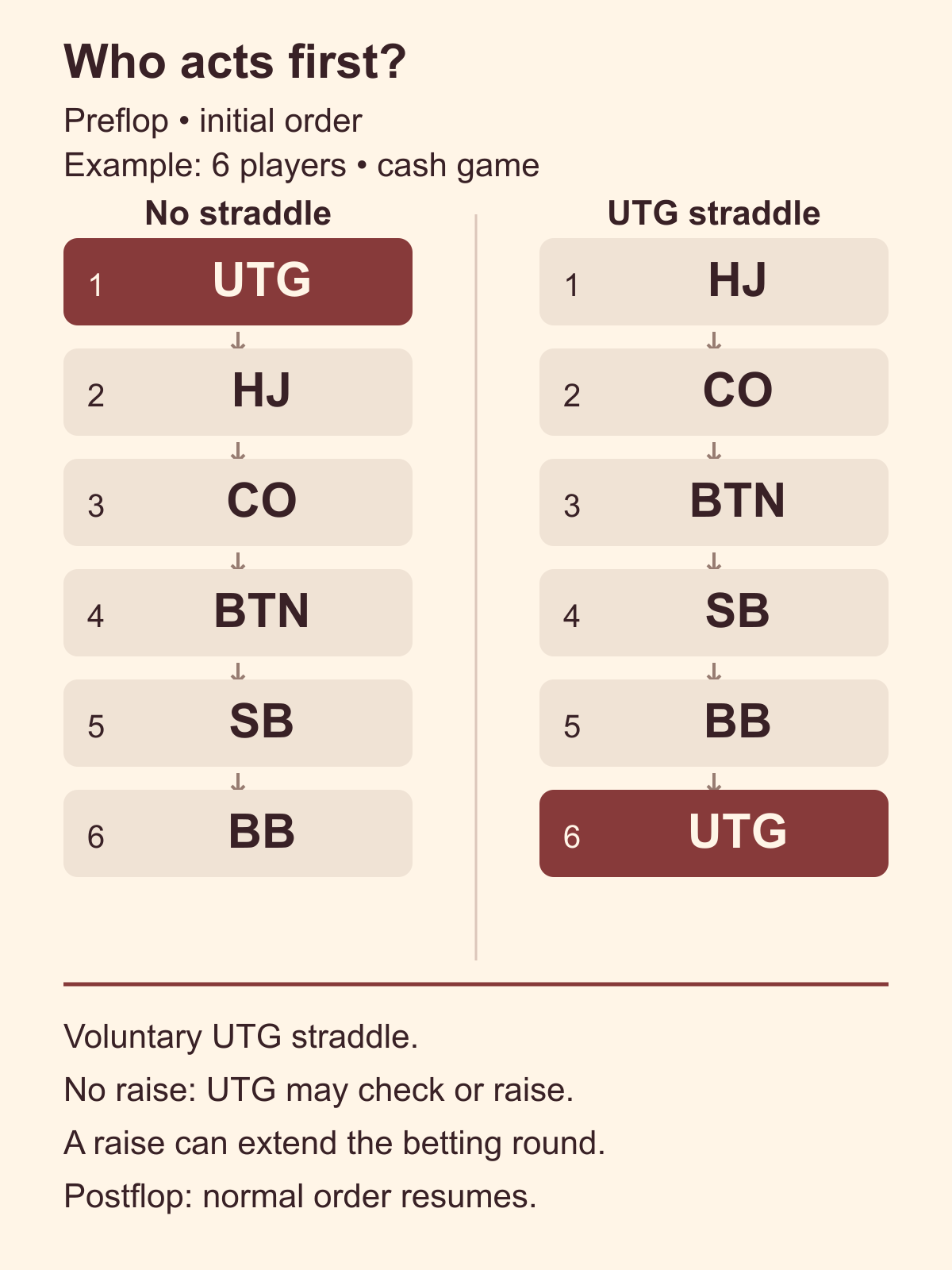
A straddle is a voluntary blind bet made before the cards are dealt. In the classic live cash game model, it is posted by the player in UTG (under the gun), the seat immediately to the left of the big blind, and the amount is usually twice the big blind [1][2]. In practice, the straddle functions as a third blind. It becomes the bet the other players must face, preflop action begins with the player to the straddler’s left, and the straddler acts last in the initial order, with the option to raise [2][3].
This article covers the voluntary UTG straddle in live cash games with three or more participants. Mandatory structures and other variants fall outside this model and appear later only as exceptions the house may define.
The straddle is typical of live cash games. It does not usually appear in tournaments because their structure already uses defined blind levels [1], and most online apps do not even offer this action [2].
Example: A US$6 Straddle in a US$2/US$3 Game
In a live no-limit Hold’em game with US$2/US$3 blinds [3], before the deal, the UTG player places US$6 in front of them, and the dealer announces "straddle" or "live six": a US$6 straddle, twice the US$3 big blind. From that point:
- Reference amount for entering the pot: before any raise, the reference amount for seeing the flop increases from US$3 to US$6. This is the live bet amount, not a guaranteed final cost: a raise can increase it, and anyone who has already posted a blind has part of that amount on the table.
- Who starts: the player immediately to the straddler’s left, who can call the US$6 bet, raise, or fold.
- Who closes: action moves around the table and ends, in the initial order, with the UTG player, the straddler.
- After the flop: action returns to the usual order.
If no one raises, the straddler still has the live option: on their turn, they can check or raise [2].
Posting the Straddle and Measuring Stack Depth
Announce or post the straddle before the cards are dealt, following the room’s procedure. Confirm whether a verbal announcement is required or placing the chips is sufficient [1].
With a straddle of twice the big blind, a stack measured in straddle units is half its size measured in big blinds [2][3]. The money has not changed; the unit used to measure it has.
To place the straddle in the context of the whole hand, it is worth reviewing how the blinds organize the action and the complete sequence of a hand.
Poker Straddles and House Rules: What Changes from Table to Table
Straddle rules vary by poker room. Confirm these points at your table [1][2]:
| Point | In the voluntary UTG model | What may change depending on the house |
|---|---|---|
| Nature of the bet | The player chooses to post the straddle [1][2][3] | Mandatory structures are outside this model and are not covered here |
| Who can post | The UTG player | The house may allow only UTG, also accept the button and other seats (a Mississippi straddle can come from any seat), or prohibit straddles [2][3] |
| Amount | Generally twice the big blind [1][2][3] | Some rooms allow larger amounts [3]; certain no-limit games may have no cap, allowing an all-in straddle [1] |
| Start of preflop action | The player to the straddler’s left [2][3] | With button straddles or straddles from other seats, the sequence changes and depends on the house [2][3] |
| Option to raise | The straddler can raise when action returns to them [2] | Most rooms treat the straddle as the new big blind for raise-sizing rules; confirm how your table measures a raise [2] |
| Successive straddles | Outside the model | In some rooms, the player to the left can double the straddle (a double straddle), and the escalation can continue before the cards are dealt [3] |
What changes if someone raises?
The straddler is last in the initial order, not necessarily the last to act in the whole betting round. If someone raises before action reaches them, they face that higher bet and cannot simply check [2].
Button straddles have their own procedures. A room may start action with UTG or the small blind. Under the procedure described here, the button is skipped until the end if no one raises; if someone raises before the button, the button acts in its normal place and can call, reraise, or fold. Confirm the room’s procedure before using this variant [3].
Postflop, the order returns to normal.
After the flop, the straddle no longer changes the order: rounds return to the usual sequence, according to positions and the players eligible to act [3]. The extra bet does not guarantee that the straddler will act first or last. For more detail on how position affects decisions after the flop, see the guide to playing in position postflop.
Next Step: What to Confirm When You Hear "Straddle"
Before acting, confirm whether the straddle is allowed from that seat, the amount posted, and who acts first. If anything is unclear, ask the floor—the poker room official who handles rules questions—or consult the posted house rules [2].
Recommended reading
- Big Blind in Poker: Values, Positions, and Order of Action with the Small Blind
- Texas Holdem Poker Rules: Cards, Betting, and the Sequence of a Hand
- Playing in Position in Poker: Information and Post-Flop Decisions
Sources
- [1] Poker Straddle Explained: What It Is and How It Works — WinStar (published on November 5, 2025)
- [2] Straddle in Poker: Live Cash Third Blind, Variants, Adjustments — Poker Skill
- [3] What is a Poker Straddle? And Should You Ever Straddle? — Upswing Poker (published on June 1, 2022)
 5 days ago