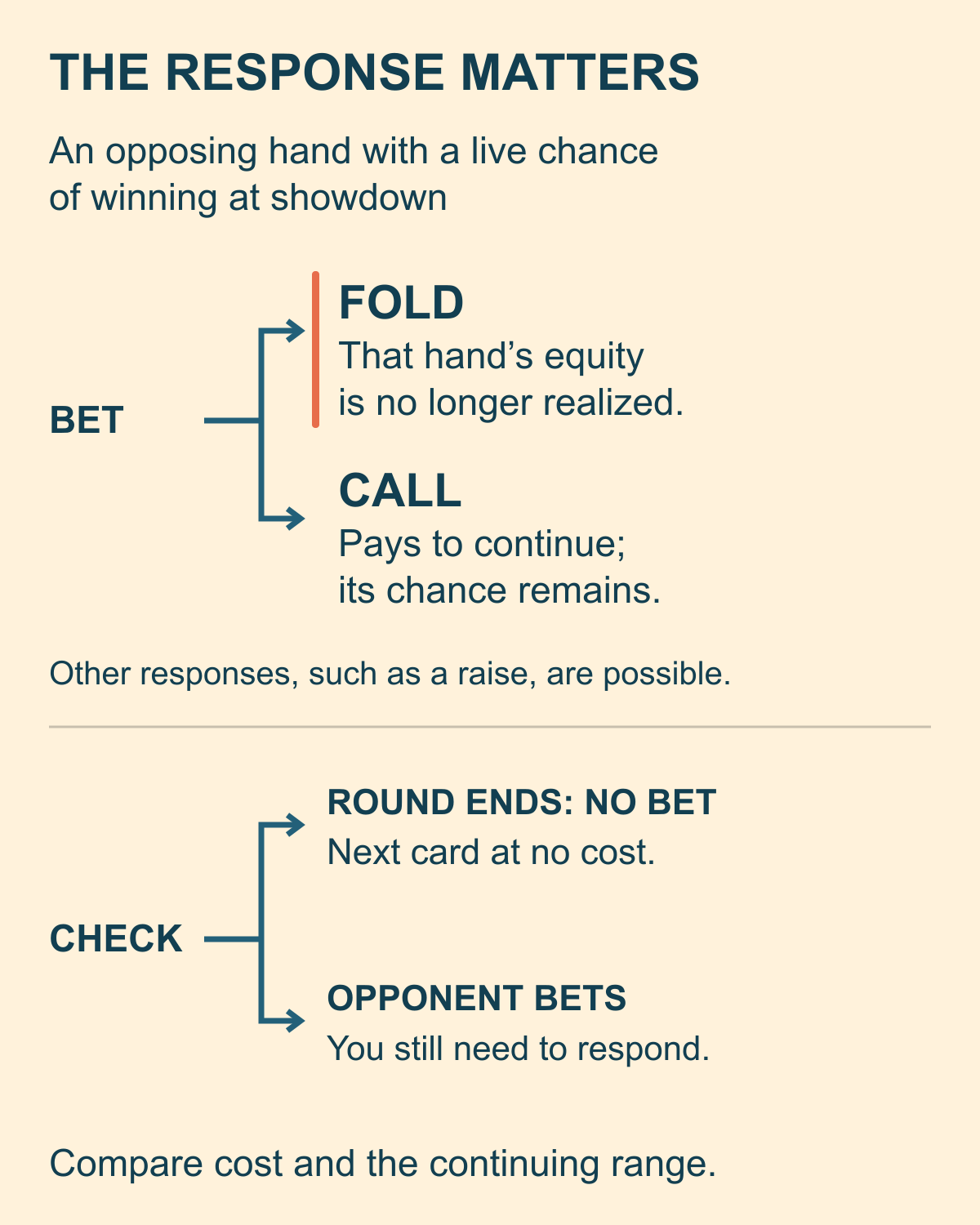
Equity denial means betting to make an opponent fold a hand that could still overtake yours, and the effect only exists if the fold happens. If they call, you have charged them a price to continue, but their hand remains in the pot and can still realize its equity [1][2]. That is why the useful question before betting is not “does this hand need protection?” but “how will the opponent’s range (the collection of hands they could hold) respond to this bet, and how much does it cost compared with checking?”
Having the best hand now is not the same as having the most equity. A vulnerable made hand can face many unfavorable turn and river cards [3].
Example: Q♣ T♠ on a 9♦ Q♥ 7♠ Flop
The example published by Poker Skill [1] uses Q♣ T♠ on a 9♦ Q♥ 7♠ flop. The hand has top pair and is vulnerable on this board. The source’s assessment is that betting can make hands with straight draws pay or fold instead of continuing for free.
With Q♣ T♠ here, first consider which straight draws are likely to fold and which will continue. If most will call, compare the value of charging them with the cost of building the pot against the full continuing range. If enough live draws will fold, denying their chances can favor betting over checking [1].
Which Chances Are You Trying to Deny?
The opponent must have live chances of beating you at showdown for there to be equity to deny. Improving their cards is not enough if they still cannot win [1][2]. The related guide to fold equity explores how an opponent’s willingness to fold affects a betting decision.
Denial, bluffs, and value bets: what you want them to do.
Value bets seek calls from worse hands; bluffs seek folds from better ones. Protection focuses on hands that could overtake yours. These purposes can overlap: a flop bet may get calls from worse pairs while making live overcards fold [1][3].
Compare the Expected Fold, the Cost, and the Alternative of Checking
Players who rarely fold draws offer less scope for denial. Multiway pots also make it harder to force every opponent out: assess the hands that remain as well as those that fold [1].
Straight and flush draws create more unfavorable future cards for a vulnerable made hand, so denial matters more on dynamic boards. On a stable board, paying to remove a small threat is less attractive [1][3].
Compare bet sizes by the hands they are likely to fold out and those likely to continue. A larger bet commits more chips and may face a stronger continuing range; the useful size depends on the board, stacks, position, and opponent [1].
Checking can keep the pot smaller or induce a bluff, which may be preferable if a bet would mainly get called by stronger hands [3]. A free next card follows only if the betting round ends without a bet.
Next Step: How to Review the Decision to Bet
When reviewing a hand in which you bet or checked with a vulnerable hand, work through four questions:
- Which cards do you not want to see? List the opponent’s hands with real chances against your hand or range, and the turn and river cards that change who is ahead [3].
- How do those hands respond to the bet? Identify the likely folds and calls from this opponent’s observed play, without inventing a fold frequency [1].
- How much does betting cost compared with checking? Weigh the chips committed, the strength of the continuing range, and what checking allows: the opponent might bet, attempt a bluff, or see the next card for free if the round ends without a bet [1][3]. For this half of the calculation, the guide to pot control covers checking, calling, and smaller bets in detail.
- Does the context support the plan? Check whether the board is dynamic or static, whether the pot is heads-up or multiway, and the stacks, position, and bet size [1].
Recommended reading
- Equity in Poker: Hands, Ranges, and Share of the Pot
- Fold Equity in Poker: Folds and Showdown Equity
- Pot Control in Poker: Concept, Choices, and Limits
 52 minutes ago