
Blocking Bets in Poker: Position, Purpose, and the Risk of a Raise
A blocking bet is a small bet made out of position with the intention of avoiding a larger bet from an opponent. The bettor hopes to receive only a call, which matches the bet, and tries to reach the next card or showdown—the comparison of hands—at a lower cost. The aim is to influence the opponent’s response; the amount bet does not guarantee the price of continuing. [1]
A River Example: Recognizing the Blocking Attempt
PokerNews presents a possibility in Texas Hold’em: on the river, a player with a middle pair is first to act and may make a small blocking bet to try to avoid a larger bet from the opponent. [3]
Blocking Bets in Poker: How Position and Intention Connect
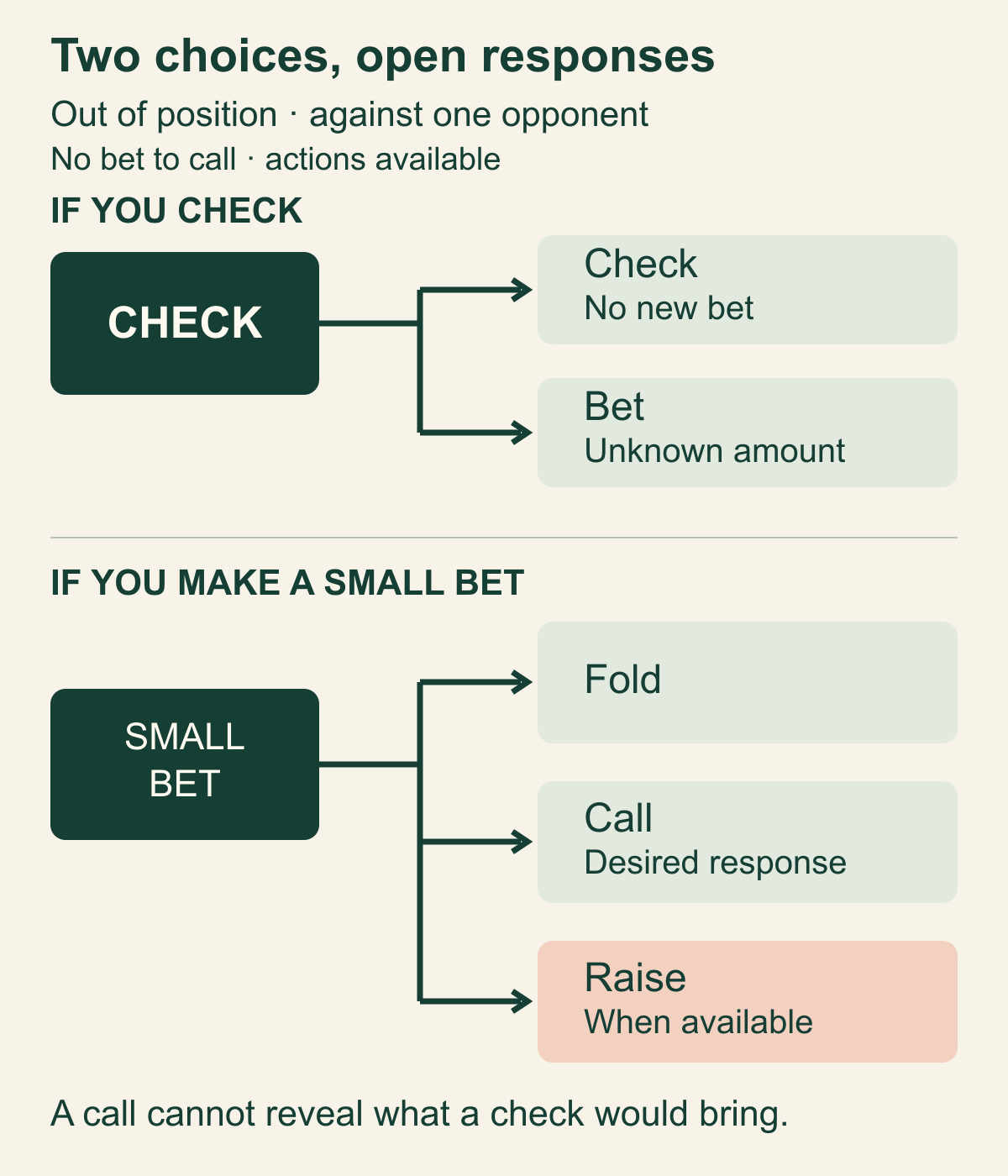
Being out of position means acting before the relevant opponent in that round. The difficulty lies in making a decision without knowing what action they will choose afterward. A blocking bet tries to address this disadvantage: the player bets small before the opponent acts, hoping the other player will simply call instead of making a larger bet after a check.
The situation changes when you act afterward. If your opponent checks and you can also check, there is an opportunity to see the next card without adding chips in that round. In this context, betting solely to try to see a cheap card does not serve the same purpose. Out of position, however, your check still leaves the opponent’s decision ahead. [1]
Compare the bet with checking. The opponent may also check; in that case, the small bet adds chips that might not have needed to go into the pot. It is therefore not necessarily cheaper.
The stage of the hand determines what the player is trying to achieve. When there is still a card to come, the aim may be to reach it at a lower cost than the one the player expects to face. On the river, with all community cards dealt, the intention becomes reaching showdown without facing the anticipated larger bet. This difference keeps the purpose tied to the stage of the hand. [1]
The relationship between bet size and its purpose helps separate the appearance of the play from its intention. “Small” describes the bet, but does not explain on its own why someone made it. Identifying it as a blocking attempt also involves position and the desire to avoid a larger bet from the opponent.
A Small Bet Does Not Prevent a Raise
The opponent can still fold, call, or raise when raising is available. The small bet does not limit their response.
A raise may come from a strong hand or a bluff. If attentive opponents notice that you bet small only when trying to avoid a larger bet, they can exploit that pattern by raising. Including strong hands in your small bets makes that read harder. [1][2]
A blocker bet and card blockers do not refer to the same thing. Blocker bet is another name used for a blocking bet: in this context, the term names a betting action. The “blocking” describes what the player is trying to achieve in anticipation of a possible opponent bet. It is not an explanation of card blockers or a property that removes the opponent’s right to raise. [1]
How to Assess the Decision Before Repeating the Play
- Would worse hands call? Consider which hands weaker than yours would call this size. Those calls can give the bet value; fear of facing a large bet is not enough. [2]
- Would checking be better? Compare this opponent’s likely responses, taking your hand and the pot into account.
- How will I respond to a raise? Consider which strong hands and bluffs this opponent could raise with before deciding whether you can continue.
Recommended reading
- Poker Bet Sizing: Amount, Purpose, and Context
- Bluffing in Poker: Meaning, Conditions, and Risks
- Cash Game Strategy: Position, Betting, and Stack Size

 1 day ago