
Set mining means calling a preflop raise with a pocket pair, usually a small or medium one, with a single objective: to make a set, three of a kind formed by your pocket pair plus one board card, and win a big pot [1][2][3]. Calling makes sense when the current price is small compared with the payout you could receive later [3]. That payout is an assumption. It depends on the cost of calling, who can still act, the effective stack, and an opponent willing to put in chips when you hit your set [1][3].
The useful question, then, is not “Is my pair good enough?” but “How much does this call cost, and what could it return?” Making a set does not guarantee winning the pot, and calling the raise does not guarantee seeing the flop for the price you expected. Below, you will see how to compare the price, action still open, effective stack, and potential payout, and how to apply these points when a squeeze changes the price.
Set Mining in Poker: What the Call Buys and What It Does Not Guarantee
Set mining works as a two-stage trade-off. You pay a relatively low price now and, only if the flop brings a set, try to collect much more. What supports this call is implied odds: the additional chips you expect to win if you hit your hand [3]. The difference lies in the plan for the flop. If you are counting on your pair’s existing strength to continue on various boards, hitting a set is just one way to win. In set mining, the payout when the pair improves needs to justify the call [1][3].
The numbers only work when the chips you can win on the occasions you hit are enough to cover the times you miss [3]. And missing is the usual outcome: most of the time, the flop does not bring a set. Facing a continuation bet, a bet from the preflop raiser, the usual course is to fold [1]. That is why the starting plan for an unhelpful flop is to get away from the hand cheaply [3].
The Four Checks Before Calling
The table summarizes what each point measures and which way it pushes the decision. The following sections explain how to read each one.
| Check | What it measures | More favorable to calling | Less favorable |
|---|---|---|---|
| Call price | What you pay now relative to the pot | A small cost compared with the potential payout [3] | A raise or 3-bet that makes calling more expensive and changes pot odds and SPR [2] |
| Action still open | What players behind you can still do | Weak players behind who are unlikely to 3-bet [2] | More players left to act; frequent squeezes that force your pair out of the hand [2][3] |
| Effective stack | How much can still be contested | Deeper stacks, which increase the maximum payout [2][3] | Few chips in play between you and whoever might pay you off: the maximum gain may not cover the flops you miss [3][4] |
| Potential future payout | Whether someone pays off your set and how easily you can extract value | An opponent who pays off with one pair; being in position against a single raiser [3] | An opponent with no hand to pay you off or who knows when to fold; acting first after the flop [1][2][3] |
Call Price: What Changes After a 3-Bet
The price is not just the initial raise. After a re-raise, compare the additional amount needed to call with the current pot. Then look at how much will remain behind relative to that pot. A 3-bet changes both pot odds and the stack-to-pot ratio (SPR), two useful measures for reassessing the situation before calling [2]. The more expensive the call, the larger the potential payout needs to be for the trade-off to keep making sense [3].
Action Still Open: Who Can Respond After Your Call
Calling the raise does not end the story: anyone who has yet to act can call, re-raise, or fold, and each response changes your situation. That is why the more players still to act behind you, the stronger your pair needs to be to call the raise [2]. The reverse also applies: if the players behind are weak and unlikely to 3-bet, you can call with more pocket pairs [2].
The trickiest case is the squeeze, a 3-bet made by a player behind after the initial raise and your call. At tables where a third player frequently re-raises, your pair may be forced out of the hand before seeing a flop [3]. This does not rule out set mining after a squeeze, but it requires reassessing every factor [2]. In other words, access to the flop at the expected price is also an assumption.
Effective Stack: How Much You Can Win and Lose
Compare what remains of your stack with what remains of your opponent’s. The smaller amount is the effective stack between you: it is the limit on how much more can be wagered between the two of you. With more than one opponent, make the comparison separately against each one [4]. This depth indicates how much can be contested later, while the opponent’s willingness to continue helps estimate how much you could actually receive [1][3]. Conversely, deeper stacks increase the potential payout: with the same amount to call preflop, the maximum payout grows with stack depth [2]. The trade-off is that the potential loss also grows. If your set loses to a stronger hand, you can lose up to the effective stack against that opponent [2][4].
With short stacks, the reasoning reverses. Even if you hit a set and take all your opponent’s chips, the gain may fall short of what you need to cover the times the flop does not help [3]. Use the chips that will still be in play when comparing the cost of calling with the potential payout [3][4].
Potential Future Payout: Who Pays Off Your Set
A set only pays if someone puts in chips. An opponent who calls large bets with one-pair hands is the type who pays off a set [3]. Recreational players, described as reluctant to fold hands, fit this profile [1].
After a 3-bet, ask two separate questions. How much more expensive has the hand become? And with which hands would this opponent keep putting chips into the pot after the flop? A range containing more strong hands may offer more opportunities to get paid, but the answer depends on the opponent and how the board develops. Paying more just to see whether you hit a set requires a better justification than the initial call [2].
Position also affects the payout. If you act before the aggressor and check, they can check back, leaving that street without a bet. In position, you can decide after seeing what they do. Consider this difference when estimating whether it will be easy to extract value with your improved hand or get away cheaply with a pair that has not improved [1][3].
Three Assumptions That Turn Set Mining into a Mistake
“Every small pair is a call.” Start by asking what needs to happen for the investment to pay off. If the pair depends on hitting a set and collecting several bets, stack depth only helps when there is an opponent willing to put in those chips. The decision changes if you have another reason to continue with the pair, such as its strength against a wider range [3].
“Miss the flop, fold.” For a plan that depends on making a set, getting away cheaply when the flop does not help preserves the reasoning behind the initial call. If the pair keeps contesting the pot without improving, assess that new decision based on the board and the bet you face. The expected payout from a set no longer explains that action [1][3].
“Hit a set, win.” Hitting your set does not settle the hand. A player with a higher set still beats you [2]. Even when the set is the best hand, the payout is an expectation that depends on the opponent and the board, not a guaranteed profit [2][3].
Example: A Squeeze After Your Call
You call a raise with a pocket pair. A player who had yet to act squeezes, the initial raiser calls, and the action returns to you. Before deciding, compare the remaining stack depth, your opponents’ tendencies, and your situation for playing after the flop [2].
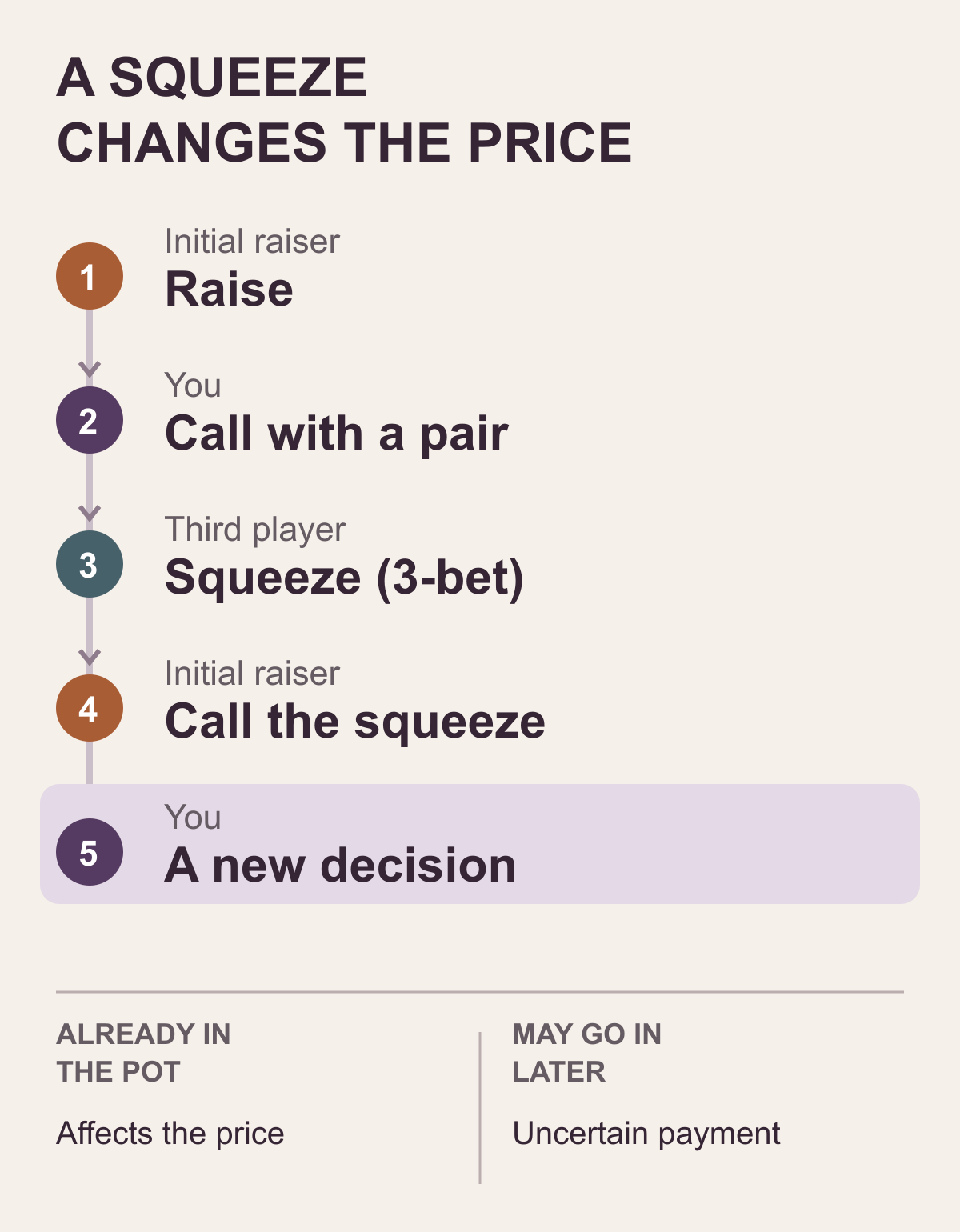
The squeeze makes continuing more expensive, while the initial raiser’s call adds chips to the pot and leaves another potential opponent to pay you off. These effects pull the comparison in different directions: the money already in the pot factors into the price of continuing, but the future payout still depends on the stacks and the players [2][3].
- Price. Redo the comparison using the additional amount needed to call the 3-bet and the current pot, including the initial raiser’s contribution [2].
- Action. Check who still has a decision to make and in what order you will act if the flop is dealt. Position and player tendencies change how much value you can expect to extract later [2][3].
- Effective stack. Compare your remaining stack with the squeezer’s and, separately, with the caller’s. If your remaining stack is smaller in either comparison, it sets the limit between you and that player [4].
- Potential payout. Assess the two opponents separately. Having another player who might pay you off only helps the estimate if the hands they continue with and the chips available support the payout you are counting on [2][3][4].
This case shows when the call loses its justification: if the price rises and the payout you can justify is small, hitting a set alone is a weak reason to continue. If you can still win enough chips from players who tend to continue after the flop, it makes sense to consider calling under that table’s conditions [2][3].
Next Step: Build the Decision Before Calling and Review It Afterward
Use the four points as a guide at three stages:
- Before the call: state in one sentence the current price, who can still act, the effective stack, and who would pay off a set. If you cannot identify who would pay, the potential payout is still just hope.
- On the flop: if you did not hit a set, the plan is to get away cheaply. If you did, check what the board makes possible for your opponent before assuming you are ahead.
- After the hand: compare your assumption with what happened. Did the opponent pay you off as you expected? Was the stack behind what it appeared to be? Missing the flop is the usual outcome, so a call that led nowhere does not prove the decision was bad. What is worth reviewing is whether the payout you imagined made sense for that opponent and that stack.
Recommended reading
- Implied Odds in Poker: Calculating the Future Payout You Need
- How to Calculate Pot Odds in Texas Hold’em: A Practical Guide to Calling or Folding
- SPR in Poker: How to Calculate the Ratio of Effective Stack to Pot
Sources
- [1] Is Set Mining Profitable? Yes, But You Need to Do This — BlackRain79, published on December 1, 2019
- [2] What is Set Mining in Poker? And When Should You Set Mine? — Upswing Poker, published on January 9, 2025
- [3] Set-Mining in Poker: When Calling Small Pairs Pays Off — Poker Skill
- [4] Effective Stack in Poker: The Smaller Stack Sets the Limit — Poker Skill

 2 hours ago