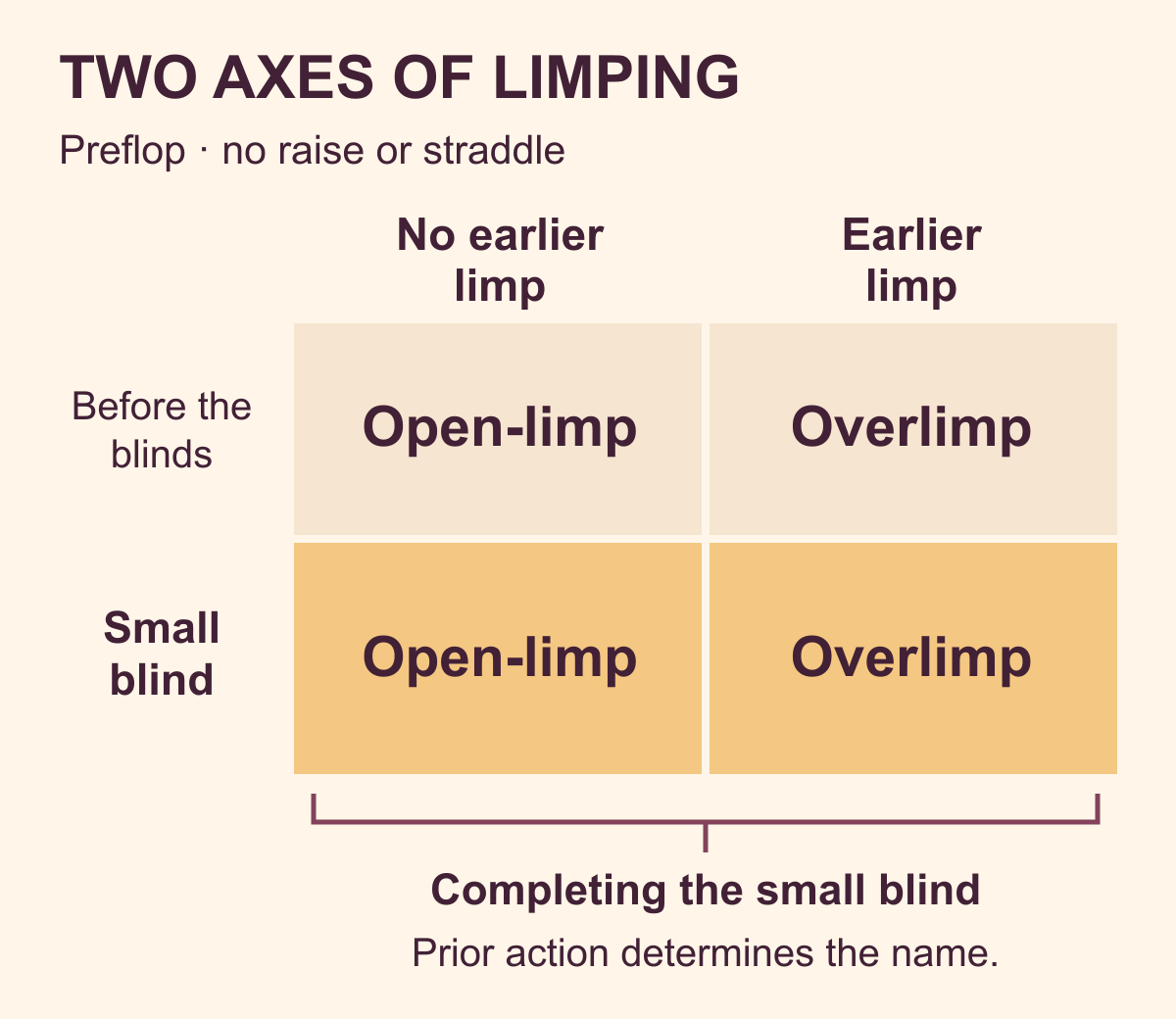
A limp means entering a hand preflop by calling the big blind instead of raising. An open-limp is the first call after all earlier players have folded; an overlimp is a call after someone has already limped. Completing the small blind describes the position and the amount left to call: it can be an open-limp or an overlimp, depending on the earlier action [1][2].
Example: Blinds of 50/100, with No Raise
Imagine this teaching example, with no ante or straddle and enough chips for everyone to continue:
- A player in early position calls 100. They are the first to enter the pot voluntarily: open-limp.
- The players between them and the button fold. The button calls 100: overlimp.
- The small blind has already posted 50 and adds only 50 to reach 100: completing the small blind and overlimping.
- The big blind has already posted 100. They can check, ending the betting round, or raise.
If the big blind checks, all four players see the flop. If they raise, the first limper, the button, and the small blind must decide whether to fold, call, or raise again. The initial call did not buy a guaranteed trip to the flop.
Change just one condition: everyone folds to the small blind. If they complete, that is an open-limp from the small blind, because nobody limped before them. The chart below organizes this distinction.
For the mandatory amounts and the order between these two positions, see the big blind in poker.
What You Gain and Risk by Limping
The initial investment is smaller than a raise, but you give up the chance to win the pot preflop by making everyone fold. A limp also offers other players a low price to enter. With more opponents, your hand must face more combinations on the flop [2].
Another risk is paying to limp and then facing a raise. In early position, more players remain to act, and you may end up out of position after the flop. Do not judge the cost only by the first big blind: consider how much you would be willing to call if someone raises.
A limp alone does not reveal hand strength. It may come from a weak hand or a strong hand hoping to induce a raise [1]. When deciding whether to attack a limper, consider how they tend to respond, not just the name of their action.
What to Consider in Each Situation
First to Enter a Cash-Game Pot
In No-Limit Hold’em cash games, a simple starting approach is to choose between raising and folding when everyone before you has folded, rather than making open-limping your default [2]. A raise can win the blinds immediately or receive calls from worse hands. If your hand does not justify entering, paying a small amount does not automatically make it suitable.
Consider your position too: opening early leaves more opponents behind you. Instead of limping to “see what happens,” decide beforehand how your hand fares against calls and raises.
There Are Already Limpers
Overlimping calls for a different assessment. Consider your position, who can still raise, effective stacks, and the kind of hand you hold. Being on the button helps postflop, but the blinds have not finished their action yet.
If the limpers tend to call raises, you are less likely to win the pot immediately. That makes it more important to have a hand that benefits from those calls when you raise. If you consider just calling, assess whether your hand plays well against several opponents and with the remaining stack relative to the pot—the SPR [3].
Do not confuse this sequence with cold calling in poker: when there has already been a raise and you call it without having voluntarily wagered earlier in that betting round, both the price and the classification of the action change.
You Are in the Small Blind
Completing costs only the difference between the blinds. In the 50/100 example, that is another 50, not another 100. This discount comes with a disadvantage: after the flop, the small blind acts before the opponents.
When everyone folds to you, the decision involves only the big blind; when there are already limpers, you may be entering a multiway pot. Do not treat the two situations as equivalent. In tournaments, professionals use strategies that include open-limping from the small blind [2]; that does not make completing a rule for every hand or stack.
At a two-player table, the button is also the small blind, and the postflop order differs from a table with more players. For that format, see heads-up poker strategy.
How to Review a Limp You Made
Record your position, the earlier action, the amount you added, and the preflop outcome. Then identify the decision you had not planned: did you expect to see the flop for the initial price? Would you call a raise? Did your hand have a reason to play a multiway pot?
This review separates a call chosen for its price, position, and hand from a call made merely because it looked cheap. Use the part that went wrong to compare limping, raising, and folding in the next similar situation.
Recommended reading
- Big Blind in Poker: Values, Positions, and Order of Action with the Small Blind
- Cold Calling in Poker: The Betting Sequence and Who Can Still Act
- Heads-Up Poker Strategy: Decisions by Position, Stack, and Opponent
Sources
- [1] Do You Know What It Means to Limp in Poker? — GipsyTeam.Com.Br, published May 7, 2024
- [2] Why Limping is Usually Bad (And When It's Actually Good) — Upswing Poker, published October 3, 2024
- [3] Not Limping vs. Limping, Poker 101 vs. Poker 102 — Red Chip Poker, published December 8, 2016

 21 hours ago