
Short Stack Poker Strategy: Decisions with Few Chips

By the Editorial Team
With few chips in No-Limit Texas Hold’em, knowing your stack in big blinds helps you understand the room you have to play a hand. Position and previous action then show which decision you face: opening a pot is different from responding to a raise. [2][3]
What You Need to Know Before Deciding
Note the big blind amount, the stacks involved, your position, and the sequence of actions. Depth in BB = chips ÷ big blind amount. Your stack relative to the blinds matters more than being among the biggest stacks at the table. [2]
When two players contest a pot, the effective stack is the smaller of the two stacks, because it limits what they can contest against each other. With more players, compare each relevant pair: the smallest stack at the table does not determine the depth between deeper players. [4]
Hypothetical Example: From Chips to a Decision
Imagine a tournament with blinds of 100/200. Before posting the blinds for this hand, you have 3,600 chips and an opponent has 10,000:
- Your stack: 3,600 ÷ 200 = 18 BB.
- Your opponent’s stack: 10,000 ÷ 200 = 50 BB.
- Between you, the starting effective stack is 3,600 chips, or 18 BB: your chips limit this matchup.
Now compare two heads-up hands, just between you, with these same starting stacks: you are in the big blind and your opponent is in the small blind. In the first, the opponent only completes to the big blind amount; in the second, the opponent raises. You face different actions and amounts, although both hands start with an effective stack of 18 BB. Guidance for facing a raise does not automatically answer a situation in which the opponent only completed the blind. Here, 18 BB lets you compare the starting depth; the action faced is the next piece of information to consider. [2][4]
A few terms used below:
- Range: the set of hands considered in a situation; on the flop, what matters is what remains after the preflop decisions.
- Shove: an all-in, betting all your remaining chips.
- Implied odds: the possibility of winning additional chips on later streets; a short stack limits that potential.
- Check-raise: checking and then raising an opponent’s bet. [1][3]
How to Apply Short Stack Poker Strategy
1. Identify the Depth
BlackRain79 primarily works with stacks of 10 or 20 BB; ThePokerBank uses a framework of up to 40 BB. These are different teaching references. At 10 BB, there is less room for sequences of bets than at 30–40 BB, so record the exact depth before using guidance. [1][2]
2. Separate Tournaments from Cash Games
In a tournament, losing all your chips can end your participation. In a cash game, the ability to reload changes session planning. Greg Walker’s hand chart was designed for tournaments, not for a cash strategy involving repeated reloads. His guidance to leave after winning a large pot applies only to someone intending to maintain a short stack style in cash games; it is not a tournament step. [2]
3. Relate Hands to Position and Previous Action
In more selective short stack preflop approaches, small pocket pairs and suited connectors—consecutive cards of the same suit—become less attractive because fewer chips can be won on later streets. In BlackRain79’s strategy, also avoiding suited aces is guidance for early and middle positions. [1][2]
That does not remove these hands from every possible range. Suited connectors can remain in the big blind’s calling range against a button raise in the situation analyzed in [3]. Opening a pot from early position and defending the big blind are different decisions, and require assessing different actions.
4. Understand the Purpose of Aggression
An all-in can pressure an opponent to fold, including when you hold a draw, a hand that still needs to improve. When considering that pressure in a tournament, also consider the players in the blinds. Ask whether the line aims to win chips when called, induce folds, or combine both goals; a short stack does not answer that by itself. [1]
5. Reconstruct the Range That Reached the Flop
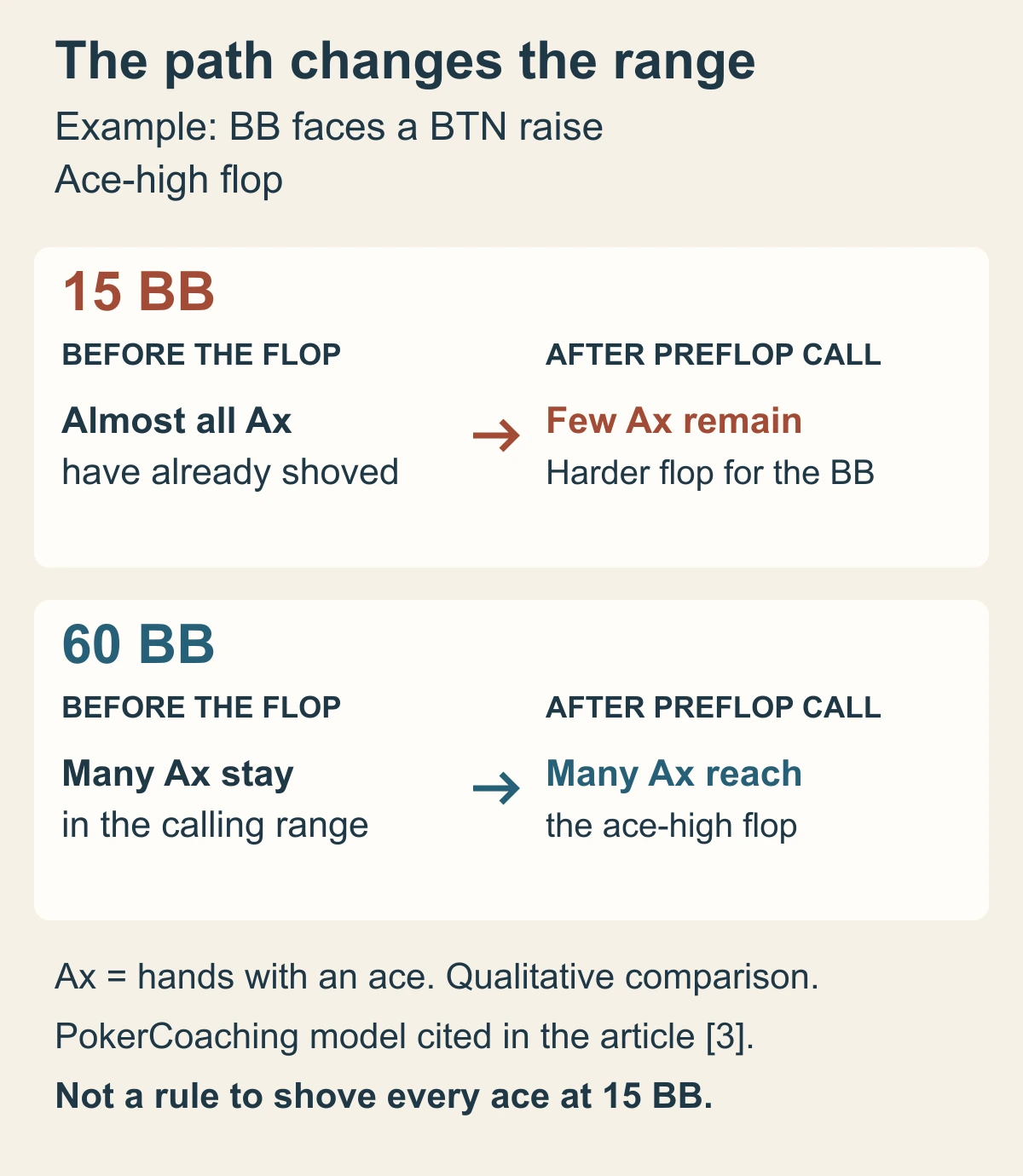
PokerCoaching example: the big blind faces a button raise with 15 BB, and the flop comes ace-high. The comparison is with the same matchup at 60 BB. In the model presented, the deeper calling range contains many ace combinations; at 15 BB, almost all of them would already have shoved preflop. The ace-high flop therefore becomes harder for the big blind out of position. [3]
The assessment changed because different hands reached the flop. This is an example of a particular position and action, not a rule to go all-in with any ace.
On textures favorable to the remaining range, a combination such as middle pair with a draw can support a greater willingness to play for stacks. The point is how the hand connects with the flop, rather than simply holding a draw. [3]
6. Choose the Sizing Based on Its Purpose
With fewer chips remaining, a smaller flop bet can build a path toward an all-in on later streets. You do not need to inflate the pot in the same way as in a deep-stacked situation to get the stack in. Relate the bet to the current pot and the chips that will remain afterward, rather than adopting one fixed percentage for every hand. [3]
In the short stack situations in this analysis, strong but vulnerable hands have reasons to play faster, while premium hands can let the opponent keep betting. The check-raising range can also include more value hands and bluffs alongside them. These choices belong to the ranges and flops analyzed; they do not make every top pair a mandatory all-in. [3]
How to Check a Decision
When reviewing a hand, record the effective depth, format, position, and action faced. You can then compare your decision with guidance for the same situation rather than justify it only by being short. A short stack strategy does not guarantee a double-up or survival in a tournament. [2]
Sources
- [1] The Best Short Stack Poker Strategy (Free Poker Chart) — BlackRain79, August 1, 2018
- [2] Short Stack Strategy | Playing Poker Short-Stacked — ThePokerBank, Greg Walker
- [3] Master Short Stack Postflop Strategy: Top 5 Easy Adjustments — PokerCoaching, March 31, 2026
- [4] Effective Stack Sizes — ThePokerBank, Greg Walker
 2 days ago