Showdown Value in Poker: Hand Strength and Decisions in Context
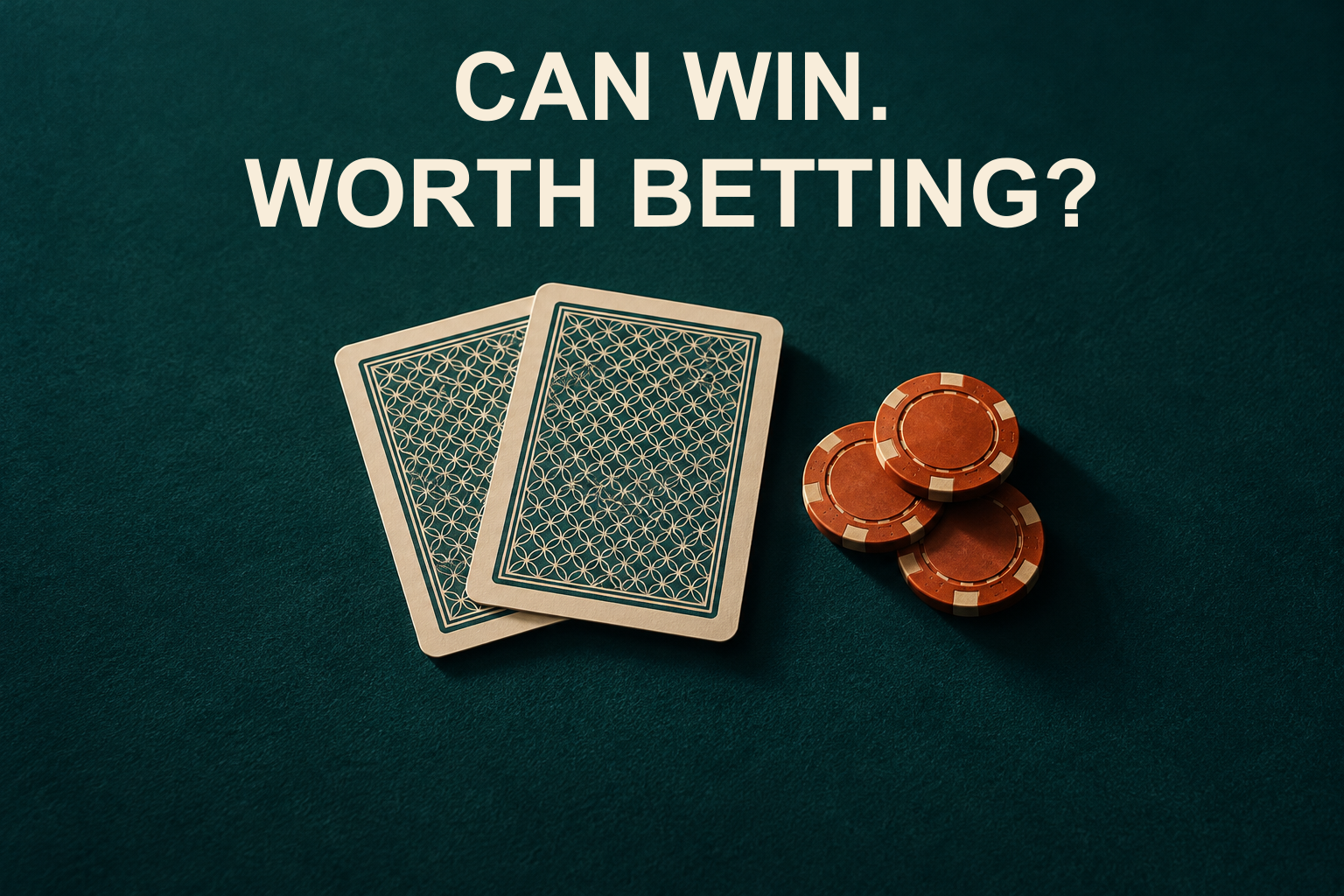
A hand has showdown value when it can win at the final comparison without needing to make the opponent fold. To assess that potential, ask: if both players stop betting, which opposing hands can mine still beat? [1][3]
The practical distinction is between having a hand that can win and having a hand worth betting. You may be ahead of some of your opponent’s hands without being able to get a call from worse hands. You may also have some showdown value and still find reasons to consider a bluff. The board, previous actions, and perceived range—the set of hands you consider possible for your opponent—all factor into this assessment. [2][3]
Showdown Value in Poker: What Your Hand Can Win by Reaching the End
Showdown value, value betting, and bluffing answer different questions. The first term describes a hand’s potential; the other two describe the purposes of a bet. Keeping them separate prevents you from treating every hand that can win as an automatic candidate for betting. [1][3]
| Concept | Key question | What is being assessed |
|---|---|---|
| Showdown value | Can my hand win if there is no further betting? | The hand’s strength relative to opponents’ possible hands. |
| Value bet | Can worse hands call my bet? | The possibility of getting calls from hands you beat. |
| Bluff | Can better hands fold? | The possibility of winning by making your opponent fold a stronger hand. |
The definitions in the table follow the distinction between the potential to win at showdown and the purpose of a bet. [1][3] They do not form three rigid categories of hands: the decision depends on how your opponent might respond.
Beating Part of the Range Is Not Enough to Value Bet
A value bet aims to get calls from worse hands. That is why simply thinking “I think I’m ahead” is not enough. You need to identify which weaker hands your opponent might have and which of them they would continue with against a bet. PokerStrategy recommends considering a value bet when you are ahead of your opponent’s range and can identify worse hands that could call. [3]
The difference is between the hands your opponent might have and those they are willing to put more chips into the pot with. Your hand may beat part of the first group but face mostly better hands in the second. In that case, having showdown value does not, by itself, provide a reason to bet.
In everyday use, the term is often associated with medium-strength hands: they can win at the final comparison but are not necessarily good candidates for extracting value or turning into bluffs. This does not limit the definition to a specific category; the point is relative strength against your opponent. [1]
The Board Changes What Your Hand Means
The board, made up of the community cards, should be considered alongside your opponent’s actions. A hand may have showdown value on the flop and lose that value by the river as new cards connect with your opponent’s possible hands. [3]
So the useful question is not just whether your own hand improved. It is also whether the community cards changed how it compares with the perceived range. Keeping the same hand category does not mean keeping the same relative standing in the hand.
Actions Help You Interpret the Perceived Range
Your opponent’s bets throughout the hand are part of assessing showdown value. The board shows which hands are possible; the sequence of actions helps you assess which of them make sense for that opponent. The guidance is to consider these elements together, rather than assign strength to your hand in isolation. [3]
This also explains why the player’s profile matters. A bet should not be interpreted the same way without considering who made it. The analysis presented by SoMuchPoker depends on the ability to estimate the likely range and understand the opponent’s behavior; an incorrect read undermines the usefulness of the assessment. [2]
The range remains an estimate. Saying that your hand has showdown value means it can beat plausible hands within that read, not that you have discovered your opponent’s cards.
Position Is Part of the Actual Decision
Acting after your opponent lets you observe their action before making your decision. This information helps you assess your hand’s showdown value against the opponent’s likely range and adjust your strategy. Being in position relative to that player therefore gives you an information advantage on that betting round. [2]
Use the action you observe to update your read: the check or bet becomes part of the history you use to assess your opponent’s plausible hands. Position does not change your cards, but it lets you make that comparison with their decision already known. The benefit depends on interpreting the action alongside the player’s profile and the board; observing what they did does not, by itself, reveal their hand. [2][3]
Having Showdown Value Does Not Require You to Check or Call
The recommendation to control the pot has a purpose: to avoid building the pot when your hand can win at showdown but offers no compelling reason to bet. PokerNews describes checking or calling as options for hands with good showdown value, aiming to reach the end without inflating the pot. The wording is conditional, not an instruction to always take a passive line. [1]
A crucial condition in this recommendation is that when you have showdown value and nothing to gain by betting, checking is often a good option. This requires assessing the benefit of a bet before ruling it out. It does not mean that every medium-strength hand should be played the same way. [3]
Checking and Calling Are Not Equivalent Decisions
When facing a bet, reassess which hands make sense in the opponent’s range after that action. Also consider the amount you must call in relation to the size of the pot; having a chance to win is not, by itself, enough reason to call. [1][3]
Pot control should not be turned into a promise of losing little or winning safely, either. Its strategic purpose is to manage the size of the pot with a hand of limited strength; the outcome still depends on how it compares with the opponent’s hand. [3]
Some Showdown Value Does Not Rule Out a Bluff
SoMuchPoker rejects the idea that a hand with showdown value should never bluff. The proposed comparison is between the expected value of the alternatives: the average result expected from bluffing and from reaching showdown without betting. If the first alternative is better, a hand with some winning potential can still be used as a bluff. [2]
This analysis includes fold equity, meaning the possibility of getting your opponent to fold. The text identifies the prospect of getting folds against a tight opponent, who is more selective about the hands they continue with, as a relevant condition. This does not provide blanket permission to attack any player with that profile: you need to compare the possibility of making them fold with the value of taking your hand to showdown. [2]
The opposite mistake also exists. Bluffing simply because your hand seems modest can waste an opportunity to win without betting. The question is not whether the hand looks strong in absolute terms, but what the bet can accomplish against the perceived range. [3]
The Opponent’s Profile Changes the Alternatives
Against tight, passive players, the guidance is to be cautious about betting on later betting rounds and to consider checking as an option. [3]
Against loose, aggressive players, a marginal hand may still be ahead even after bets or raises. On the river, the analysis presents checking with showdown value as a possible way to avoid facing a raise. It also allows for value betting against loose players when you have a medium-strength hand. [3]
These alternatives show why a player’s profile helps refine the decision rather than replace it. The risk of playing too passively is missing both value bets and bluffs that would make sense in that context. [2]
An Example: Pocket Eights Facing Two Overcards
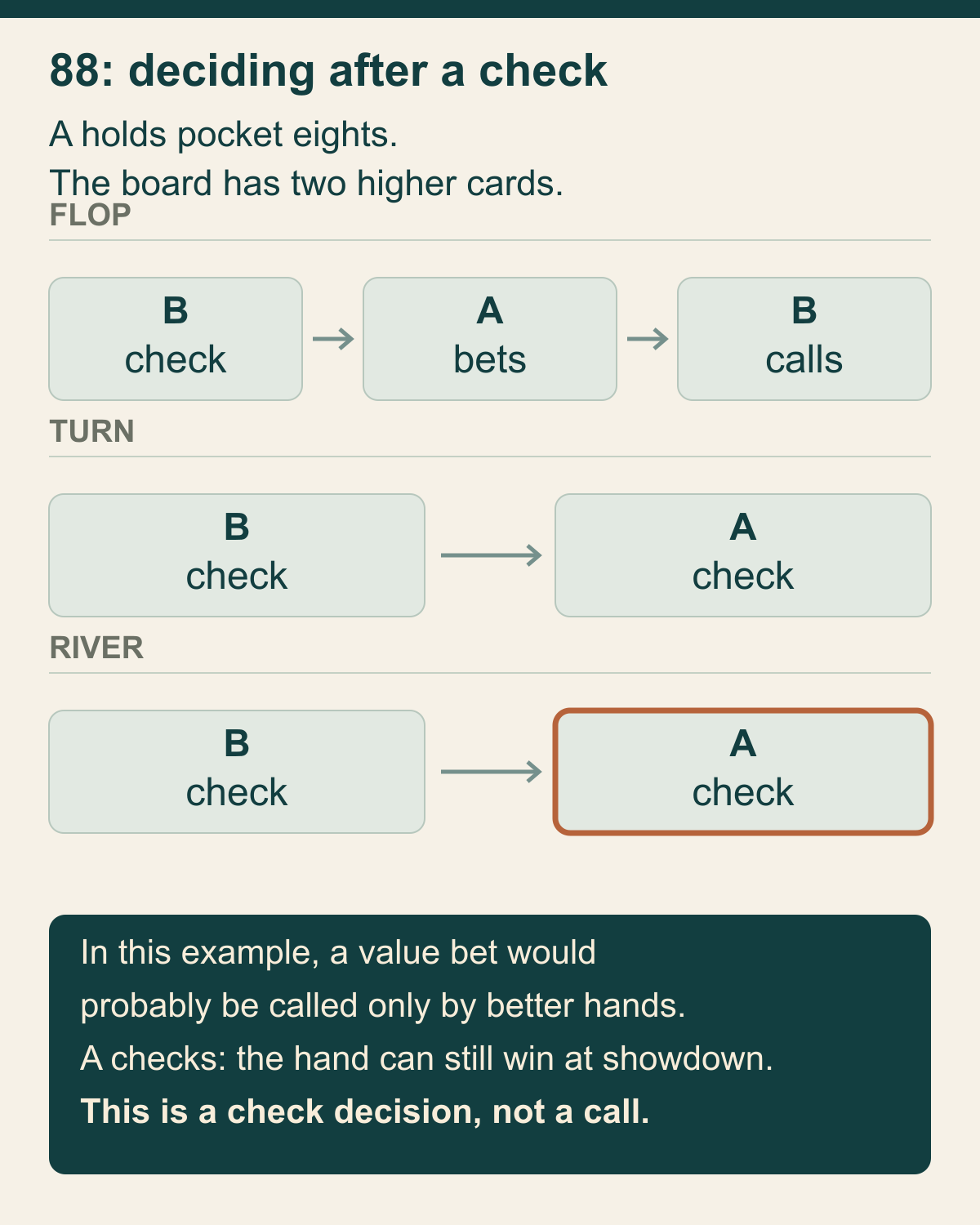
In PokerStrategy’s example, A holds 8♠ 8♦ and B holds A♣ K♠. The flop is J♥ 7♣ 4♠, the turn is 2♦, and the river is Q♥. On the flop, B checks and calls A’s continuation bet; both check the turn, and B checks again on the river. [3]
On this board, A’s pocket eights beat B’s ace-high, even though two community cards are higher than an eight. A can still win without betting. But a worse hand, such as this unpaired AK, may fold to a bet; in the example’s assessment, the hands likely to call would be better than 88. A therefore chooses to check after B and take the pair to showdown. [3]
How to Structure the Assessment for Your Next Decision
Applying the concept starts with reading the current situation. The method is to relate hand strength, the board, and the opponent’s behavior before choosing an action. Use the questions below to compare the alternatives in the hand. [1][2][3]
- Which plausible hands do I still beat? Consider the community cards and the perceived range, rather than assessing only the name of your hand.
- What have previous actions changed about this read? Reassess the estimate in light of the betting sequence and your opponent’s profile.
- What is the decision in my position right now? Separate the choice of betting after a check from the decision of responding to a bet.
- What benefit could a bet bring? To value bet, identify worse hands that can call. To bluff, assess which better hands might fold.
- How does this compare with reaching showdown? Consider the potential your hand already has without treating that potential as a certain win.
The most useful answer is not simply “I have showdown value.” It is being able to explain where that value comes from and what a bet would add. If the justification depends on opposing hands that no longer make sense after the actions or new cards, the assessment needs to change. If there are worse hands that can call, fear of losing showdown value should not end the analysis of a value bet. [3]
That is the role of the concept: to help compare alternatives based on context, keeping separate the possibility of winning with your cards and the possibility of winning more—or making a better hand fold—through a bet. [2][3]
 13 hours ago