Omaha vs Texas Holdem: Rules and Differences for Evaluating Your Hand
The main difference lies in which cards can make up your final hand. In Texas Hold’em, you receive two hole cards and can use neither, one, or both. In four-card Omaha high, you receive four, but must use exactly two hole cards and three community cards. In both games, the final combination consists of five cards. [1][2]
Quick Comparison of the Variants
The key differences are gathered below. In this comparison, “Omaha” refers exclusively to four-card Omaha high. [1][2][3]
| Criterion | Texas Hold’em | Four-card Omaha high |
|---|---|---|
| Hole cards dealt | Two | Four |
| Final hand size | Five cards | Five cards |
| Hole cards used | None, one, or two | Exactly two |
| Community cards used | Five, four, or three, respectively | Exactly three |
| Can you play the board? | Yes | No |
| Betting rounds | Preflop, flop, turn, and river | Preflop, flop, turn, and river |
| Hand rankings | The same as in Omaha high | The same as in Hold’em |
| Best-known format | No-Limit Hold’em, or NLHE | Pot-Limit Omaha, or PLO |
| Other betting structures | Available | Available |
Omaha vs Texas Holdem: How to Make the Best Hand
Hole cards are the cards dealt individually to each player. Community cards are placed face up on the table and make up the board. The task is to find the best five-card hand allowed in the variant, combining these two groups according to each game’s rules. [1]
In Hold’em, the Number of Hole Cards Used Can Vary
In Texas Hold’em, the best hand can be formed in three ways: two hole cards with three community cards, one hole card with four community cards, or just the five cards on the board. There is no requirement to use the cards you were dealt. [2]
In Omaha, the Two-Plus-Three Ratio Is Mandatory
In Omaha, “use two hole cards” does not mean “use up to two.” The number is exact. A selection with one hole card and four community cards is invalid, as is a selection with three hole cards and two community cards. Even if it looks stronger, that combination cannot represent your hand. [1][2]
The Rounds Are the Same; the Restriction Still Applies
Both variants follow the preflop, flop, turn, and river rounds, and the complete board contains five community cards. In Hold’em, when multiple players remain after the final betting round, a showdown takes place to compare their hands. [1][3]
More Cards Mean More Possibilities, Not a Guaranteed Win
The partypoker article lists 1,326 possible two-card preflop combinations in Hold’em and 270,725 possible four-card preflop combinations in Omaha, using a standard deck. These are counts of starting card sets, not winning percentages or assessments of strength. [3]
In Omaha, look at how the four cards work together: connected ranks and matching suits can offer possibilities for straights and flushes. [1][2]
Hand Construction and Betting Structure Are Different Rules
Omaha and Hold’em identify the variants; pot-limit and no-limit identify betting structures. This distinction prevents a restriction on bet sizes from being attributed to the rules for using cards. Both variants can be played with different structures. [3]
PLO stands for Pot-Limit Omaha: Omaha with bets limited by the pot. NLHE stands for No-Limit Hold’em: Hold’em without a betting cap determined by the size of the pot, allowing a player to commit all available chips in a legal action. These are the best-known formats for each variant, but they are not the only options. [1][3]
PLO Is Not Synonymous with All Omaha
Similarly, the fact that Hold’em is frequently associated with no-limit does not mean every Hold’em table allows betting in that form. Fixed-limit and pot-limit versions exist. Before interpreting what someone can bet, you need to identify the structure at that table.
It does not change the number of hole cards that can be used in the final combination. [1][3]
Pot-Limit Does Not Mean All-Ins Are Prohibited
An all-in commits all of a player’s available chips. The pot limit restricts the amount allowed for a bet or raise; it does not create a blanket prohibition on putting in every chip. If the total amount to be committed falls within the permitted action, the pot-limit structure does not prevent an all-in simply because it is an all-in. [3]
A Legal Hand Still Needs to Be Evaluated in Context
To assess your hand’s relative strength, consider the combinations the board makes possible for your opponents and how their actions help you interpret those possibilities. Your hand’s strength can change as further community cards arrive. [1][2]
In late position, you can see what your opponents do before deciding on your action. This gives you more information and greater pot control, especially in PLO. Also check the stacks—the available chips—and the betting structure, which limit the amounts that can be put into play. [1][2][3]
Hand-Reading Examples: One Suit and the Complete Board
Each hypothetical example below uses one board to compare the two variants. [2]
A flush consists of five cards of the same suit that do not form a sequence. A straight consists of five consecutive ranks that are not all of the same suit. A pair consists of two cards of the same rank plus three other cards; if there is no combination in these categories or higher, the hand is classified by its high card. [4]
1. Four Hearts on the Board and Only One in Your Hand
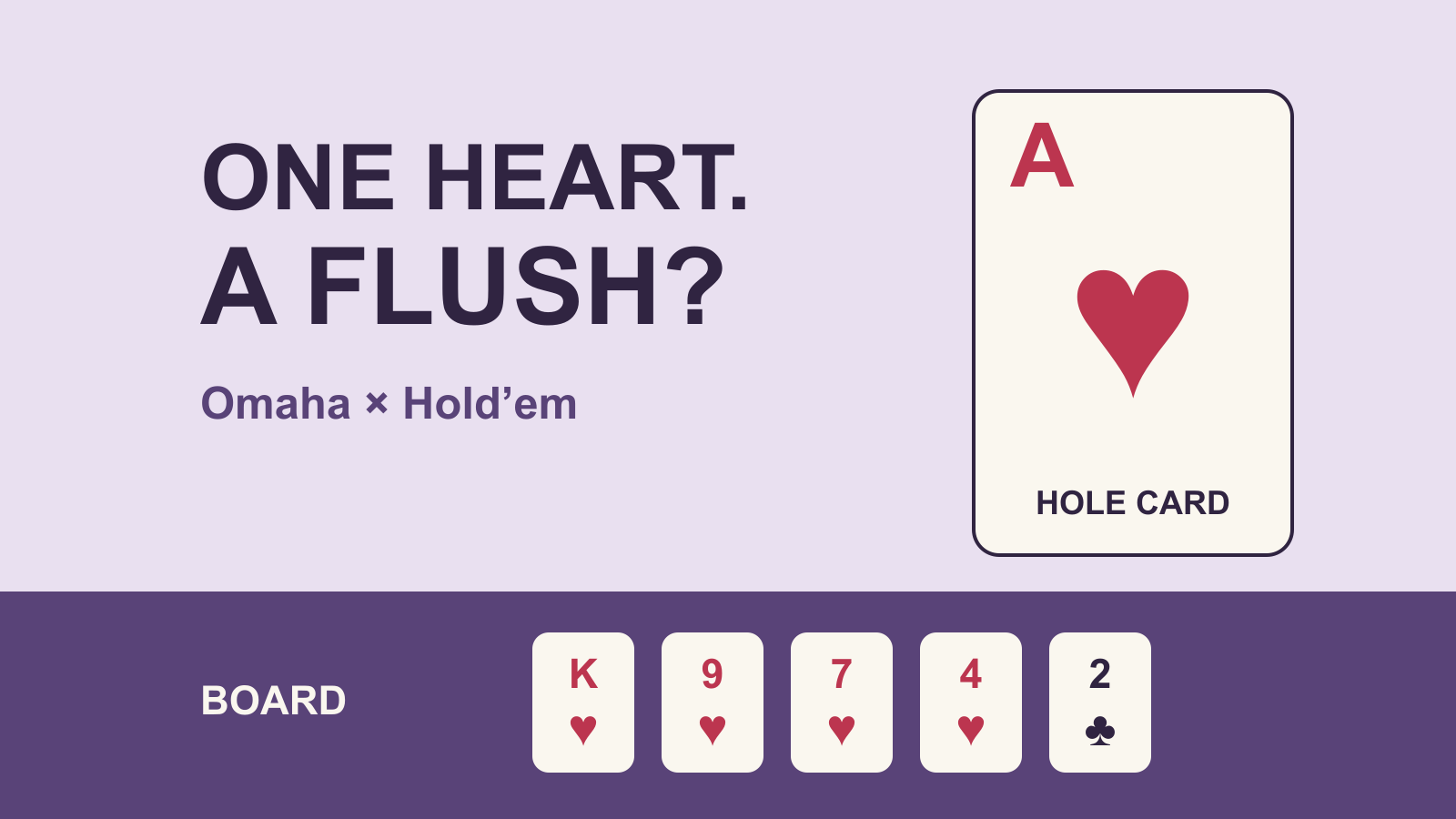
The board is K♥ 9♥ 7♥ 4♥ 2♣.
- Texas Hold’em: hole cards A♥ Q♠ → best five A♥ K♥ 9♥ 7♥ 4♥, a heart flush.
- Four-card Omaha high: hole cards A♥ Q♠ J♦ 10♣ → best five A♥ Q♠ K♥ 9♥ 7♥, an ace-high hand.
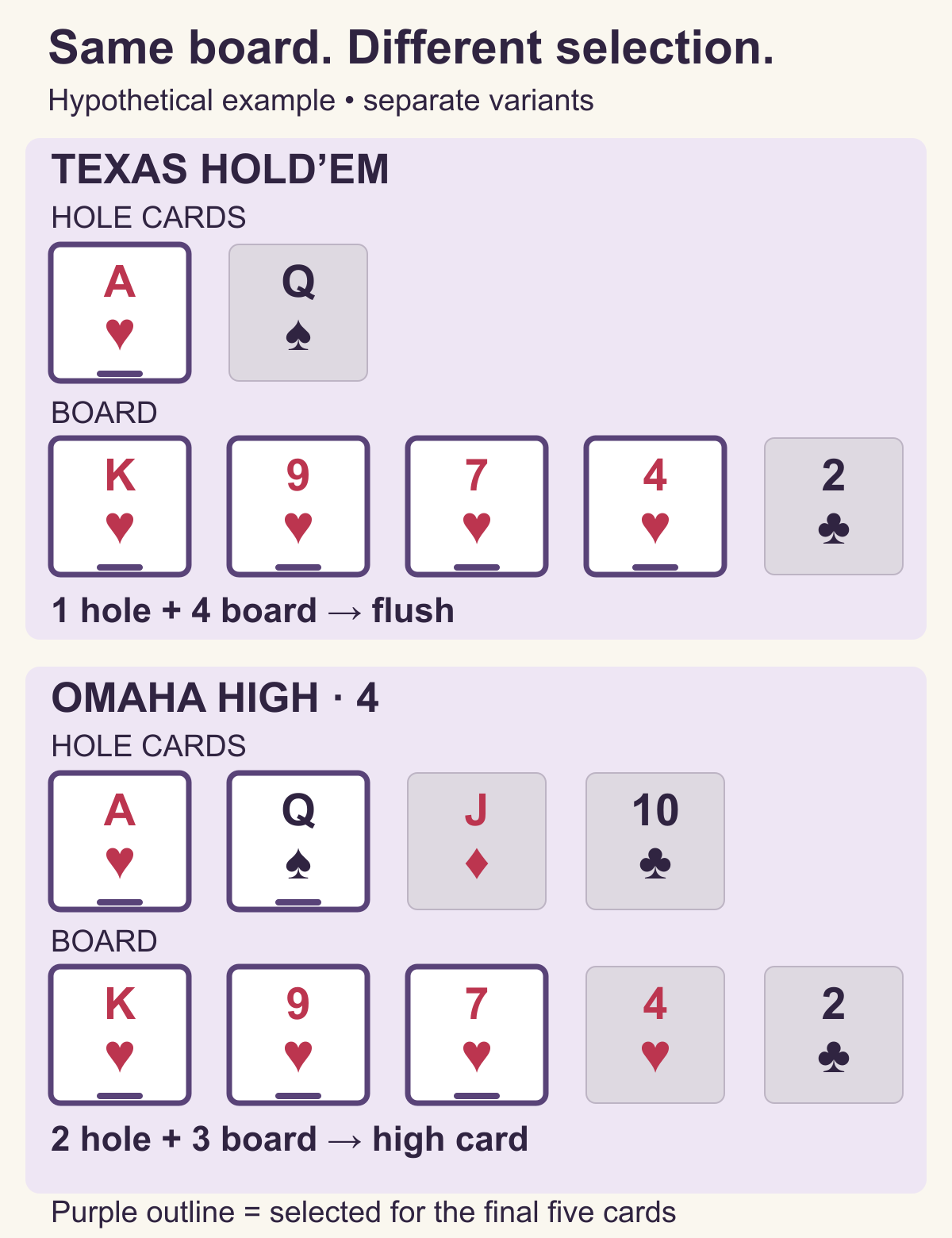
In Hold’em, one heart from your hand can combine with the four hearts on the board. In Omaha, you must use two hole cards, but only one of them is a heart, so you cannot make the flush. [2][4]
2. A Straight on the Board Does Not Automatically Count as Your Omaha Hand
The board is 9♣ 8♥ 7♦ 6♠ 5♣.
- Texas Hold’em: hole cards A♣ K♦ → best five 9♣ 8♥ 7♦ 6♠ 5♣, a nine-high straight made entirely from the board.
- Four-card Omaha high: hole cards A♣ K♦ 2♣ 2♥ → best five 2♣ 2♥ 9♣ 8♥ 7♦, a pair of twos.
In Hold’em, the ace and king do not improve the straight and can stay out of the final hand. In Omaha, two hole cards are mandatory: the two twos make a pair, completed by the three highest community cards. Playing only the board is not allowed. [2][4]
The Next Step Is to Separate the Combination from the Decision
Start by identifying the five cards permitted by the variant. Then consider your opponents’ possible hands and actions; check position, stacks, and the betting structure to assess the decision. [1][2][3]
Sources
- [1] Difference Between Texas Hold'em and Omaha — WinStar. Published on September 11, 2024.
- [2] Omaha vs Texas Hold'em: Key Differences & Strategy Guide — CardPlayer. Published on March 6, 2026.
- [3] The Main Differences Between Texas Hold’em and Omaha — partypoker. Published on January 22, 2019.
- [4] Poker Hands Order – Poker Hands Ranking Guide — CardPlayer. Published on November 18, 2024.
 1 hour ago