
Continuation Bet: When to Bet or Check

In no-limit Texas Hold’em, a continuation bet, or c-bet, is a bet made on the flop by the last preflop aggressor. It can seek value with a strong hand or try to win the pot by making an opponent fold. Raising before the flop, however, does not require you to bet again: the decision depends on how the flop connects with the players’ possible hands, your position, and who is still in the hand. [1][2]
Betting tends to find more favorable conditions against fewer opponents and on flops that offer them few ways to connect. Conversely, a weak hand against several opponents, a flop that favors an opponent’s range, or the difficulty of acting out of position are reasons to consider checking. [3]
This distinction avoids treating every c-bet as a bluff and every check as weakness. The selection of hands that bet can include value hands, bluffs, and draws; the selection of hands that check can also include very strong hands. The goal is to choose an action that fits the situation. [2]
Value-betting example: you were the last preflop aggressor, hold J♦ J♠, and see 2♣ 9♣ 5♠ on the flop. Your pair is above every board card, making it an overpair. Poker Skill uses this hand to illustrate a value c-bet. It shows a reason to bet beyond keeping the initiative: seeking calls from weaker hands. [2][3]
How a Continuation Bet Works: Purpose, Flop, and Opponents
The sequence that defines a c-bet is simple: a player takes the aggressive role preflop and continues betting once the flop is dealt. Whether they hit the flop is not part of the definition. That information changes the purpose of the bet and how appropriate it is, but not the name of the action. [2][3]
The first step is to distinguish why you want to bet. A value bet aims to get called by hands weaker than your own. A bluff aims to make an opponent fold. A semi-bluff uses a draw: a hand that can improve and become strong with the next cards. These purposes help organize the decision before you think about bet sizing. [1][2][3]
Flop Texture Indicates Ways to Connect
Texture is the way the flop cards relate to one another. A dry flop has loosely connected cards and few draws. A coordinated flop offers more possibilities for draws or straights. This difference affects which hands opponents can continue with when facing a bet. [2]
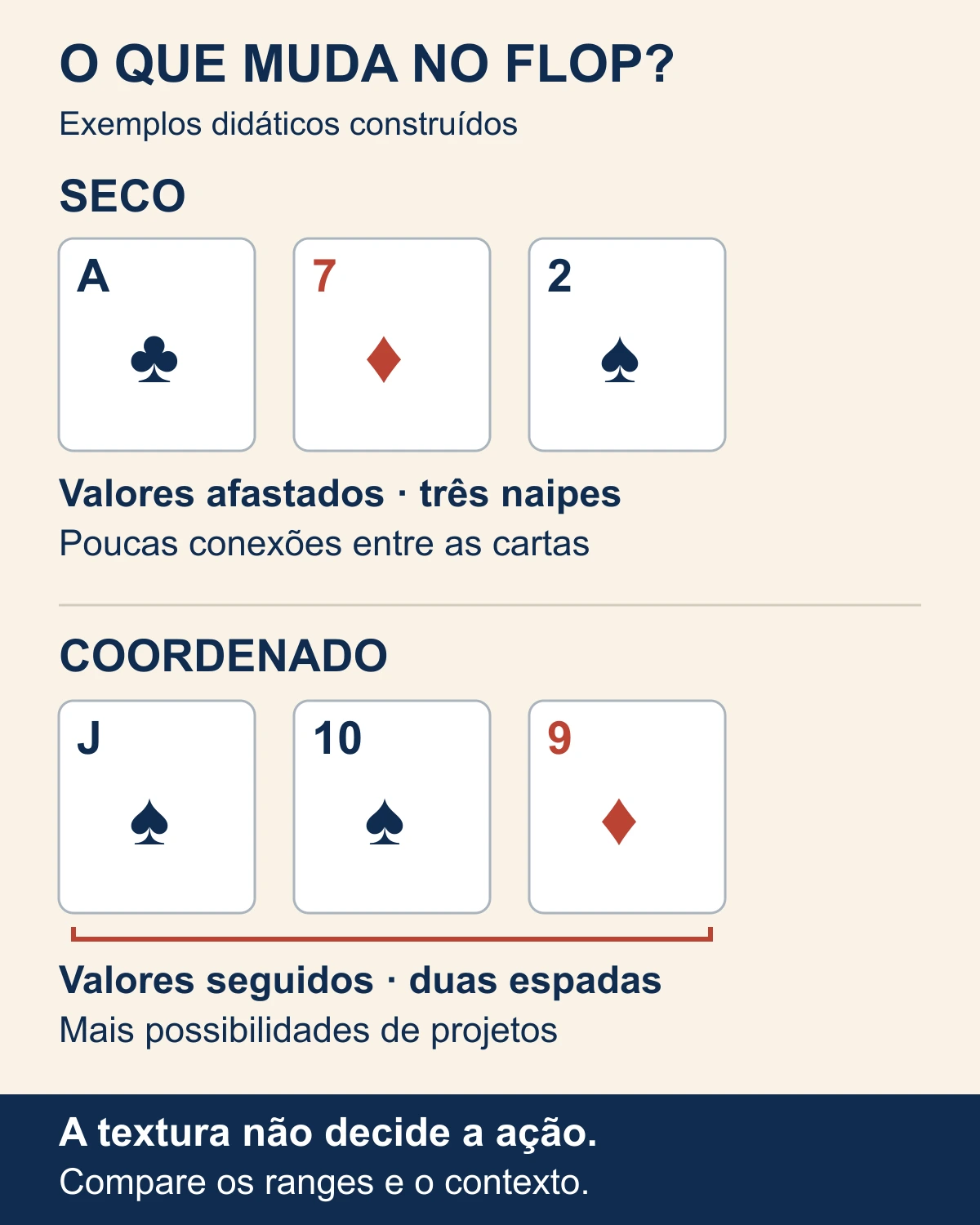
On dry flops, fewer dangerous combinations and draws are available, which can favor the pressure exerted by a c-bet. But classifying the board does not settle everything. You also need to assess each player’s range, meaning their set of possible hands. A flop may favor an opponent’s range more than your own. In that case, betting requires more care: you may get called or raised by strong hands that connect well with that board. Checking becomes an alternative that lets you assess how the hand develops. The useful question is not limited to “Did I hit anything?”; it also includes “What hands could my opponent have hit here?” [1][3]
Position Changes the Information Available
Being in position means acting after a particular opponent in that betting round. You observe their action before making your decision. Being out of position means acting before that opponent, with less information available at that moment. [2]
Out of position, betting can leave the aggressor facing difficult decisions and make pot control harder. Checking and assessing the opponent’s response can be a suitable alternative. The caution comes from deciding with less information; it does not prohibit betting from that position. [2][3]
The Number of Opponents Affects the Pressure of the Bet
A c-bet tends to work better against fewer opponents. When several players remain in the pot, especially if you have a weak hand, there are more reasons to avoid an automatic bet and consider checking. [1][3]
An Opponent’s Behavior Changes the Choice Between Value and Bluffing
Against players who call too much, known as calling stations, the advice is to reduce bluffs and focus your bets on value. Pressure becomes less useful when an opponent rarely folds; in this context, persisting with bluffs can burn through chips unnecessarily. [2][3]
Against someone you have observed folding too often, there is more room to increase the pressure. That read comes from identified behavior, not an assumption about unknown players. [2]
SuperPoker also points out that a c-bet can represent strength, a bluff, or a poorly considered action. The bet alone therefore does not reveal the player’s intention. Their behavior helps you interpret what that action means and how it fits into the dynamics of the hand. [1]
The Relationship Between Stacks and the Pot Completes the Context
Another factor is SPR, calculated by dividing effective stacks by the size of the pot. The guidance presented by Poker Skill associates low SPRs with more straightforward value betting; at higher SPRs, it emphasizes balanced ranges and selective bluffs. This factor adds another dimension to the analysis: beyond the cards and opponents, the decision considers the number of chips in relation to the pot. Texture, position, behavior, and SPR all contribute to the choice. None of them, on its own, dictates a mandatory betting frequency or size. [2]
An Example for Understanding SPR
In a hypothetical no-limit Texas Hold’em hand, at the start of the flop before any bet on that street, the pot is 12 BB and the remaining effective stack is 60 BB. BB means big blinds. The SPR = 60 ÷ 12 = 5: the remaining effective stack is five times the pot. [2]
Where Fixed Rules Stop Helping
Missing the flop does not require you to bluff. An aggressor can c-bet even without improving, but that possibility needs to be weighed against the board and the resistance expected. When the flop favors the opponent’s range more, or when a weak hand faces several players, checking can preserve chips and allow for a fresh assessment. [3]
It is also not enough to think that the preflop bet needs to be “confirmed.” Betting every flop without considering texture and never checking as the aggressor are mistakes identified in c-bet guidance. The decision should change with the situation instead of simply repeating the previous action. [2]
Strong Hands Can Check Too
Value betting is a central part of the strategy, but that does not mean betting every strong hand in every circumstance. There is room to check occasionally with very strong hands in an attempt to induce action. This possibility helps explain why checking is not synonymous with giving up or lacking strength. [2]
The choice involves a trade-off: betting aims to get called and build the pot; checking a very strong hand may avoid driving away opponents who would fold to a bet. The second option is presented as a possibility that depends on context, especially when your hand is much stronger than your opponents’ hands. It does not make every very strong hand a mandatory candidate for a check. [3]
Bet Sizing and the Turn Require Their Own Decisions
C-bet sizing should also account for board texture and the opponent’s tendencies. Choosing to bet does not automatically determine how much to bet. A fixed size, applied without considering the situation, fails to incorporate the factors that justified the decision itself. [3]
Betting the flop does not require you to keep betting the turn. A second bet is known as a double barrel. If you are bluffing and the opponent is likely to keep calling, consider stopping the bluff. If you have a strong hand and expect calls from weaker hands, consider continuing for value. The purpose of the bet and the opponent’s expected response guide the choice. [2][3]
How to Review Your C-Bet Decisions
When reviewing hands, a useful step is to reconstruct the reason for your flop action. Study guidance includes reviewing the mix of value bets and bluffs and recognizing situations where the preflop aggressor should consider checking. [2]
You can organize this review into a short sequence:
- Identify the purpose of the bet. Was it meant to get called, induce a fold, or apply pressure with a draw?
- Relate the flop to the ranges. Look at the texture and whether the cards favored the opponent’s possible hands more.
- Record the conditions of the hand. Consider position, the number of opponents, observed tendencies, and the relationship between stacks and the pot.
- Compare it with the option of checking. Assess whether there was a concrete reason to bet or whether the decision simply repeated the preflop aggression. [1][2][3]
This review does not require finding a rule that works for every flop. It aims to distinguish decisions with different purposes: extracting value, bluffing in favorable conditions, using draws selectively, or checking when there is no clear reason to bet. The next decision becomes easier to understand when you can explain what you intended to achieve with the action and which conditions supported that expectation. [1][2]

 1 day ago