Fold Equity in Poker: Folds and Showdown Equity
What Is Fold Equity in Poker?
A bet can win the pot in two ways: with the best hand at showdown or by making the opponent fold before it. Fold equity is the benefit of that possibility of inducing a fold, even when your cards are not the best. [2]
Upswing uses the term for the probability of a fold; PokerNews emphasizes its associated benefit, while GTO Wizard distinguishes that value from EV, the average result of an action. [1][2][3]
How Fold Equity Works in Poker
Example: an 80-chip pot and a 40-chip river bet
Consider this hypothetical example, based on Upswing’s risk-reward formula: on the river in Texas Hold’em, one opponent remains, the pot contains 80 chips before your bet, and you bet 40 chips. The opponent can only fold or call; if they call, you always lose. There are no further betting decisions and no rake, the fee deducted from the pot. [1]
| Opponent’s response | Net result of the bet |
|---|---|
| Fold | You win the 80 chips already in the pot. Your 40-chip bet is returned to you. |
| Call | You lose the 40 chips you bet. |
Let f be the probability of a fold. Expected value combines the two outcomes:
EV = f × 80 − (1 − f) × 40
To find the break-even point, set EV to zero. The general formula is bet ÷ (pot before the bet + bet). Here:
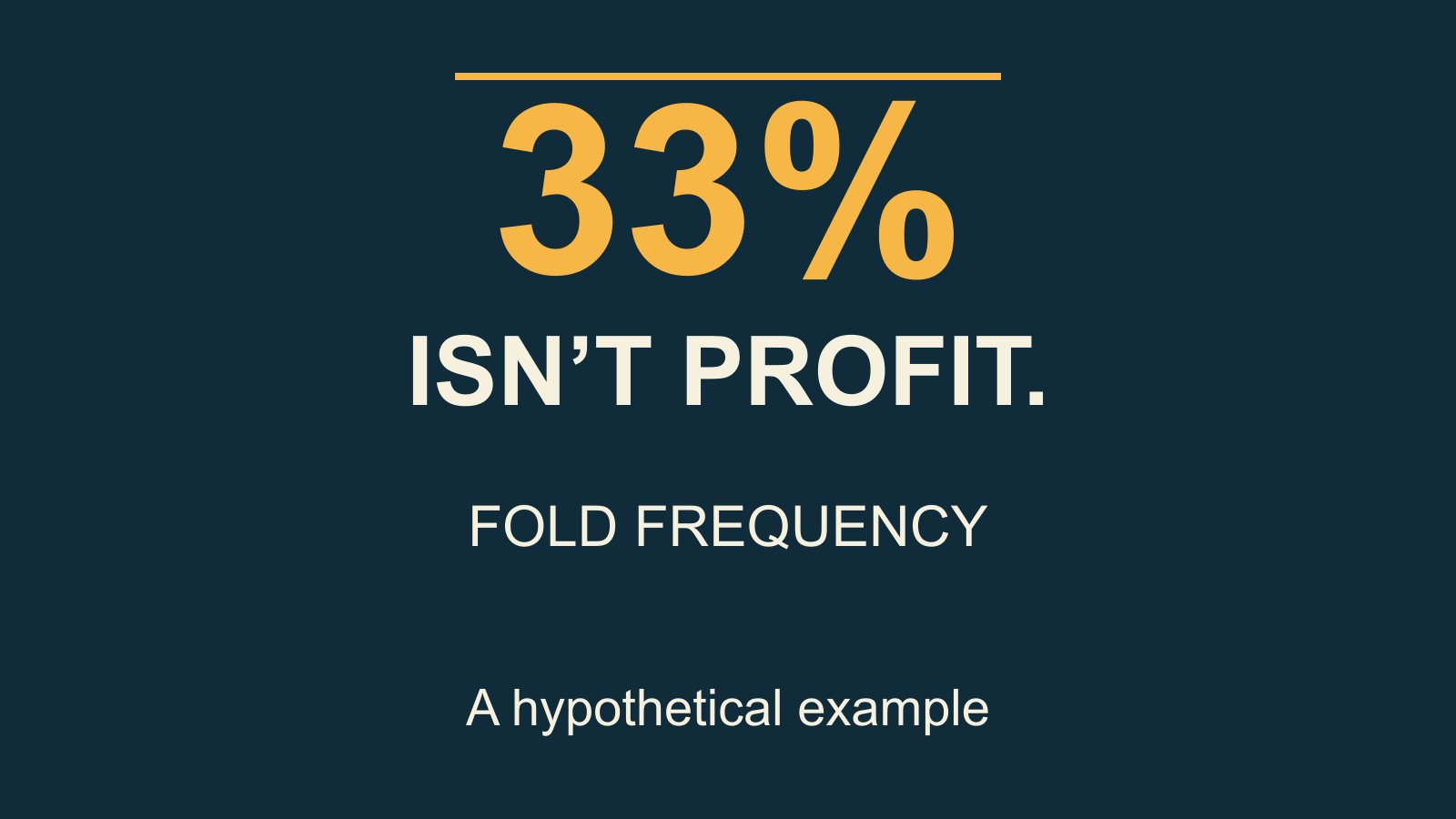
Required fold frequency = 40 ÷ (80 + 40) = 1/3 ≈ 33.3%. [1]
This helps you assess the price of the bluff: under these conditions, the opponent must fold one-third of the time for EV to be zero; above one-third, it is positive, and below, negative. This is a threshold to reach, not a prediction that the opponent will fold that often.
Semi-bluffing before the river
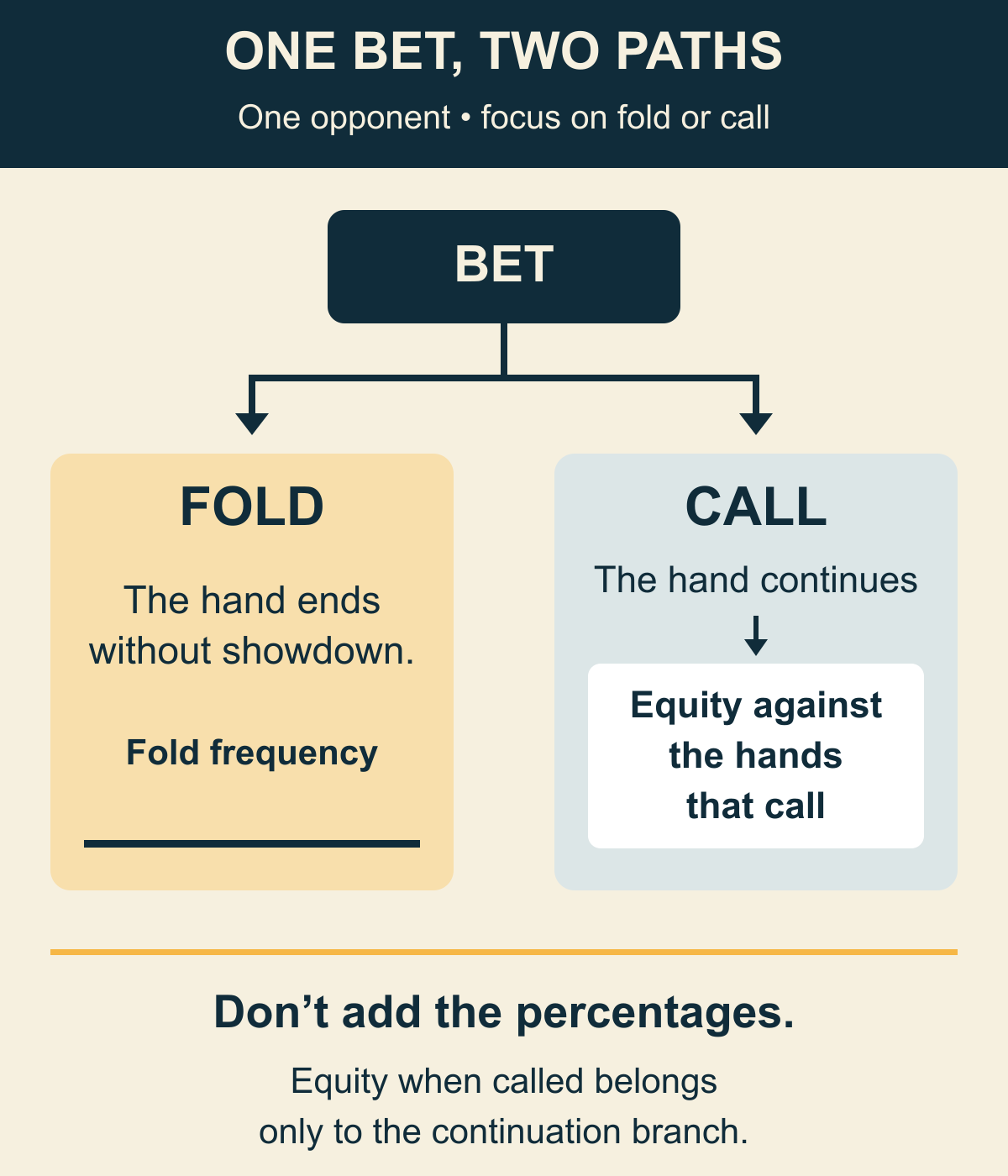
Before the river, a semi-bluff can induce a fold and the hand can still improve if called. Being called therefore does not mean automatically losing the amount bet: the evaluation needs to include equity against the hands that continue and decisions on later streets. [1]
The two paths are separate. Equity when called belongs to the occasions when a call occurs, so its percentage should not simply be added to fold frequency. [1][3]
What to observe when estimating folds
The opponent’s playing style, the bet size, and the board texture—the characteristics of the community cards—help estimate fold probability. It may be harder to induce folds from someone who calls with many hands; someone more inclined to let a hand go may fold more often. Observe how they respond to the situation rather than assigning everyone the same frequency. [1][2]
Betting more changes the cost of the bluff
For the same initial pot, a larger bet raises the required fold frequency in the example’s model. Bet size can also influence the opponent’s response. Compare the added cost with the folds you expect to induce: a larger bet merely looking more threatening does not establish that the bluff is worthwhile. [1][2]
Which hands fold also matters
A range is the set of hands considered for an opponent. If your bet only forces out hands with no potential to beat yours, those folds may add no value compared with checking, meaning passing the action without betting. The effect differs when you make hands with meaningful potential against yours fold. Consider both the hands that leave the contest and those that continue. [3]
Comparing betting with checking also depends on your hand: a hand with showdown value retains another way to win the pot. The pure-bluff calculation addresses the specific situation in which you always lose when called. [1][3]
When to use a fuller evaluation
With multiple opponents, possible raises, future bets, or rake, the possible outcomes and their costs change. Do not apply the example’s two-outcome calculation to those situations. When your hand has winning potential, equity realization concerns how much of that potential becomes a result through the remaining decisions. [1]
How to study fold equity
Observe a hand you are not playing and mentally compare different bet sizes: would a larger bet induce more folds? Would a smaller one have a similar effect? Consider the opponent’s style and the community cards when forming your estimate. This exercise, suggested by Upswing, trains you to read the opponent’s response. [1][2]
Sources
- [1] What is Fold Equity and Why is it Important? — Upswing Poker — Dan B., April 1, 2024.
- [2] Fold Equity Definition | What is Fold Equity in Poker? — PokerNews
- [3] The Value of Fold Equity - Experiment — GTO Wizard — July 3, 2022.
 1 hour ago