Showdown in poker: when to show your cards and compare hands

By the Editorial Team
The showdown is the stage when players who are still in the hand show their cards to determine who wins the pot. In Texas Hold’em, it occurs when the final betting round ends and at least two players remain in contention. There does not need to be a called bet on the river: if everyone checks on that round, the hands will also be compared. [2]
If a bet makes all opponents fold, the only remaining player wins the pot without a showdown and without needing to show their cards. [3]
The comparison uses each player’s best five-card combination, selected from their two hole cards and the five community cards. Using both hole cards is not mandatory. [5]
Poker showdown rules: from the final bet to comparing cards
The conventions below concern the order of showing hands without an all-in. In a live game, follow the rules in use and the dealer’s guidance. [2][3]
Who shows first after a bet on the river?
The convention described by the sources is that the last player to bet or raise on the river shows first. Betting means placing a bet; raising means increasing an existing bet. Calling does not make the caller the last aggressor. Here, “aggressor” identifies whoever made the last bet or raise on that round. [3]
If everyone checked on the river, the order depends on position relative to the button, even if someone bet on the flop or turn. [2][3]
What if everyone checks on the river?
If there was no bet on the final round, the convention described is to start with the first player still in contention to the left of the button, proceeding clockwise. The button, also called the dealer button, is the marker used as a reference for this order. Anyone who has already folded does not rejoin the hand to show cards. [2][3]
| How the hand ended | Is there a showdown? | Procedure described in the sources |
|---|---|---|
| A bet makes all opponents fold | No | The only remaining player wins without needing to show their hand. [3] |
| There is a bet or raise on the river, betting ends, and at least two players remain | Yes | Under the convention described, the last aggressor on the river shows first. [3] |
| Everyone checks on the river and at least two players remain | Yes | Under the convention described, the first remaining player to the left of the button starts, proceeding clockwise. [2][3] |
How to show a hand that is contesting the pot
The rule for showing cards described by Wikipedia requires a player to show all their cards face up on the table to receive any part of the pot at showdown, even if some of those cards are not used in the final combination. In Hold’em, this means showing both hole cards. [1]
Even if your best hand is entirely on the board, show both hole cards to claim the pot under this rule. [1]
The principle that cards speak also applies: the actual value of the hand shown takes precedence over a player’s mistaken declaration. If someone announces a combination different from the one their cards form, reading the cards determines its value. In the description of a game with a dealer, the dealer is responsible for reading and announcing the winning hand. [1][3]
How to choose the five cards that actually count
At showdown with a complete board—all five community cards face up—each player has seven cards available to make their best hand: the five community cards and their two hole cards. The final combination can use: [5]
- Both hole cards and three community cards.
- One hole card and four community cards.
- Only the five community cards.
A hole card is left out of the final combination when it does not improve the best five cards available. [5]
Compare the hand categories first, then the relevant values within each best five-card combination. [5][6]
A kicker is a tie-breaking card outside the main grouping of a hand; it counts only when it belongs to those five cards. If the best hands remain equal in value, the pot is split. [6]
In standard Texas Hold’em, a sixth card is not added to the comparison, and suit rankings are not used to break that tie. The analysis ends with the five cards that make up each hand. [6]
Mucking, all-ins, and table rules
Mucking means discarding a hand without revealing its cards. The situation described by PokerStars Learn is that of a player who sees a stronger hand already shown and decides to discard their losing hand without showing it. The PokerNews definition adds that folding this way means giving up any claim to the pot. [4][2]
Check your hand and the board before surrendering your cards face down to the dealer. [3]
When should cards be turned face up in an all-in?
In tournaments using TDA rules, once a player is all-in and all betting action by the others is complete, with no further betting possible, every hand still contesting the main pot or any side pot must be tabled immediately. There is no need to wait for the river to be dealt. If other players can still contest a side pot and continue betting, that point has not yet been reached. In cash games or events with a different ruleset, follow the rules in use. [6]
Can I demand that an opponent show a mucked hand?
Do not assume you have that right in every room. Wikipedia notes differences between rulesets: some rooms restrict requests to see a mucked losing hand and require a concern about possible collusion, meaning coordinated action between players. Under those rules, simple curiosity about an opponent’s cards does not establish an automatic right to see them. [1]
If there is any doubt, direct the request to the dealer. [1]
A tie and an odd chip are different issues
If hands tie and a chip of the smallest denomination remains after splitting the pot, follow the table’s allocation rule. Under the procedure described by PokerHarder, it goes to the eligible player closest to the left of the button. [5]
Example: different hole cards, the same final five cards
The rule allowing players to use only the board explains why different hole cards can result in a tie. Each player selects their best combination from the seven available cards; when the five community cards are the best hand for both, those are the five cards used in the comparison. [5]
Hypothetical example: in Texas Hold’em, betting has ended and two players show their hands. The complete board is A♣ K♦ Q♥ 9♠ 7♣. Player A holds 4♥ 2♦; Player B holds 6♠ 3♥. Player A’s best five-card hand is A♣ K♦ Q♥ 9♠ 7♣. Player B’s best five-card hand is also A♣ K♦ Q♥ 9♠ 7♣. The result is a tie, with the pot split between the two.
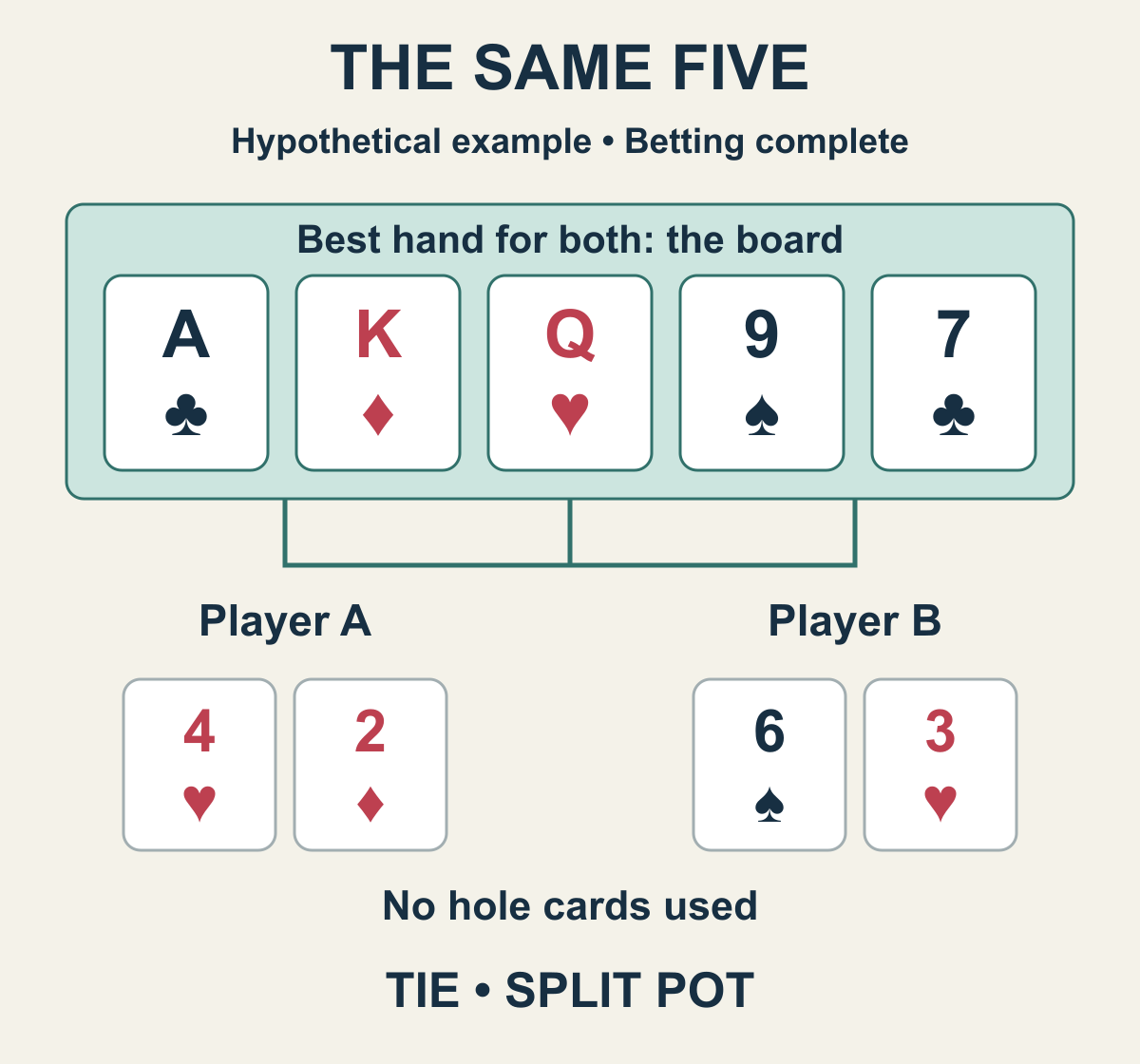
| Element | Player A | Player B |
|---|---|---|
| Hole cards | 4♥ 2♦ | 6♠ 3♥ |
| Shared board | A♣ K♦ Q♥ 9♠ 7♣ | A♣ K♦ Q♥ 9♠ 7♣ |
| Best five-card combination | A♣ K♦ Q♥ 9♠ 7♣ | A♣ K♦ Q♥ 9♠ 7♣ |
| Hole cards used | None | None |
Player B does not win by having a higher hole card than Player A’s: that card is not among the five that determine the result.
The tie in this example occurs because neither player can improve on the five community cards. Sharing a board alone does not establish a tie. [5]
At the table, confirm the procedure before discarding
Wait for the dealer’s indication of your turn to show, and check your hand and the board before discarding. [3]
Before joining a table or tournament, it is worth clarifying these points with the organizers:
- What procedure for showing cards is used after betting on the river and after a checked-through round?
- What requirements for exposing cards apply to all-ins?
- Under what circumstances can a losing hand be discarded without being shown?
- How are requests to see mucked cards and any odd chips handled?
During the hand, a question about procedure should be resolved before taking an irreversible action with the cards.
Sources
- [1] Showdown (poker) — Wikipedia)
- [2] Showdown Definition | What is a Showdown in Poker? — PokerNews
- [3] Showdown Definition: All You Need to Know About Showdown — PokerStrategy
- [4] Poker Showdown — PokerStars Learn
- [5] The Showdown - The rules of the Poker Showdown — PokerHarder
- [6] Learn the Rules of Texas Hold’em — CBTH, July 21, 2024

 1 hour ago