
Poker Hand Ranges: Reading and Making Decisions in Context

A range is the set of hands a player can have in a given situation. Instead of trying to guess two cards, you consider a set of possibilities and assess how your hand fares against it. An opponent’s range is an estimate built from position, previous actions, stack size, and table behavior. [3]
Poker Hand Ranges: How to Read and Build a Hypothesis
What the Matrix Represents
The preflop matrix groups pairs, suited hands (two cards of the same suit), and offsuit hands (different suits). Each cell contains the combinations for the hand shown. In the notation, A is ace, K is king, and J is jack; s means suited and o means offsuit. [3]
| Notation | How to Read It | What It Contains Preflop |
|---|---|---|
AKs | Ace-king suited | The four ace-king combinations with both cards of the same suit |
AKo | Ace-king offsuit | The 12 ace-king combinations with cards of different suits |
JJ | Pocket jacks | The six possible combinations of this pair |
Thus, three highlighted cells can represent different numbers of combinations. A range can also be recorded as a string, a text list used to discuss and transfer sets of hands between applications. [3]
First, Identify Whose Range It Is
Your strategic range contains the hands you intend to play in a situation. The range assigned to an opponent contains the hands you consider possible for them. Analysis can compare hand versus hand, hand versus range, or range versus range — the last includes both players’ sets. [3]
Teaching Hypothesis: How a Reraise Changes the Read
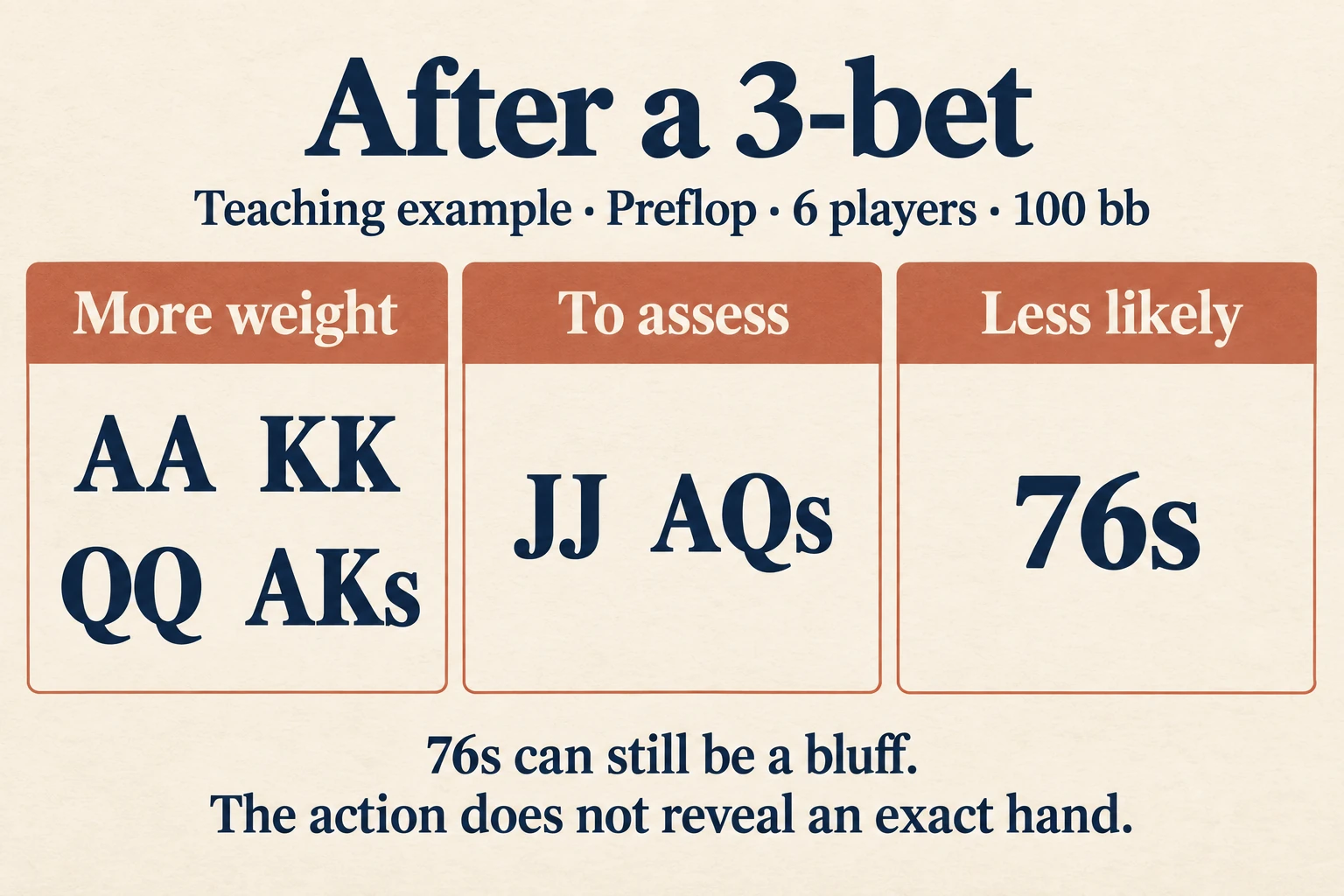
Imagine a preflop Texas Hold’em hand at a six-player table with effective stacks of 100 big blinds. For this exercise, consider AA, KK, QQ, JJ, AKs, AQs, and 76s as initial possibilities for an opponent in late position. An early-position player opens with a raise, and this opponent makes a 3-bet, or reraise.
Also assume, as part of the exercise, that this opponent usually reserves reraises against early-position opens for strong hands. Given that information, AA, KK, QQ, and AKs deserve more weight in the read; 76s becomes less likely, although it could still appear as a bluff. JJ and AQs remain possibilities, with their weight to be assessed from the observed behavior. The action helps reorganize the set without revealing an exact hand.
Position, Actions, and Stack Size Give the Set Meaning
Position: early positions generally use narrower, stronger ranges; late positions allow more hands, while considering opponents’ behavior. Stack size: measure depth in big blinds and use the effective stack for the matchup. [2]
Previous actions: opening the pot differs from responding to a raise followed by a reraise. Freebetrange’s guide recommends a narrower set when an open raise and a 3-bet have already occurred before your turn. Table dynamics: player count and playing styles also help shape the range. [3]
Composition Matters as Much as Width
In Reg Life’s classification, a linear range contains strong hands with good playability; a polarized range combines very strong and weak hands; a condensed range concentrates on medium-strength hands, with few top hands and no very weak ones. Calling a range “wide” alone does not explain how those hands are distributed. [2]
A Chart Only Guides the Situation It Describes
Before using a chart, check the format, number of players, position, stack size, and action being analyzed. Freebetrange’s UTG (early preflop position) opening material covers 6-max Texas Hold’em cash games. PokerNews Brasil presents all-in charts for six-player and nine-player tables, separated by stack size. An opening chart alone does not tell you how to continue after a 3-bet, and an all-in chart does not cover every preflop decision. [1][3]
Example: Which Stack Should Guide the Analysis?
In Reg Life’s example, you have 100 big blinds and face an opponent with 30 big blinds. The effective stack for this matchup is 30 big blinds: use that depth when consulting a range strategy, because the extra 70 big blinds in your stack are not at stake against this opponent. [2]
How to Apply This Reasoning to Hand Reviews
When reviewing a hand, record the format, positions, stacks, and action sequence; write down the hands you assign to the opponent; then explain which information increases or reduces the weight of those possibilities. Compare alternatives against the set instead of justifying a decision with a guess about two cards. [3]
Choosing between calling, raising, and folding also requires considering the price of the bet and the hand’s situation; the list of possibilities alone does not determine an action.
Sources
- [1] 10 Poker Range Charts — PokerNews Brasil
- [2] Ranges: How to Build the Perfect Strategy — Reg Life — published on October 11, 2023.
- [3] Poker Ranges: A Complete Guide — Freebetrange — update indicated in the text: September 11, 2024.

 5 days ago