
Check-Raise in Poker: The Sequence and What to Consider

A check-raise happens when you check, an opponent bets, and you respond with a raise in the same betting round. The play can seek value with a strong hand or serve as a bluff to try to make a better hand fold. The action is the same; the result you want to achieve is different. [3]
The decision depends on two assessments: whether your opponent tends to bet after your check and how they usually respond to a raise. For value, you want action from worse hands. As a bluff, you want better hands to fold. An opponent willing to bet is not necessarily willing to fold afterward, and that difference affects your choice of play. [2][3]
The central point is to have a purpose before raising. A check-raise involves passing up the initial bet to try to take advantage of someone else’s action. That is why a strong hand alone does not settle the decision: you also need to consider your opponent’s behavior and your plan for what comes next. [1][2]
Check-Raise in Poker: How the Sequence Works
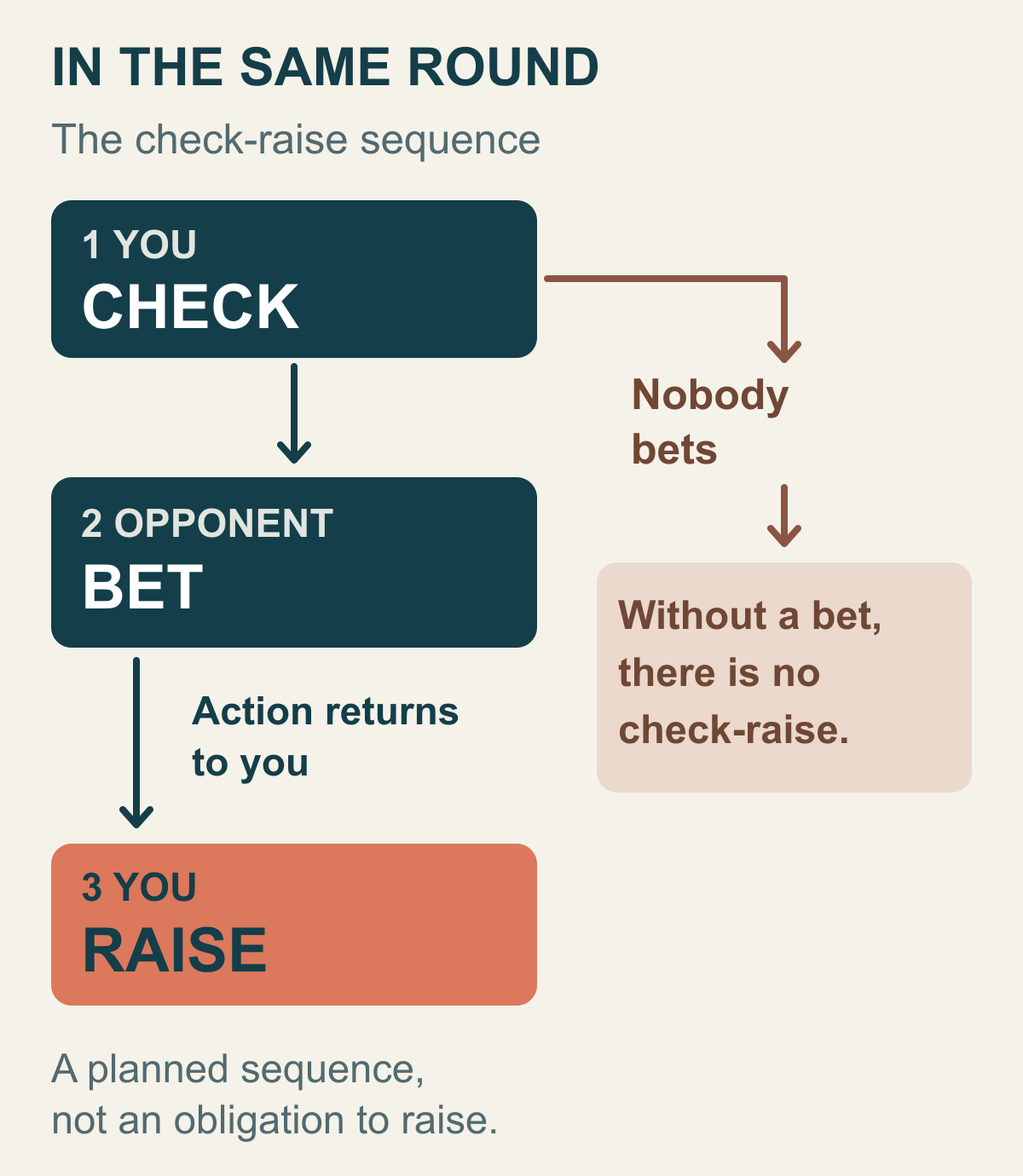
The sequence has three distinct actions, and their order is part of the definition. First comes your check; then your opponent’s bet; finally, your raise over that bet. Everything happens within the same round. [3]
The check makes room for your opponent’s bet. You pass the action with the intention of giving the other player an opportunity to bet. In this plan, the check can conceal a strong hand or set up an attempt to pressure your opponent. By itself, it does not reveal which of these objectives is at play. [1][2]
The bet creates the opportunity to raise. This is the part that depends on your opponent. You may want them to bet, but you do not control that decision. If no one bets after the check, there will be no bet to make your planned raise over. A tendency to check behind is therefore a direct obstacle to this line. [2]
The raise completes the play. After the bet, when the action returns to you, comes the raise. Simply matching the bet would be a call; for it to be a check-raise, you must raise after having checked in that round. [1][3]
Position Helps Create the Opportunity
Position matters because the plan requires an opponent to have an opportunity to bet after your check. This does not make the first seat at the table a requirement for the play: what matters is the relationship between the actions in that round. Hand strength, opponent tendencies, and position all factor into the assessment. [2][3]
In live games, executing the play requires attention to your turn to act. Wait for your opponent’s bet before responding, without acting prematurely. GipsyTeam’s guidance is to observe the other player’s actual action and avoid revealing your intention to raise in advance. [1]
Value and Bluffs Call for Different Responses
For Value: Getting Action from Worse Hands
A check-raise for value aims to build a bigger pot with a hand you expect to be ahead. The goal is for your opponent to put in more chips with worse hands, including by calling the raise. Having a strong hand explains your interest in growing the pot; the possibility of getting that call explains where the value would come from. [2][3]
This distinction helps you assess the raise size. An oversized raise with a hand of marginal strength can drive out worse hands and leave you in a large pot when a better hand continues. Raising more therefore does not automatically mean extracting more value. The response the sizing produces is part of the decision. [2]
There is also a difference between wanting to build the pot and managing to do so. Your opponent may fold to the raise. Their initial bet does not oblige them to call the raise, so a value plan needs to consider which hands would still be willing to continue. [3]
As a Bluff: Making a Better Hand Fold
When bluffing, the immediate goal is to make a better hand fold. PokerNews presents the check-raise as an option against aggressive players who bet when someone checks. That aggression can provide the opportunity to raise, but it is not enough to justify the bluff. [3]
You need to distinguish betting frequently from folding under pressure. A player may bet often and also call raises with relatively weak hands. Against this tendency to call, a line heavy on bluffs meets resistance; the potential to extract value becomes more important. [2]
A Semi-Bluff Has the Potential to Improve
A semi-bluff uses a hand with the potential to improve, known as a draw. The raise aims to pressure your opponent into folding, while the possibility of completing a stronger hand offers another prospect for continuing. This plan differs from both betting for value with a made hand and bluffing without that same potential to improve. [1][2]
Still, having a draw does not make a check-raise mandatory. Your opponent’s willingness to bet and to fold remains relevant. The potential to improve is a characteristic of the hand; whether the raise is suitable also depends on the situation in which it is being played. [2][3]
Dependence on Your Opponent Limits the Plan
The first risk arises before the raise: your opponent may not bet. When they tend to check behind you, waiting for a bet can prevent you from building the pot as intended. This makes betting directly an alternative to compare, especially when the purpose is to put more chips into the pot with a strong hand. [2]
The second risk arises afterward: your opponent may continue. For a check-raise bluff, facing frequent calls undermines the objective of winning the pot immediately. For a value line, getting called may be desirable, but that action alone does not identify the exact hand that called. Planning should account for tendencies without turning a response into certainty about the cards. [1][2]
Plan for an opponent’s reraise as well. Deciding only how to induce the first bet leaves that continuation unanswered; another raise does not require an automatic fold or call. [1][2]
The Sizing Needs to Serve the Objective
In No-Limit Texas Hold’em, a check-raise can make the pot grow considerably and change the decisions that follow. Your choice of sizing should consider the purpose of the raise and what may happen in the coming rounds. A bigger pot can bring more difficult decisions if your opponent calls or reraises. [2]
This relationship cannot be reduced to a universal multiplier. For value, what matters is which hands can keep calling; as a bluff, what matters is the pressure needed to induce folds. Using the same sizing out of habit, without relating it to the objective and expected response, leaves out precisely the factors that guide the choice. [2]
The image you have built at the table also factors into this assessment. If opponents start expecting check-raises, they may cut back on lighter bets after your checks. Their previous patterns therefore need to be interpreted alongside how they perceive your actions. [2]
An Example of a Check-Raise for Value
PokerNews presents a Texas Hold’em example in which a player is dealt pocket aces and flops a set. They check to induce a bet from their opponent. The opponent bets, and the player then raises. [3]
If your opponent often checks behind, betting directly may be more effective for building the pot with a strong hand. [2]
How to Assess the Decision When Reviewing a Hand
When reviewing a check-raise, try to reconstruct the plan that existed before the action. The recommendation to define the reason for the play and prepare for what follows allows you to organize the analysis around three questions: [1][2]
- What supported the expectation of a bet? Consider the patterns observed in your opponent, especially their willingness to bet after a check.
- What response was the raise intended to produce? Identify whether the intention was to get action for value or induce a fold as a bluff.
- How did the plan account for resistance? Examine whether the chosen sizing and planned continuation made sense if your opponent called or raised again.
To study further, examine the check-raise on the flop, turn, and river, comparing how your hand and continuation plan relate to each other in each betting round. [1][2]
Sources
- [1] Check-Raise in Poker: Learn About This Play — GipsyTeam. Marcelo Augusto; expert: Eduardo “eduardo850” Silva. Published on August 4, 2022.
- [2] Check-Raise in Poker: Worked Examples & Sizing Guide — Poker Skill
- [3] Check-Raise Definition | What Does Check-Raise Mean in Poker? — PokerNews

 1 day ago