Equity Realization in Poker: The Direct Answer
Equity realization (EQR) describes how a hand’s showdown equity relates to its expected value (EV) when there are still bets, folds, and cards to come. It is not a probability of winning. It shows whether the hand captures, on average, more or less of the pot than its equity would indicate if no one bet again [1][2].
Equity uses a showdown without further betting as its reference for the pot. At the table, you can fold, call further bets, or make your opponent fold, and each hand makes use of those opportunities differently. EQR summarizes this effect in one number. To compare it, EV and equity must use the same pot, unit, and reference point [1][2].
Assumptions Before the Ratio: EV, Pot, Unit, and Reference Point
Before comparing two numbers, define what each term represents:
- Pot: the total being contested at the point in the hand you are analyzing. Equity and EV are measured relative to this same pot.
- Reference point: raw equity, meaning the share of the pot the hand would take, on average, at showdown against the opponent’s hand or range if there were no further bets [1]. Imagine that, from this point on, no one bets again and the remaining cards are dealt. What share of the current pot would your hand take, on average, at showdown? In a game where every hand was played this way, every player would realize 100% of their own equity [2]. This is the starting point for the comparison.
- EV: in this interpretation, the average value the hand realizes by the end, after accounting for bets, folds, position, and future cards [2]. It is expressed on the same scale as equity, as a fraction of the pot at the reference point.
- Unit: both terms are entered as fractions of the same pot. If you prefer to count in chips, big blinds, or reais, use the same unit and the same pot on both sides. This way, the pot size cancels out in the division, leaving a result with no currency unit.
- Situation: EQR applies to a hand in a specific context. It depends on position, board texture, stacks, and the composition of both players’ ranges [1].
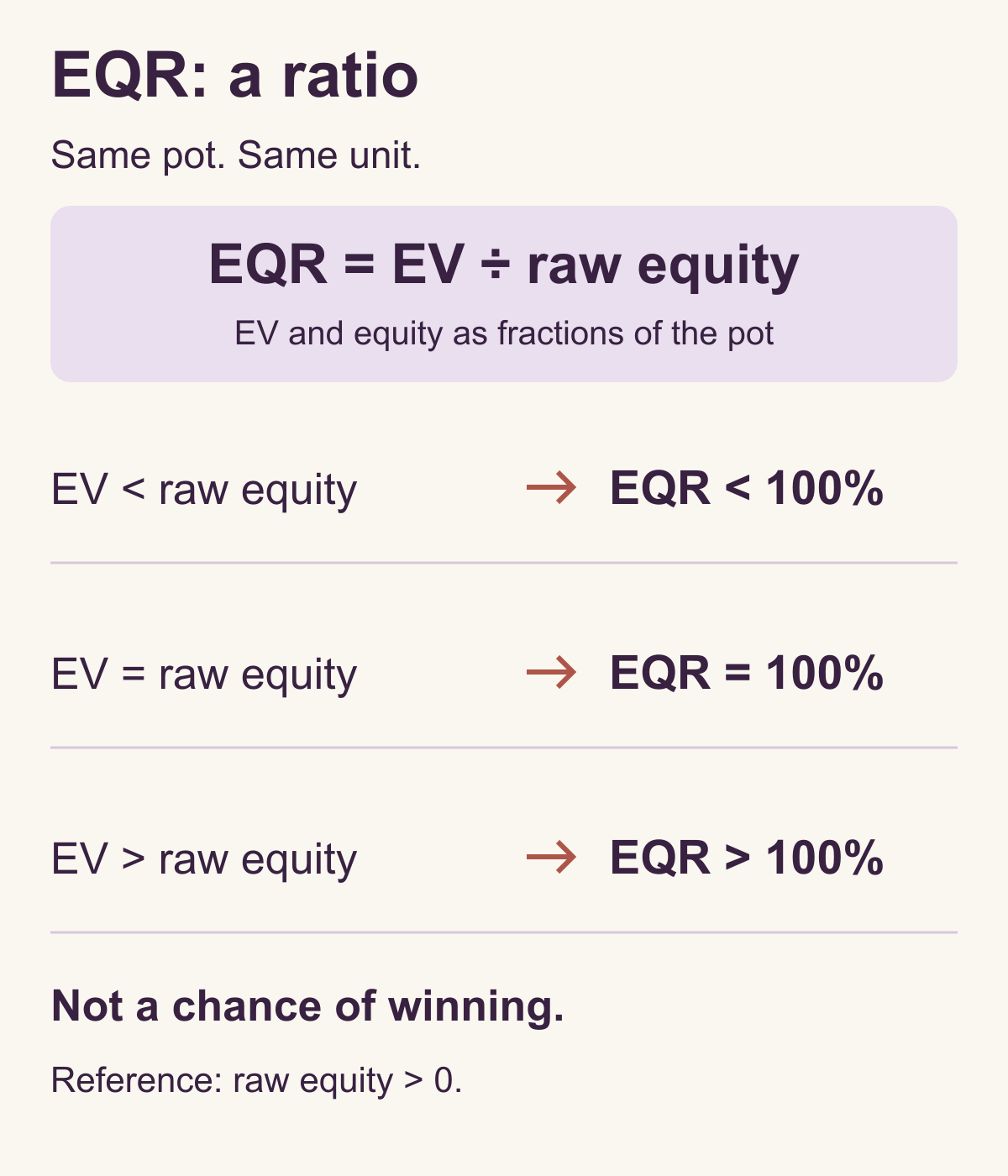
With these assumptions fixed, EQR is the ratio of EV to raw equity:
EQR = EV ÷ raw equity (both expressed as fractions of the same pot). Rearranging: EV = EQR × raw equity.
- EQR equal to 100%: EV equals equity. Future betting neither takes anything away nor adds anything.
- EQR above 100% (over-realization): EV exceeds equity. The hand yields more than a showdown with no further betting would suggest.
- EQR below 100% (under-realization): EV falls below equity. Some equity is lost through folds, position, and future cards before showdown [2].
The interpretation is relative. The ratio compares the hand with its own equity and does not tell you whether that equity is high or low [1].
How Future Betting Changes Equity Realization: Why the Ratio Rises or Falls
GTO Wizard treats EQR as a measure of playability: how much a hand benefits or suffers from the betting opportunities still to come. Strong hands benefit from building the pot. Weak hands benefit from bluffing. Hands in the middle suffer because they risk putting more money in against better hands or folding against worse hands [1].
That is why the hands that under-realize the most are medium-strength hands with a reasonable chance at showdown but not enough strength to bet for value. This is the territory of showdown value. Draws that only improve to a medium-strength hand also under-realize because they face the same dilemmas even when they hit [1].
The ratio rises when EV exceeds starting equity: a hand may gain value by getting paid by worse hands or making the opponent fold [1][3]. Putting more money into the pot against better hands, however, may reduce that value. What matters is which hands the money goes in against, not simply how much goes in. The benefit of inducing a fold is called fold equity, and it helps explain how a hand can yield more than its raw equity indicates.
| Factor | Described tendency |
|---|---|
| Position | Out of position, all hands have lower EQR. Acting last has the greatest influence on realization: in position, when the opponent checks and there is no bet to call, you can check behind (check after them) and see a free card. Out of position, you face bets that often force folds, and folds before the river burn equity [1][2]. |
| Suited and connected hands | On average, suited hands realize much more equity than offsuit hands. Flush draws, backdoor draws, and combo draws provide ways to continue, and connected cards make straights [2]. |
| Medium strength | This is the most difficult category: the hand wants to reach showdown but cannot withstand pressure [1][2]. |
| Future value-betting or bluffing potential | Raises the ratio. This applies to hands that are already good candidates for betting, hands that can improve to a value hand, and hands with a blocker that makes a bluff profitable [1]. |
| Depth (SPR) | Low SPR favors hands such as top pair that want to commit. Higher SPR rewards speculative hands that need depth to get paid when they hit. Deep stacks also make calling with the second-best hand more costly (reverse implied odds), which can reduce these hands’ realization [2]. |
| Range composition | In a mostly weak range, the rare strong hands realize more. In a mostly strong range, the few weak hands realize more [1]. |
| Quality of play on later streets | Players who miss value-betting or bluffing opportunities realize less than a solver would predict. If the opponent calls too light or folds too much, you can realize more [1]. |
Read the table as an indication of direction, not weight: the effect of each factor changes with the board, stacks, and ranges [1].
Interpreting EQR: Ratio, Value, and the Calling Price
Read EQR above 100% as EV exceeding starting equity. It measures relative realization, not winning frequency: the hand can take the pot without showdown by making the opponent fold [1][3]. Always consider the ratio alongside raw equity. A high-equity hand may realize less than 100% and still have value; a very weak hand may realize much of its small equity through bluffs without becoming a strong hand [1][3].
To assess a call, combine that reading with the current price. A hand that tends to fold on flops where it misses, gets pressured off marginal strength, or pays with the second-best hand converts less equity into EV. An apparently favorable price may then fail to compensate for losses on later streets. EQR and pot odds belong together in the analysis because the ratio alone does not incorporate the price or the bet size [2].
Use values in the context where they were calculated: position, board, stacks, ranges, and future play. A solver gives exact EQR under the assumption of equilibrium strategies on later streets; at the table, the task is to estimate the paths available to the hand and how each player uses them [1].
Complete Example: K9o Versus 75s in the Big Blind
This case comes from Poker Skill and applies only to the scenario it describes: a 6-max NLHE cash game, 100 big blinds effective, with the button opening to 2.5 BB and you defending in the big blind [2]. The question is which of the two hands better converts the equity it has. Against the button’s opening range, K9o has more raw equity than 75s. After the flop, the picture changes.
Much of K9o’s equity lies in fragile, medium-strength hands: on most flops, it has king-high or a weak top pair. The opener can pressure these hands street after street. Meanwhile, 75s can flop flush draws, open-enders (four consecutive cards that can complete a straight at either end), pair-plus-draws (a pair accompanied by a draw), or backdoor equity (a possibility requiring improvement on both the turn and river). These paths allow it to continue under pressure. When it hits a disguised straight or flush, the payoff can be large [2]. The hand has fewer ways to win at showdown but more possible ways to get there. Realizing more of its own equity does not, by itself, mean having higher EV: the ratio compares each hand with itself.
Looking at equity alone, K9o appeared to be the better defense. The source concludes that, after accounting for realization, 75s is usually better [2].
How to use the case: compare starting equity with the ways to continue postflop. In this scenario, 75s’s draws favor realization relative to K9o’s medium-strength hands; that is why the source prefers defending 75s [2]. The case provides a qualitative direction, not a calculated calling threshold. A different position, stack depth, or range requires a new comparison [1].
Next Step: How to Use the Ratio When Studying a Hand
Use EQR as a review question, not a number to memorize. For each hand you want to understand:
- Define the situation: position, board, stacks, and both sides’ ranges [1].
- Set the reference point: estimate raw equity, the fraction of the pot the hand would take without future betting.
- Classify the hand’s path: is it strong enough to bet for value? Can it improve to that point? Does it have a blocker or characteristics suited to bluffing? Or does it sit in the middle, without a clear plan [1][3]?
- Consider who plays better afterward: the ratio changes if you or your opponent miss value-betting and bluffing opportunities [1].
- Only then return to the pot and the price: EQR shows how much equity converts into EV. The price of the call and the bet size remain another part of the calculation [2].
When studying value hands, examine bet sizing; when studying weak hands, examine bluffing opportunities [3]. The question shifts from merely “is my hand strong?” to “which play makes the best use of this hand’s equity in this situation?”.
Recommended reading
- Equity in Poker: Hands, Ranges, and Share of the Pot
- Fold Equity in Poker: Folds and Showdown Equity
- Showdown Value in Poker: Hand Strength and Decisions in Context
Sources
- [1] Equity Realization — GTO Wizard (published November 16, 2022)
- [2] Equity Realization in Poker: Why Raw Equity Isn't EV — Poker Skill
- [3] News: Which hands over or under realise equity? — PokerStrategy (published May 22, 2024)
 6 hours ago