

Suited connectors are two cards of consecutive ranks in the same suit, such as T9s or 67s [2][3]. What they offer is potential: ways to make a straight or a flush, rather than a guaranteed strong hand [1][2]. The useful question, then, is not whether the hand looks attractive. It is how much it costs to continue, from which position, with what stacks, after what action, and against which hands you could be behind.
In GipsyTeam’s example, you hold 65s on the button. Be more cautious against an UTG opening range, which is usually stronger, than against a wider cutoff opening range. The same hand can be a better candidate for a 3-bet—a raise over the opening raise—against the cutoff. Also consider whether the opponent folds, stack depth, and raise size when deciding. [1][3]
Why this matters: players of all levels enjoy playing these hands [2]. According to one analysis, the difficulty often lies in having the discipline to let them go, because suited connectors look too attractive to fold [3]. An appealing hand is not enough reason to invest chips simply in the hope that the board will help.
Suited Connectors in Poker: Where the Potential Comes From and What Is Still Missing
Connectors are two cards of consecutive ranks that can combine with three cards on the board to make a straight [1]. When they also share a suit, a flush becomes a second route. According to [2], the main value of this family of hands lies in flopping straight or flush draws—in other words, combinations that are still incomplete. Making use of that value depends on playing those draws well.
When the board helps, the reward can be substantial. In No-Limit Texas Hold’em, connectors such as T-9, 9-8, 8-7, and 7-6 can build a large pot because an opponent is unlikely to expect a straight made with cards like these. The tradeoff is that the same analysis treats them as tricky, speculative hands: unlike broadways (high cards), they depend on the board to become strong hands by the river [1].
What Determines the Cost of Continuing: Position, Stacks, and Previous Action
How you play depends on the type of flop, the type of opponent, and your position relative to them [1]. Position, stacks, and previous action change the cost of continuing.
Position. Position is always measured relative to another player. Playing in position opens up three possibilities with connectors [1]:
- seeing another card for free if the opponent checks;
- applying pressure with precisely sized bets;
- if you did not bet the flop and complete your hand later, the opponent may miss its strength and bet, building the pot.
Out of position, the situation reverses: you are exposed to the opponent’s playing tendencies and may be forced to abandon a promising hand because calling the bet is not worthwhile [1].
Stacks. When the preflop raiser has a shorter stack, the stack-to-pot ratio, or SPR, leaves less room to maneuver postflop. It also reduces the possibility of winning a very large pot when you complete your hand. The analysis of low connectors, such as 65s and 76s, links these two conditions to less effective 3-bet bluffing. With deeper stacks, there is more room to play after the flop and to win a large pot when the hand gets there. [3]
Previous action and the opponent’s tendencies. Two different pieces of information matter here. The first is the action you see in the hand: who raised, who called, and who has yet to act. It indicates how many players could raise again and how strong the earlier player’s range might be—that is, the set of hands they reach that point with [1][3]. The second is the opponent’s known tendencies, which come from what you know about their style rather than from the current hand [2]. Against someone who dislikes folding, a 3-bet bluff loses an important incentive [3]. In addition, [1] warns that when an opponent defends against your 3-bet, that defense may represent strength, so it is not worth overdoing the bluffs.
Domination Risk and Other Limits to the Potential
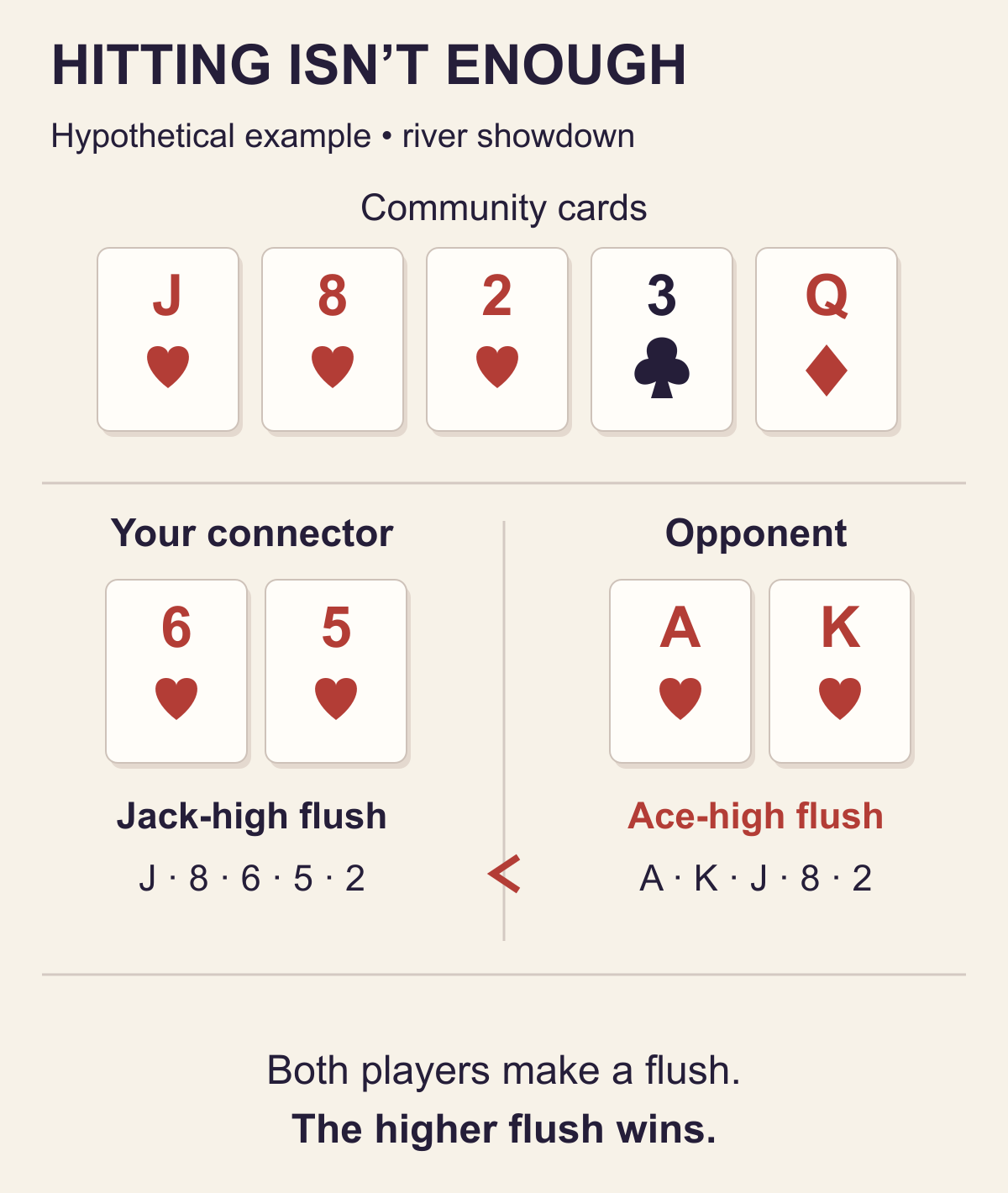
Domination: improving your hand and still making the weaker combination. The risk is not just starting behind preflop. Even when the board helps, you can make a hand weaker than your opponent’s: completing a flush, for example, does not prevent them from having a higher flush. This risk is highlighted in the analysis of opponents who call 3-bets with hands others would fold. The problem becomes clear when both players connect and your strong hand loses to a better one—a cooler. The possibility of improving therefore needs to be considered alongside the hands that could beat that improvement. [3]
Blockers and 4-bet pots. Another limitation appears with the 4-bet, a re-raise over a 3-bet. A bluff depends on the opponent being able to fold, so it matters which strong combinations your hand prevents them from holding: this is the blocker effect. Connectors without an ace or king do not have those cards to remove combinations such as AA, KK, or AK. Against a tight opponent who continues with strong hands, simply hoping they will fold can be costly. [2][3]
For example, 65s removes some of the A5s and A6s combinations your opponent could hold. If they would 3-bet those hands and then fold to a 4-bet, you are removing hands that could fold. That works against your 4-bet bluff. Evaluate other connectors by the specific cards they contain. In addition, 4-bet pots leave a lower SPR and less room to play after the flop. [3]
To see how position and previous action change the value of any starting hand, it is worth reading about preflop hand strengths and the factors that change their value.
Aggression or caution: which condition has changed? Playing suited connectors aggressively seeks a second way to win the pot: making the opponent fold, instead of relying only on making a straight or flush. That incentive weakens against someone who dislikes folding. Evaluating the line requires bringing together the opponent’s likelihood of folding, the stacks, and the scope for playing after the flop. [1][2][3]
Calling simply in the hope of connecting with the board also leaves questions unanswered: how much more might you have to pay, and who has the opportunity to raise after you? Instead of choosing a line because the cards look promising, compare those conditions with the investment it requires. Reading the opponent and the previous action is what allows you to distinguish between situations. [2][3]
Examples: The Same Connector in Different Contexts
The contrasts below, from [3], show how previous action changes the assessment. An overcall means calling a raise that one or more players have already called. Cold-calling a 3-bet means entering the pot for the first time by calling when there has already been a raise and a 3-bet before you act.
| Contrast | What the source describes |
|---|---|
| The opener facing a 3-bet × a player entering with a cold-call after a raise and a 3-bet | The opener gets a much better price to continue and generally closes the action. A player entering with a call can still face a re-raise from someone acting later. The source advises against cold-calling with connectors. |
| Overcalling on the Button or in the Big Blind × overcalling from other positions | The analysis distinguishes the Button and Big Blind from other positions. These exceptions do not remove the need to assess who has already entered, the stacks, and who can still raise afterward. |
| Weak × aggressive players behind | An overcall may be reasonable if the players behind are weak and unlikely to 3-bet, or if someone already in the pot is worth targeting. Players behind can 3-bet and force you to fold, and the source advises against overcalling when those players are aggressive. |
In all these contrasts, the cost is not just the amount you put in now. It also involves who can still act and how strong the range you face is.
Before Investing Chips: The Next Step in the Decision
Before putting chips in with suited connectors, work through five questions:
- Who am I playing against, and what do I know about their style—for example, whether they dislike folding?
- Am I in position relative to them?
- How deep are the stacks?
- What has already happened in the pot: raises, callers, and who can still act after me?
- If the board does not help, or if I connect and the opponent has a hand that dominates mine, what supports my investment?
These questions do not replace calculating the price of a call. For that, the next step is calculating pot odds. The practical lesson: suited connectors derive their value from what they can become, and the context determines how much that potential is worth paying for.
Recommended reading
- Best pre-flop poker hands: strengths and factors that change their value
- SPR in Poker: How to Calculate the Ratio of Effective Stack to Pot
- How to Calculate Pot Odds in Texas Hold’em: A Practical Guide to Calling or Folding
Sources
- [1] How to Play Great Connector Hands in Poker — GipsyTeam, published on January 18, 2023.
- [2] How to Play Suited Connectors — Hand2Note, published on August 24, 2024.
- [3] What Suited Connectors Are & How to Play Them — Upswing Poker, published on December 5, 2024.

 1 hour ago