
The Poker Squeeze Play: The Sequence and a Plan for the Responses

By the Editorial Team
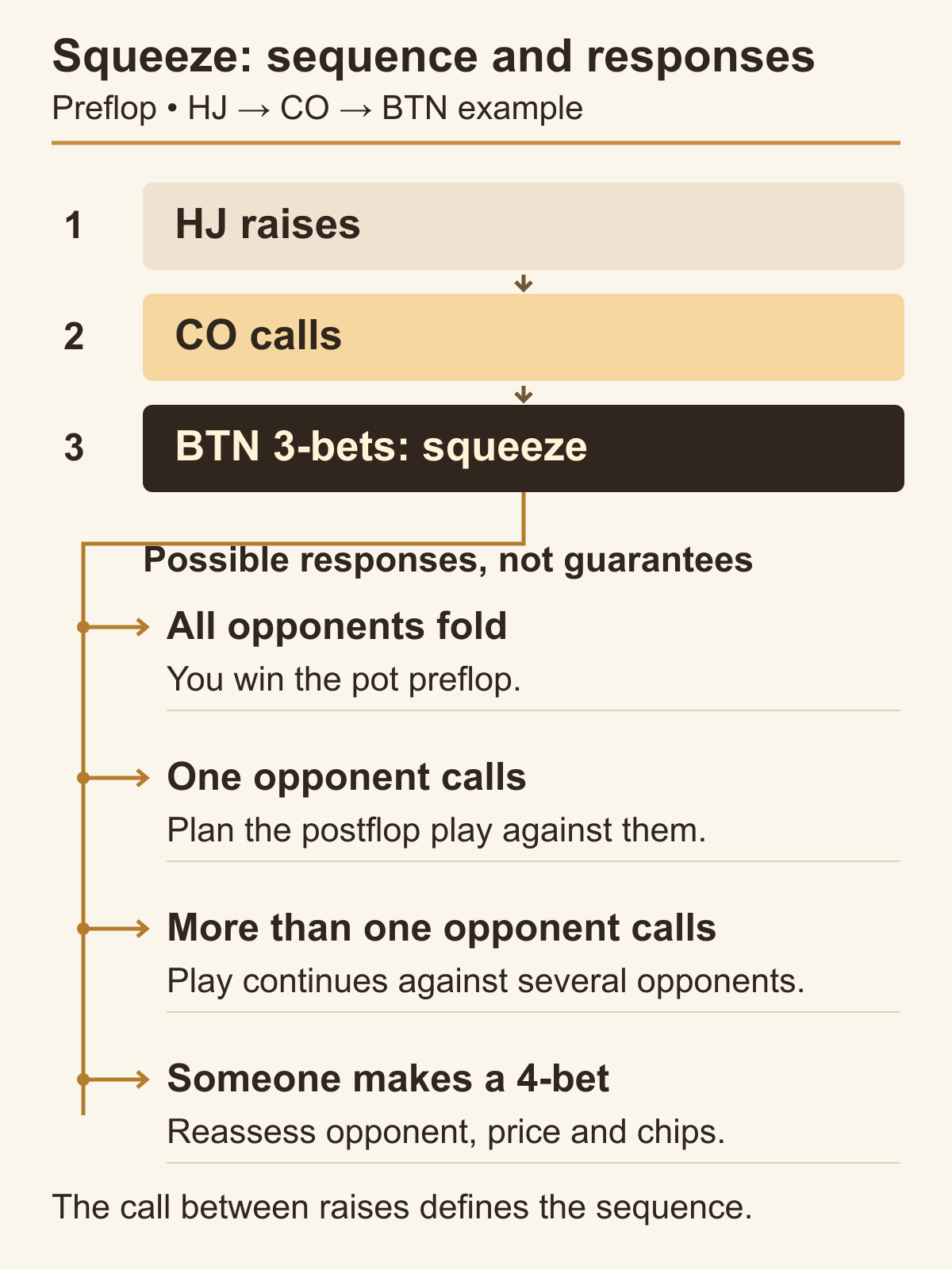
Preflop in Texas Hold’em, a squeeze is a 3-bet made after a raise and at least one call: one player raises, another calls, and a third raises again. The call between the raises defines this sequence. The play can aim to make opponents fold or build a bigger pot for value with a strong hand. [1][3]
To evaluate a squeeze in No-Limit Hold’em, you need to look at both the opener and the caller. Position, available chips, and players who can still act also factor into the decision. This matters because the reraise does not necessarily end the contest: getting called or facing a 4-bet, the next raise, requires a different plan from the one in which everyone folds. [1][2]
Example: Raise, Call, Then a Squeeze
An example presented by Upswing Poker starts with this setup: the player in the hijack raises, the cutoff calls, and you are on the button. If you 3-bet, you are making a squeeze. Hijack, cutoff, and button are the names of the positions used in this sequence. [1]
How the Poker Squeeze Play Works Preflop
The raise and call have already put chips into the pot. By reraising, you give the players involved who can still act a new decision. Part of the appeal of the play comes from that existing pot, but chips in the middle of the table are not enough to justify the raise. [1][2]
Start with the Original Raiser
The range of hands the initial aggressor typically opens is the main factor in evaluating a squeeze. The caller’s tendencies also influence the choice, but they do not remove the importance of the opening raise. Against a tighter aggressor, the recommendation is to be more selective, even when the caller plays many hands. [1]
Consider the opener’s position alongside their behavior. A late-position open from someone who plays many hands and often folds to reraises presents different conditions from a highly selective opening raise. Opening many hands and folding to a 3-bet are different behaviors: an active player may also respond with another raise. When attempting to win through folds, that reaction needs to factor into your assessment. [1][2]
Assess How the Caller Responds to a Reraise
When assessing the caller, try to understand how that player responds to an additional raise. Calling the opening raise is not the same decision as calling a squeeze: the behavior that matters for a bluff attempt is their willingness to fold in this new situation. Against someone known for continuing to call and resisting pressure, the guidance is to focus on squeezing for value. This assessment needs to go alongside your read on the initial aggressor. [2]
Include Your Position and the Players Who Can Still Act
Before raising, check who can still act. An opponent capable of responding aggressively changes the situation, even if the initial aggressor and caller seem vulnerable to pressure. The analysis includes the other players who still have a decision ahead of them. [2]
Then consider your position if you get called: will you have to act before or after the opponent who continues? Caution is especially relevant when the squeeze could lead to a raised pot out of position with a medium-strength hand. Position is also one of the factors used to adjust the squeeze itself. [1][2]
What the Sequence Does Not Tell You
A Call Does Not Prove Weakness
An opponent known for disguising strength and setting traps may simply call the opening raise with a strong hand. Assess the caller’s tendencies without treating the assumption that they “would have raised with a strong hand” as certainty about their cards. [2]
Value and Bluffs Do Not Depend on the Same Response
A value squeeze aims to get called by weaker hands and extract more value from them; a bluff squeeze mainly aims to make opponents fold and win the pot immediately. [1][2][3]
The Amount of Chips Available Changes How You Continue
Stack depth—the chips available to play—also factors into the choice. A play designed for deeper stacks should not automatically be carried over to a situation with fewer chips, because the room to maneuver after a call may be much more limited. [2]
With short stacks, the guidance is to place more emphasis on value squeezes. For bluff attempts, depth also matters when the pressure fails to end the hand. This requires relating the play to the available chips and the pot that could develop, without establishing a universal raise size. [2]
Possible Responses to the Squeeze
After squeezing, adjust your plan to the opponents’ response: [1]
| Response | What changes for your plan |
|---|---|
| All opponents fold | You win the pot preflop. A fold by only one opponent does not end the hand if someone else continues. [1][3] |
| One opponent calls | Prepare to play postflop against that caller, accounting for your position and the conditions of the pot. [1][2] |
| Several opponents call | The hand remains multiway; a plan that assumed only one opponent no longer fits. [1][3] |
| Someone 4-bets | Reassess that opponent, the new raise size, the price to continue and the remaining chips relative to the pot. There is no universal response. [1] |
Before Raising, Plan How to Continue
Before putting in the chips, be able to answer: “If I get called, does my plan still make sense in this position and with these chips available?” There is no need to turn this question into an automatic betting sequence. Its purpose is to avoid a squeeze whose only justification is hoping that nobody continues. [2]
Sources
- [1] The Squeeze Play: The Ultimate Guide to Squeezing in Poker — Upswing Poker — Dan B., September 1, 2020.
- [2] Squeeze Play in Poker: When to Fire, When to Fold — Poker Skill.
- [3] Understand How the Squeeze Play Works in Online Poker — GipsyTeam — November 3, 2022.

 1 day ago