Poker and Blackjack: Differences in Rules and Decisions
By the Editorial Team
What Is the Difference Between Poker and Blackjack?
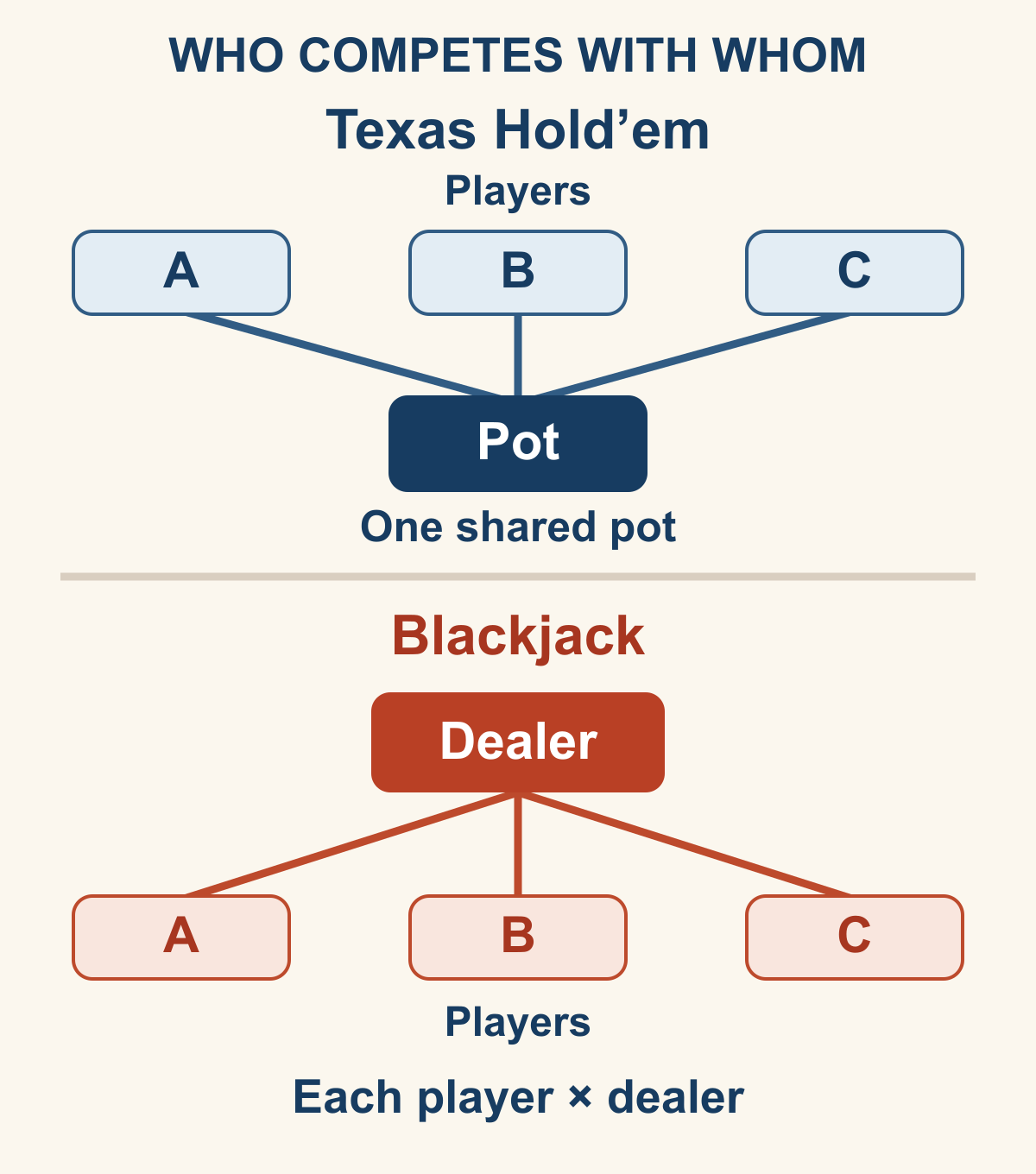
In blackjack, you compare your hand’s point total with the dealer’s without going over 21. In traditional Texas Hold’em, you compete for the pot against other players: you can win with the best five-card hand at the final comparison or when all opponents fold. The central difference, therefore, is the opponent and the criterion used to determine the outcome. [1][3][4]
Taking another card in blackjack changes your hand’s total; calling a bet in Hold’em responds to another player’s action. The table brings together these differences in opponents, objectives, cards, and actions. [1][2][3][4]
| Aspect | Texas Hold’em Against Other Players | Blackjack Against the Dealer |
|---|---|---|
| Opponent | The other players still in the hand. | The dealer; each player’s result is determined individually. |
| Objective | Win the pot with the best five-card hand or when everyone else folds. | Beat the dealer’s total without going over 21, or win if the dealer busts and the player’s hand remains valid. |
| Cards | Two hole cards per player and up to five community cards. | Two initial cards for the player, with the possibility of receiving more. |
| Evaluation | Combinations organized into a hand ranking. | The sum of the cards’ values. |
| Basic actions | Check, bet, call, raise, and fold, depending on the situation. | Hit and stand; other options depend on the applicable rules. |
| Conclusion | There may be a comparison of hands or a win without that comparison. | The outcome depends on the player’s hand and the resolution of the dealer’s hand. |
How Cards and Decisions Work in Each Game
Blackjack: Adding Points and Comparing with the Dealer
In blackjack, numbered cards have their face value. Jacks, queens, and kings are worth 10 points each. An ace can count as 1 or 11, depending on which value is more favorable to the hand. Evaluation therefore begins with a calculation: what do the cards add up to, accounting for this possible adjustment to the ace? The objective is to beat the dealer’s total without going over 21. Exceeding that limit means busting. You can win with fewer than 21 points if your total beats the dealer’s. [1][3]
Each player initially receives two cards. In the dealing procedure described by Blue Lake Casino Hotel, the dealer receives one face-up card and one face-down card. The player makes decisions about their own hand before the dealer reveals the face-down card and completes their hand according to the table’s rules. [1]
The two basic actions serve different purposes:
- Hit — take a card: receive an additional card, which becomes part of the hand’s value.
- Stand — stop taking cards: keep the current cards, ending requests for more cards for that hand. [1][2]
When you stand, you keep your hand for comparison with the dealer rather than abandon the contest.
Texas Hold’em: Making a Hand and Competing for the Pot
In Hold’em, each participant receives two hole cards. Community cards are dealt face up in the center of the table in three stages: the flop, with three cards; the turn, with the fourth; and the river, with the fifth. They are shared by the players still in the hand. There is a betting round after the initial deal, called preflop, and another after each of these stages. The hand therefore develops through the dealing of community cards and betting decisions. [1]
When the hand reaches the final comparison with all community cards face up, each player has their two hole cards and the five cards in the center of the table available to them. The objective is to identify the best five-card combination among them. Evaluation follows poker’s hand rankings, with categories such as a pair, a straight, and a flush. This final comparison is called the showdown and occurs when more than one player remains after the last betting round. [1][3]
If all opponents fold, the remaining player wins without a showdown, even before the river. [4]
The pot contains the bets being contested. Hold’em’s five basic actions refer to this collection of chips and the other participants’ bets. [1]
| Action | Basic Meaning |
|---|---|
| **Check — pass the action** | When there is no bet you need to match, decline to bet and pass the action to the next player. |
| Bet — wager | Wager chips during the round. |
| Call — match a bet | Match a bet. |
| Raise — increase a bet | Increase a bet. |
| Fold — give up the hand | Abandon the hand. |
Blackjack Table Rules
The Dealer’s Procedure
The dealer does not choose between hitting and standing in the same way as the player: their actions follow an established procedure for the table. The total that determines when the dealer takes another card or stands should be checked in the applicable rules. [1][4]
Double Down, Split, and Surrender
In addition to hit and stand, blackjack may offer double down, split, and surrender. WinStar describes doubling down as doubling the bet and receiving one more card; it describes splitting as separating a pair into two hands. Surrender means ending the hand by giving up half the bet. [1][2]
Check the table’s rules for which options are available, when they can be used, and the applicable payouts. [1][3]
Example: When 21 Ends in a Tie
Imagine that you and the dealer take additional cards and both finish with 21 points. The result is a tie, called a push: you neither win nor lose. [1]
This outcome shows why reaching 21 is not enough to win. Your hand must beat the dealer’s without busting, or remain valid when the dealer busts. [1][3]
The Next Step Is to Read the Rule That Addresses Your Question
To deepen your understanding of Hold’em, the next topics are hand rankings and comparing the best five cards, along with the conditions that make each betting action available. These subjects complete the explanation of what is being contested as the hand progresses through the rounds. [1][3]
To understand a specific blackjack table, consult its rules: the dealer’s procedure, payouts, and conditions for doubling down, splitting, and surrendering. The general explanation helps you recognize the terms; the table’s rules determine how they apply. [1][2][3]
Sources
- [1] Blackjack vs. Poker: Key Differences — Blue Lake Casino Hotel — published on June 30, 2024.
- [2] Difference Between Blackjack and Poker — WinStar Casino — published on February 13, 2024.
- [3] Poker vs. Blackjack: Understanding the Primary Differences — Capitol Casino — published on March 20, 2024.
- [4] Blackjack vs Poker: Which Game Should You Play? — Arkadium
 1 day ago